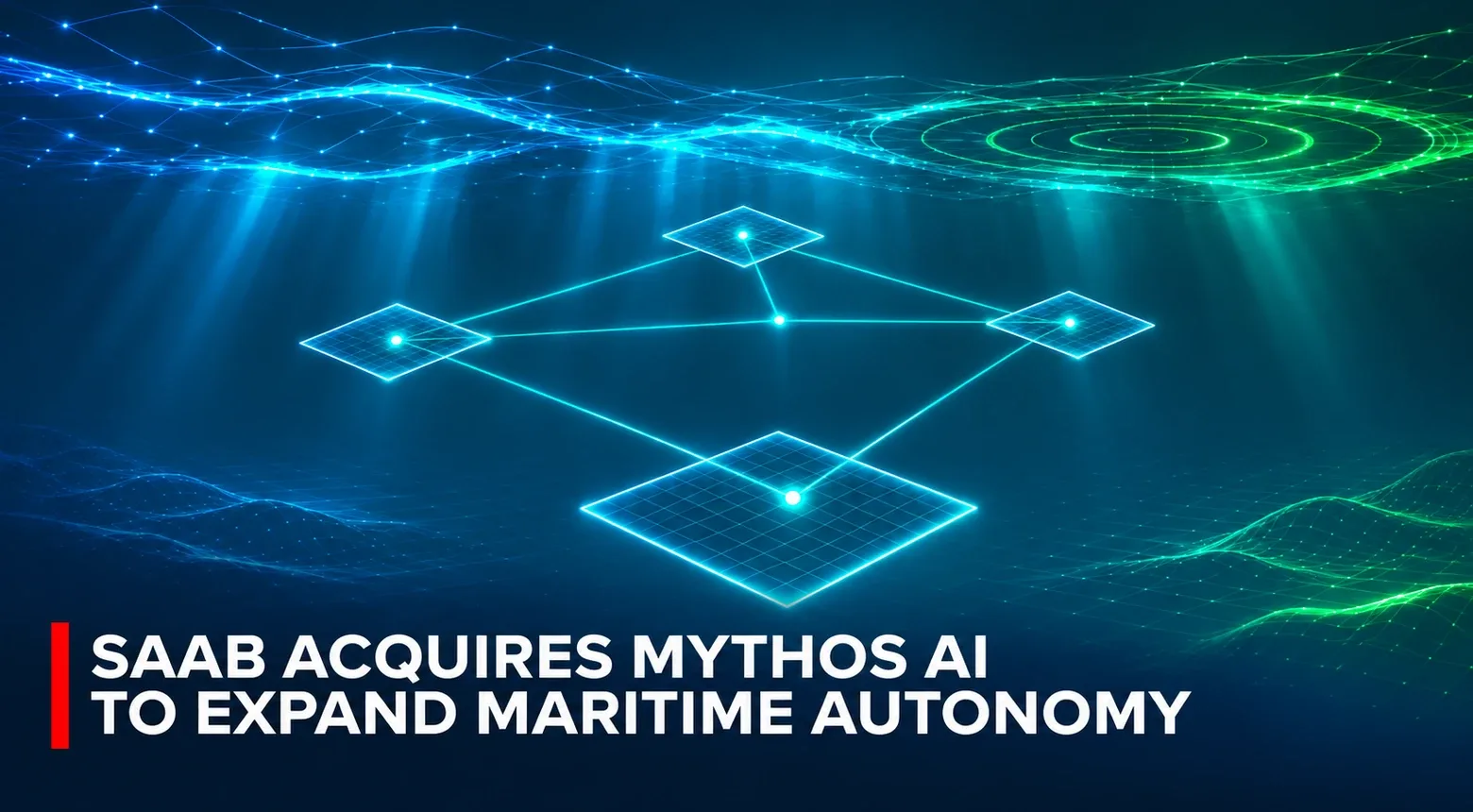
The Saab Mythos AI acquisition was completed by 24 November 2026, according to the Swedish defence and aerospace group’s official announcement. The transaction brings a US maritime software specialist into Saab’s portfolio and illustrates the increasing importance of software ownership in the maritime industry. It also connects a relatively small technology business with an established naval systems supplier at a time when commercial operators and government customers are evaluating autonomy under evolving safety requirements.
Saab Mythos AI acquisition expands maritime software portfolio
Mythos AI has 15 employees and develops applications for navigational assistance, autonomous vessel navigation and automated hydrographic surveys. Saab says the software can be incorporated into existing vessels or new builds. The financial consideration was not disclosed in the reporting reviewed, including the 27 November 2026 UK Defence Journal report. The transaction therefore cannot be assessed against a public purchase-price multiple or a disclosed earnings contribution.
The companies had already collaborated before the acquisition. Saab identifies a 2025 demonstration involving its Enforcer vessel in California as evidence of that relationship. Mythos AI’s management also reports 30,000 miles of autonomous navigation experience and nearly 40,000 encounters and avoidance manoeuvres. These are supplier-reported aggregate figures, rather than an independently audited safety record. The published announcement does not specify the full conditions, measurement methodology or independent acceptance criteria associated with those totals.
For the maritime industry, the transaction demonstrates a distinction between acquiring a technology supplier and ordering an operational fleet. An acquisition transfers corporate ownership, while vessel procurement depends on separate customer requirements, commercial agreements and acceptance processes. No new vessel order, delivery quantity or fleet-wide certification follows directly from the announcement. Nor does it establish that existing customers will change suppliers or adopt a common software architecture.
Software companies can offer maritime operators an alternative to purchasing entirely new assets when a vessel has remaining economic life. However, the case for adapting an existing ship depends on its condition, the cost of modifications, the assurance documentation available and the operator’s existing contractual obligations. A new-build solution may provide a different balance of integration cost and lifecycle responsibility. Neither route can be assumed to offer a universal cost advantage without comparable project data.
The acquisition also raises questions about the relationship between specialist suppliers and larger industrial groups. The latter may provide capital, sales channels, legal resources and long-term customer support. Integration can nevertheless introduce new administrative obligations and competing priorities. Maintaining continuity for existing commercial users while developing new offerings will be an important measure of whether the acquisition produces durable business value. At present, detailed plans for the organisation, staffing and financial contribution of the acquired business have not been published in the sources reviewed.
Maritime autonomy regulation, industrial risks and next steps
The civil maritime regulatory environment is changing independently of the Saab transaction. On 22 May 2026, the International Maritime Organization announced adoption of its MASS Code, an international safety framework for autonomous and remotely operated cargo ships within its stated scope. It took effect on 1 July 2026 as a non-mandatory instrument, complementing existing applicable conventions. The UK Maritime and Coastguard Agency publication, issued on the same date, provides additional context for the transition towards more consistent regulation.
This development is commercially relevant because maritime autonomy is not simply a question of software availability. Shipowners, classification societies, insurers and public authorities need a shared understanding of accountability, documentation and the boundaries of approved operation. The IMO framework applies to specified commercial cargo vessels; it is not a blanket certification of naval systems or of any particular supplier’s software. Defence Agenda’s reporting on the regulatory framework for Royal Navy uncrewed vessels and the DNV–Fassmer classification partnership illustrates related but distinct efforts to address maritime assurance.
From a procurement perspective, future disclosures should clarify the commercial terms under which software is supplied and maintained, including responsibility for updates, customer data and long-term support. These considerations apply to both commercial and government customers, although their legal and contractual requirements may differ. A supplier acquisition alone cannot resolve those issues, and the costs of ongoing support are not available in the announcement.
Implications / Next: The transaction is confirmed as completed, but its economic contribution and customer adoption remain open questions. Relevant public milestones would include disclosed commercial contracts, documented safety approvals, customer retention and financial reporting on the acquired business. Until those indicators emerge, the most defensible conclusion is that Saab has expanded its maritime software portfolio, not that it has demonstrated a new fleet-wide operational capability.
Further Reading
- Saab — Acquisition completion
- UK Defence Journal — Saab buys Mythos AI
- Calibre Defence — Saab acquires Mythos AI
- IMO — First global code for autonomous ships
- UK Maritime and Coastguard Agency — MASS Code publication
- Defence Agenda — UK Advances Rules for Royal Navy Uncrewed Vessels
- Defence Agenda — DNV and Fassmer Partner on Autonomous Naval Vessels