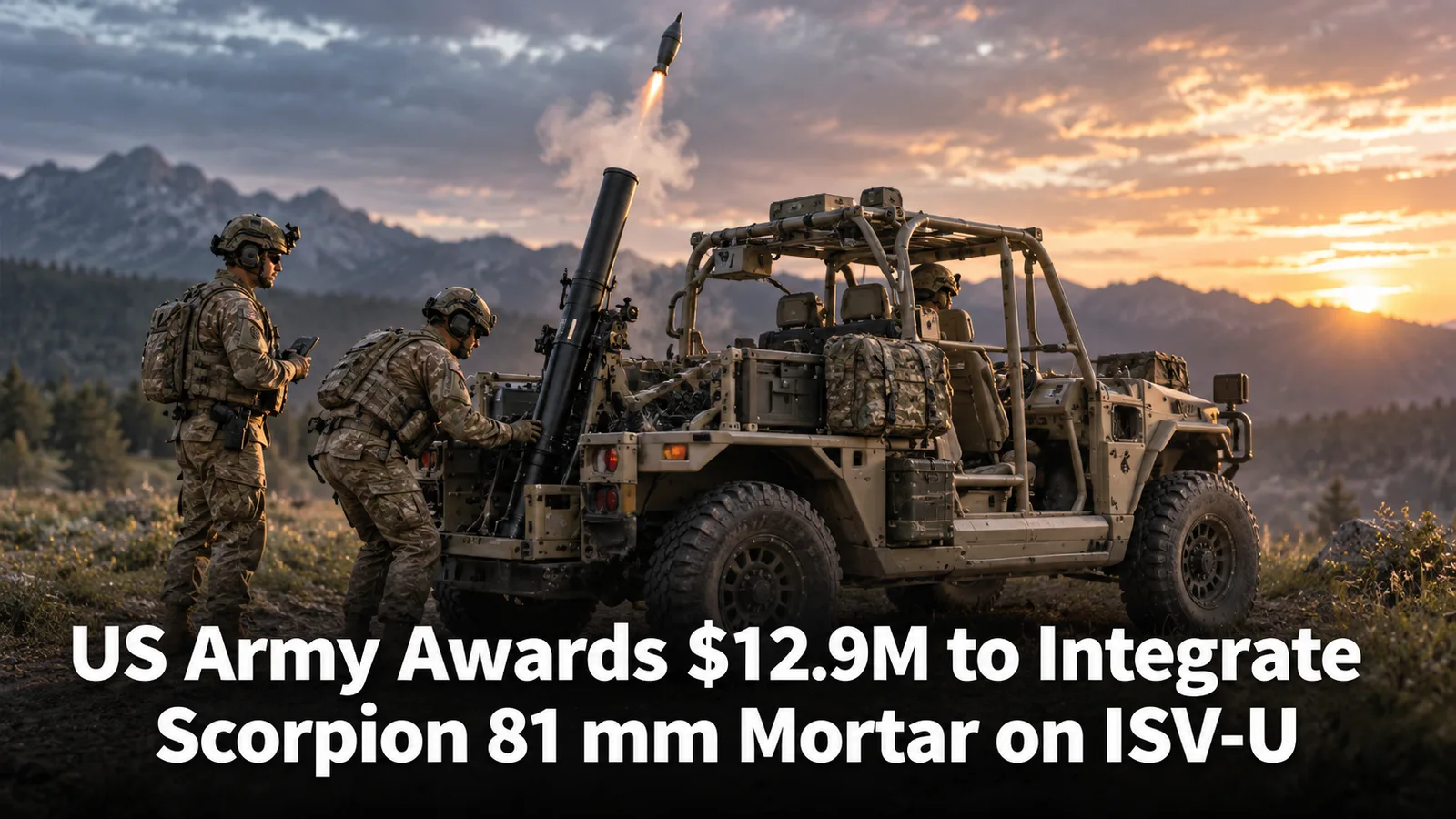
The U.S. Army has awarded Global Military Products a $12.9 million contract to integrate the Scorpion Light 81 mm Mobile Mortar System with Army digital fire control, government-furnished M253 mortar barrels and Infantry Squad Vehicle–Utility platforms.
The DOTC Other Transaction Authority award follows two years of soldier trials and is intended to mature a configuration that can complete certification and support a later production decision.
Integration, Mobility and Fire-Control Architecture
Scorpion Light has already been exercised by the 25th Infantry Division in Hawaii and during Balikatan 2026 in the Philippines, giving the Army two years of practical data before the current integration award. Those events helped refine vehicle layout, firing sequence and crew workflow, while the new effort moves the system from contractor-supported experimentation toward an Army-integrated configuration. Armada reports that contractor-provided fire-control elements used in earlier demonstrations will be replaced by U.S. Army digital fire-control technologies and government-furnished M253 mortar barrels, aligning the weapon more closely with Army fires-management architecture.
The operational value lies in combining an 81 mm mortar with the mobility of the ISV-U rather than treating the weapon as a static firing point. Global Military Products says the hinged Scorpion system can deploy from a light vehicle, fire eight rounds and relocate in under two minutes, which is intended to shorten the time a mortar team remains exposed after firing. That timing is a company-reported demonstrated drill rather than a guaranteed figure for every crew, terrain or tactical condition, but it illustrates the shoot-and-scoot concept the Army is evaluating.
Programme Scope and Industrial Context
The ISV-U is the cargo and utility member of the Infantry Squad Vehicle family, so integrating Scorpion creates a mobile indirect-fire node that can move with dispersed light formations while carrying ammunition and digital mission-processing equipment. The current $12.9 million DOTC Other Transaction Authority award is therefore more than a simple vehicle-mount contract: it is intended to mature an Army-specific configuration through certification and toward a later production decision. The work also creates a U.S. pathway for a system derived from the internationally marketed Scorpion/Alakran architecture while substituting U.S. government barrels and Army fire-control technology where required.
A separate U.S. Marine Corps award should remain outside the Army programme value. Global Military Products received a $4.9 million Marine Corps contract in February 2026 for Scorpion Light on the Polaris MRZR Alpha 6×6, with Janes reporting MARSOC as an expected principal user of that configuration. Pre-award Army reporting also discussed 16 systems, but the September award does not publicly confirm that quantity, so the Army fielding number remains unresolved.
Limitations and Counterpoint
The OTA award is a significant programme step, but it is not a full-rate production decision and does not by itself establish an operational fielding quantity. Certification, Army acceptance, final configuration and follow-on procurement remain to be completed before Scorpion can be treated as a standard Mobile Brigade Combat Team capability. The contract also does not establish a universal range or accuracy figure beyond the performance of the government-furnished mortar barrel, ammunition and fire-control configuration selected for a specific mission.
Implications / Next
The next meaningful milestones are completion of the Army-integrated design, certification testing and a formal decision on production. A confirmed fielding quantity would show whether the system remains a limited integration effort or becomes a recurring mobile-mortar capability for light formations. Further Army exercises should also reveal how digital fires integration, displacement time and ammunition handling perform outside controlled demonstrations.