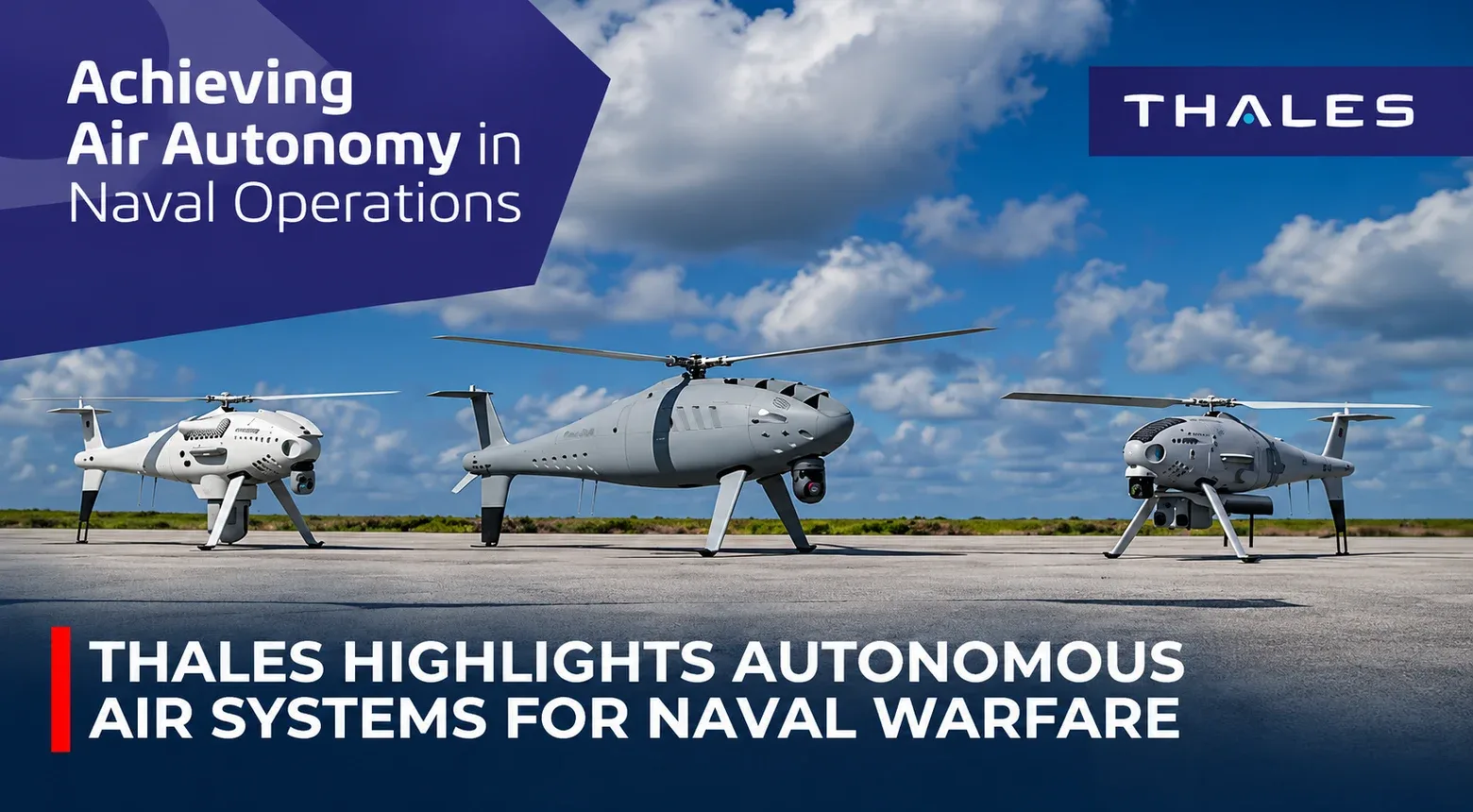
Thales has set out its naval air autonomy strategy in an industry feature published by sUAS News on 29 November 2026, arguing that uncrewed aviation should become a more integrated part of maritime operations. The company's vision brings together aircraft, onboard software and information management. Its relevance to defence procurement lies in the transition from individual uncrewed aircraft to sustainable, interoperable aviation services. The feature is a statement of industrial strategy, rather than the announcement of a new contract or an independently validated fleet-wide capability.
Naval air autonomy: from industry vision to service experience
The Thales feature via sUAS News describes autonomy at three levels: aircraft, payload and mission. Thales presents its portfolio as a means of coordinating crewed and uncrewed equipment and supporting multiple maritime roles. These are company-stated objectives. The publication does not establish that every proposed configuration has completed qualification, that all cited technologies have been deployed together, or that a customer has approved a new acquisition.
The Royal Navy's Peregrine programme provides a documented example of the distinction between a concept and a fielded system. On 10 February 2023, DE&S — Peregrine procurement announced procurement worth approximately £20 million. The project combined Schiebel's S-100 aircraft with Thales surveillance equipment, with the intention of supporting the Royal Navy's maritime aviation requirements. The disclosed figure concerns that procurement, not the cost of the broader autonomy strategy outlined in November 2026.
On 11 September 2025, the Royal Navy — Peregrine entry into service confirmed the formal introduction of Peregrine into service, following experience aboard HMS Lancaster. This gives the programme a stronger evidentiary basis than a design presentation. It remains a specific surveillance capability, however, rather than proof of unrestricted autonomous operations across the entire fleet. The public announcement does not provide a comprehensive breakdown of long-term availability, lifecycle costs or the number of aircraft required for a wider rollout.
A separate benchmark is Leonardo's Proteus project. The Royal Navy — Proteus maiden flight was reported on 16 January 2026 as a milestone in a £60 million demonstrator programme. This is an experimental aircraft, not an additional Peregrine order or a Thales product. The two projects illustrate the diversity of the naval aviation market: a fielded surveillance system and a research programme can coexist without having reached equivalent maturity.
The distinction matters for industrial reporting. Manufacturers may discuss multiple products within one technology portfolio, while acquisition authorities generally approve specific configurations, support arrangements and authorised uses. A programme's status therefore cannot be inferred from the maturity of a related product. Nor should a successful demonstration be counted as a delivery or an accepted operational capability.
Procurement, interoperability and responsible autonomy
From an acquisition perspective, the commercial implications extend beyond airframe manufacturing. Long-term demand may involve software maintenance, operator education, safety documentation and certification services. These are potential categories of expenditure rather than confirmed future orders. Suppliers and investors should distinguish the initial acquisition value from the continuing costs of supporting equipment throughout its service life.
Interoperability is also a governance and contractual issue. Purchasing authorities need clarity about data ownership, software licensing, responsibility for maintenance and the consequences of a supplier changing its product roadmap. An attractive initial offer does not necessarily establish acceptable lifetime costs. Equally, a larger initial investment may be justified if a customer can document dependable support and compatibility over time.
Safety and accountability are particularly important where the same term, autonomy, can refer to very different activities. Automated aircraft operation is not equivalent to authorisation to use force. The NATO — Revised AI strategy, adopted in July 2024, places responsible use and interoperability among its objectives. Its principles address legal compliance, accountability, reliability, explainability, human governability and bias. These requirements provide a policy context, not a certification of the systems discussed by Thales.
Defence Agenda's coverage of the Naval Group Unveils SCX 26 Drone-Focused Warship illustrates a parallel discussion about the future composition of naval fleets. Its reporting on the Autonomous Weapons Debate Faces a Definition Gap, CFR Analysis Finds provides additional context for the distinction between automated functions and decisions involving the use of force. Neither article is evidence of a new Thales order.
Implications / Next: The next meaningful public milestones would be independently documented safety assessments, customer acceptance decisions, disclosed orders and evidence of sustainable service support. No new acquisition value or delivery timetable is established by the November feature. Until such information becomes available, the appropriate interpretation is that Thales has articulated its industrial direction while Peregrine supplies a specific, separately documented example of service maturity.