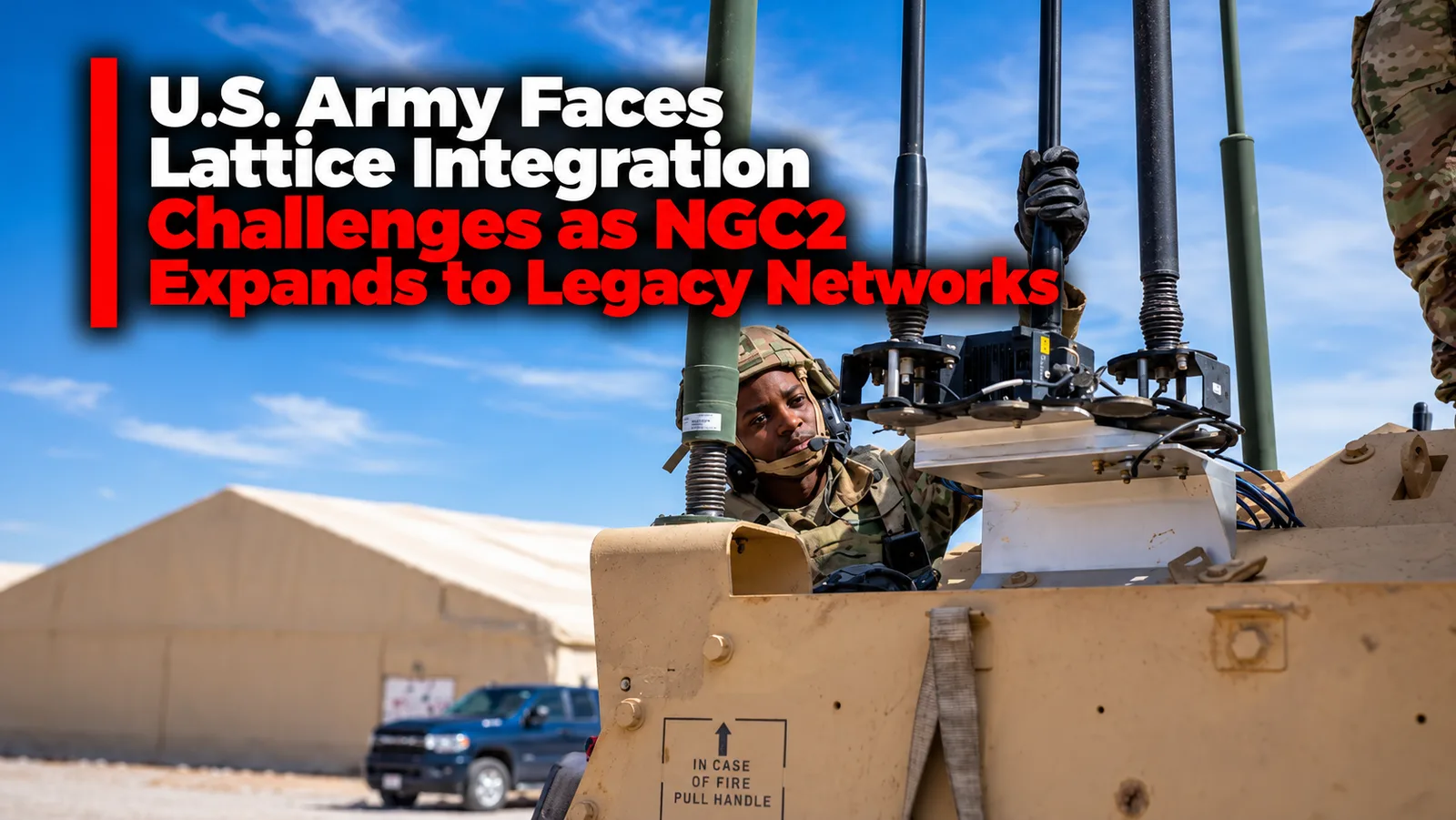
The U.S. Army faced integration difficulties when it brought Anduril's Lattice technology onto the 25th Infantry Division's existing tactical communications network during September 2026's Lightning Surge 5 exercise in Hawaii. Army and contractor officials described data-scaling issues, different radio configurations and constraints on light-vehicle and tablet computing, according to Breaking Defense.
Lockheed Martin, the division's NGC2 integration lead, is working with Anduril and other suppliers to improve the architecture before broader rollout. Army officials say the problems are valuable because most future units will retain at least some legacy equipment instead of receiving an entirely new communications package.
How Lightning Surge 5 Exposed a Legacy Network Integration Gap
The Army's 25th Infantry Division tested the combination of Anduril's Lattice software and its existing tactical communications equipment during Lightning Surge 5 in Hawaii in September. Reporting by Breaking Defense on 19 October described limitations in the way the new data-layer capability operated across that installed network, based on interviews with Army officials and executives from Anduril and Lockheed Martin.
Brig. Gen. Shane Taylor, the Army's portfolio management executive for Command and Control Information Network, characterized the experience as a learning phase rather than a completed integration failure. The service is seeking to identify the configurations that need to change before similar systems reach formations with mixed generations of radios and computing devices. No quantified throughput test result or system-wide outage was disclosed.
Lockheed Martin Flagged Data Scaling Issues
Lockheed Martin leads vertical integration of the NGC2 architecture for the 25th Infantry Division, while Anduril supplies its Lattice technology as part of the common data-layer portfolio. Lockheed's Chandra Marshall told Breaking Defense the company had anticipated difficult integration work and said moving data through the architecture with Lattice was not yet performing at the desired level.
The official division of responsibilities matters. The U.S. Army named Anduril lead for the NGC2 common data baseline in June 2026, alongside Palantir and Raft; it did not make Anduril the sole integrator of every division's communications and hardware. Lockheed Martin is responsible for bringing the mixed products together in the 25th ID environment. That arrangement creates a multi-vendor engineering task rather than a single-product rollout.
TSM Radios and Different Configurations Complicated Interoperability
Anduril NGC2 programme manager James Craven said the company had to work with TSM tactical radios using waveform and configuration settings different from those encountered with the Army's 4th Infantry Division. Contractors and soldiers also worked through channel capacity, separating voice and data traffic, and ensuring that selected personnel had beyond-line-of-sight connections such as Starshield.
These reported integration tasks should not be read as confirmation that Starshield failed or that the TSM waveform itself was defective. The technical issue identified in the source is configuration and data transport across a wider communications architecture. The Army has not published a definitive fault analysis assigning responsibility to a particular device, radio supplier or software component.
The 25th Division Is a More Representative Fielding Test
The 4th Infantry Division had been experimenting with NGC2 in Colorado using relatively new, largely commercial equipment. The Hawaii-based 25th Infantry Division, by contrast, must continue operating a portion of its existing tactical communications systems. Officials consider the latter closer to the circumstances under which many other Army units will receive new command-and-control capability.
Terrain and force structure add constraints. Open training terrain at Fort Carson differs from Hawaiian vegetation and the broader Indo-Pacific operating environment. The 4th Division's heavier vehicle mix provides different space, power and computing options than the 25th Division's lighter Infantry Squad Vehicles and dismounted teams. A software application working well on one platform is not automatically deployable on another without adaptation.
Tablet-Based Edge Computing Became a Live Exercise Requirement
At the 4th Infantry Division, Lattice had been integrated onto the Mounted Family of Computer Systems. During Lightning Surge 5, the 25th Infantry Division requested that the capability also run on tablets. Anduril said that integration was undertaken during the exercise itself rather than being completed beforehand.
That adjustment made the exercise a test of computing footprint as well as network integration. In a light infantry formation, available electrical power, processing capacity and physical space can shape which services operate locally and which rely on an external data connection. The report did not provide tablet model numbers, software benchmarks or a measured performance threshold.
Lightning Surge 5 Also Tested Four Mission Threads
In an 8 October statement, Lockheed Martin described four principal Lightning Surge 5 mission threads: tactical graphics distribution, electronic warfare data ingestion, sensor-to-shooter fires information and sustainment reporting. The company said its team worked with Anduril, Palantir, Raft and Rune to bring the common-data architecture into the division's field environment.
Those reported achievements provide useful context but should not override the later accounts of technical difficulty. The company statement describes what the team demonstrated and adjusted; the 19 October interviews address the remaining challenges in achieving the required performance consistently with older communications configurations. Both describe different aspects of the same ongoing integration campaign.
NGC2 Is Moving Toward I Corps Fielding
The U.S. Army intends to use the lessons from the 4th and 25th Infantry Division prototypes to establish NGC2 capability across I Corps. That headquarters and its subordinate formations operate across geographically dispersed areas of the Pacific, placing a premium on interoperability among different unit types, communications paths and command echelons.
Army officials told Breaking Defense that baseline work for additional divisions is planned within fiscal year 2027, which began on 1 October 2026. They did not announce an exact rollout timetable. The federal continuing resolution was reported to be affecting the pace at which some systems could be supplied, while distance and logistics across the Pacific remain additional constraints.
Why This Matters for the Army's Industrial Integration Model
The NGC2 effort seeks to move from separate, hardware-centred command systems toward an open, shared data layer connected to mission applications and tactical networks. This design can give commanders a common operational picture across sensors, communications and effectors, but the 25th Division trial highlights the engineering cost of making those services function on equipment already fielded.
For the industrial base, the lesson is that compatibility, deployment tooling, radio integration and low-footprint edge operation are procurement deliverables alongside the core software. A vendor's successful demonstration on a new equipment set does not by itself establish that the same performance has been achieved on all Army legacy hardware.
What Remains Unconfirmed
The public record does not quantify packet loss, throughput, latency, software stability or the number of affected radios and vehicles. Officials have not announced a new contract value tied to the Lightning Surge 5 integration issues, a programme cancellation, or a final acceptance date for the 25th Infantry Division legacy-network configuration.
The next useful evidence will be repeated field trials using stable radio configurations, confirmed tablet integration before exercises, documented operational performance in different formations and explicit milestones for I Corps rollout. The reported difficulties are therefore best understood as active integration problems during scaled fielding, not proof that NGC2 or Lattice has been abandoned.
Sources and Further Reading
- Breaking Defense — Army feels 'growing pains' as it integrates Anduril NGC2 tech with older comms
- U.S. Army — Army and industry align on common data baseline, as Next Generation Command and Control moves from prototyping to delivery
- Lockheed Martin — Lockheed Martin Continues to Accelerate Next Generation Command and Control (NGC2) Converged Architecture
- Lockheed Martin — Next Generation Command and Control (NGC2)