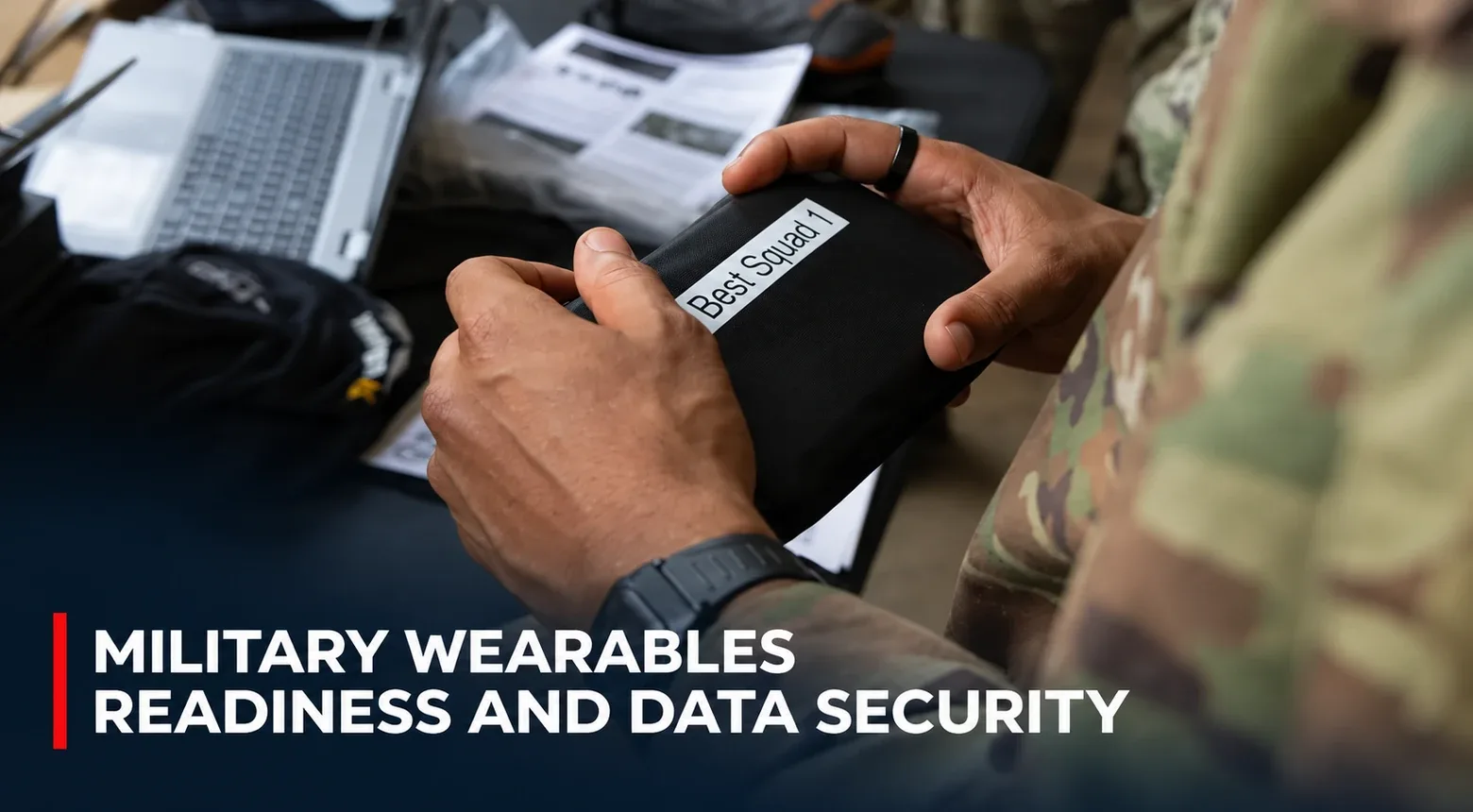
Military wearables are prompting renewed discussion about the relationship between preventive medicine, artificial intelligence and the protection of sensitive personnel data. In a RealClearDefense commentary published on 28 November 2026, researchers Elise G. Annett and James Giordano argue that physiological information should be treated as a matter of security and governance as well as healthcare. Their essay raises questions about the reliability of AI-assisted health assessments and the protection of service members' information. It is an expert opinion, not an announcement of a new acquisition or an official policy decision.
Military wearables and preventive healthcare
Connected health devices can record physiological measurements outside a medical facility. Their relevance to defence is not limited to fitness: the technology may help healthcare professionals recognise emerging health problems during physically demanding training. Annett and Giordano distinguish physiological measurements from clinical records and other categories of personal information. These data differ in sensitivity and evidential value, and a measurement alone cannot establish a diagnosis or a reliable assessment of a person's health.
The discussion has an established institutional background. In 2023, the US Army reported on the evaluation of its Health Readiness and Performance System (HRAPS) at the Best Squad Competition. Participants from 12 squads wore monitoring devices during the event. The exercise gave researchers an opportunity to observe how the equipment functioned during demanding activities, but it did not establish that every possible military application had been validated. A competition also differs materially from a clinical trial designed to measure health outcomes.
On 22 July 2025, the US Army described the Wearable All-hazard Remote-monitoring Program (WARP) and its selection of the LifeLens platform. The announcement identified an initial operational test in November 2024 and anticipated the beginning of fielding in fiscal year 2026. It also reported instances in training in which access to physiological information prompted medical assessment. Those accounts illustrate a possible benefit for personnel safety; they do not establish a population-wide reduction in injury rates or confirm that the planned rollout has since been completed.
In a separate article published on 1 February 2026, Pulse of Army Medicine examined wearable technology and AI in preventive medicine. The authors discussed the potential for earlier recognition of health concerns and highlighted privacy, device reliability and user confidence as barriers to adoption. Their examples include proposed scenarios, rather than a comprehensive clinical validation dataset. Together, these publications demonstrate sustained interest in the technology while leaving questions about real-world effectiveness open.
For healthcare procurement, the distinction between monitoring and diagnosis matters. A device can record a signal accurately without its associated software being able to interpret that signal reliably in every population or environment. Assessment of any product should therefore consider the quality of evidence behind its intended medical use. Independent evaluation, appropriate clinical review and a clear mechanism for addressing incorrect readings are important safeguards. A wearable should not displace a qualified healthcare professional's judgement.
Biometric data security and accountability
Personal health information requires particular care because disclosure may harm the individual even when the underlying device performs correctly. The Government Accountability Office report released on 7 October 2025 identified shortcomings in the US Department of Defense's management of risks associated with publicly accessible digital information. That report addresses a wider digital security problem; it is not evidence of a confirmed breach involving the wearable programmes discussed here.
Existing health-information rules also matter. The Military Health System guidance on the Military Command Exception explains that authorised disclosures to military command authorities may be permitted for defined purposes, including fitness-for-duty assessments. It also explains that disclosed protected health information remains subject to Privacy Act protections. This framework should not be interpreted as an unrestricted entitlement to every record generated by a commercial or government device. Applicable obligations depend on the information, the entity holding it and the purpose for which it is used.
For suppliers, a useful distinction is between a product's advertised functionality and the evidence supporting safe use. Purchasers also need to consider the implications of vendor access to sensitive records, the accuracy of privacy statements, contractual responsibility for incidents and the continuity of medical support if a supplier ceases trading. These are governance and consumer protection questions, not simply technical performance measures.
The wider technology context has been explored in Defence Agenda's coverage of wearable technologies and digital soldier concepts and the relationship between emerging technology and defence innovation. The present debate is narrower: how to protect the welfare and rights of the person whose health information is being collected.
Implications / Next: Evidence of sustained clinical benefit, independent evaluation and transparent data governance will be relevant to future adoption. The November commentary advocates further scrutiny; it does not establish a new mandatory policy, expenditure commitment or deployment deadline. Until stronger evidence is available, the potential medical value of military wearables should be distinguished from claims about their wider performance, while individual privacy and accountable human judgement remain central.
Further Reading
- RealClearDefense — When the Warfighter Becomes the Sensor
- US Army — Health monitoring at Best Squad Competition
- US Army — Wearable hazard monitoring technology
- Pulse of Army Medicine — Wired for Readiness
- GAO — Security risks of publicly accessible information
- Military Health System — Military Command Exception
- Defence Agenda — Digital Troops Reshape Modern Battlefield Command
- Defence Agenda — Military Technology and Popular Culture Shape Defence