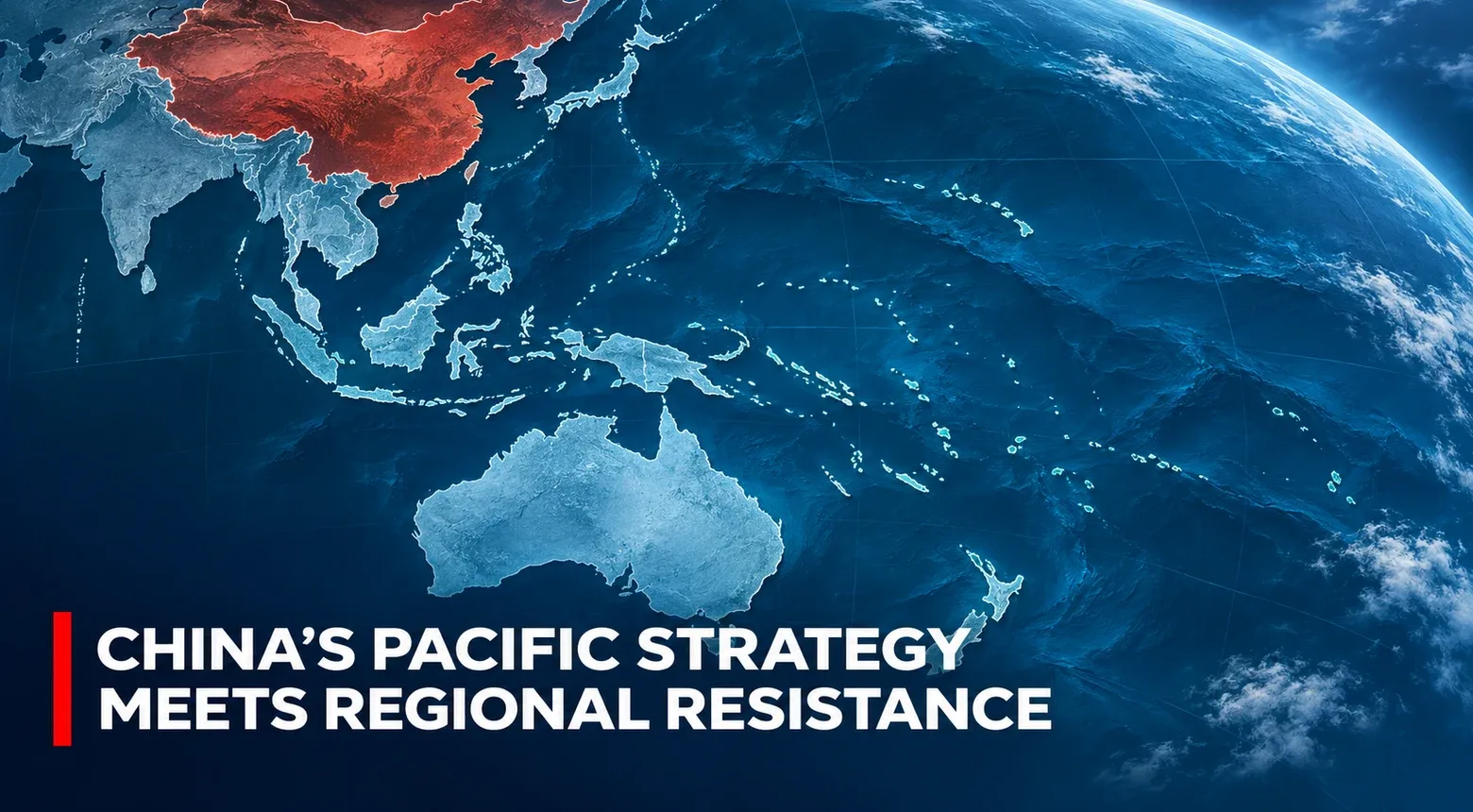
China’s Pacific strategy is receiving renewed scrutiny after a 16 November 2026 assessment from the Institute for the Study of War (ISW) and the American Enterprise Institute (AEI), followed by the signing of the Australia–Solomon Islands Treaty on 25 November 2026. The developments illuminate a central question for Indo-Pacific security: how economic engagement, infrastructure investment and security partnerships interact in a region whose governments have priorities of their own. The research offers one interpretation of Beijing’s ambitions; the treaty provides a documented example of regional governments making different choices.
China’s Pacific strategy: influence, infrastructure and sovereignty
The CDR Salamander commentary draws attention to the longer-term competition for influence in the Pacific. The original page could not be retrieved for this assessment, but an indexed reproduction of an excerpt connects the argument to research on Chinese maritime thinking. Its premise is that enduring relationships and economic activity deserve attention alongside conventional measures of military capability. That is a policy argument, rather than evidence that a specific government has already achieved its strategic objectives.
The underlying ISW and AEI assessment, published on 16 November 2026, describes a framework through which the researchers believe Chinese economic, political and maritime activities could interact. Its title uses the term “guerrilla” as an analytical characterisation of that framework. It should not be confused with an official Chinese declaration of doctrine. Nor does the research establish that every Chinese-backed commercial project is intended for military use. The distinction between observed activity, inferred purpose and future possibility is essential when using the assessment in procurement or investment decisions.
Infrastructure is an especially important category because it can serve multiple legitimate purposes. A commercial port, communications project or transport investment may improve local connectivity and reduce the costs of moving goods. It can also raise questions about ownership, contractual obligations, access to sensitive information and regulatory oversight. These questions are relevant regardless of the nationality of a project sponsor. A rigorous assessment needs to establish what rights a contract actually grants, rather than treating the existence of external investment as proof of a military arrangement.
The latest diplomatic development provides a useful test of overly deterministic interpretations. The Australian Department of Foreign Affairs and Trade records that the Australian and Solomon Islands prime ministers signed their new bilateral treaty in Canberra on 25 November. The Australian prime minister’s announcement also identifies education as an important part of the agreement. It is therefore more than a narrowly defined defence initiative. The treaty is a formal bilateral development, but the signature does not establish that all implementing arrangements have already entered into effect.
According to ABC News reporting on 25 November, the agreement includes commitments against the establishment of foreign military bases and provisions relating to the protection of sensitive infrastructure. The reporting also distinguishes these commitments from a blanket prohibition on all relationships with external partners. That distinction matters: political and commercial relations with China can continue even where a government adopts a different security arrangement. The exact legal scope, implementation and durability of the new agreement require separate assessment.
Beijing has presented its regional engagement differently. On 24 November 2026, Anadolu Agency reported the Chinese foreign ministry’s response, which emphasised equality and mutual respect and rejected the suggestion that cooperation with Pacific countries was a geopolitical contest. This statement represents China's publicly articulated position. It does not independently establish the purpose of every project, just as the concerns expressed by external security researchers do not independently prove the existence of undisclosed military arrangements.
Regional perspectives further complicate the picture. The 54th Pacific Islands Forum Leaders Meeting concluded in Honiara on 12 September 2025 with a regional peace declaration and a wider development agenda. Fiji's foreign ministry also publishes the 2050 Strategy for the Blue Pacific Continent, which frames the future of the region around collective stewardship and shared prosperity. These documents offer a locally articulated reference point against which external initiatives can be assessed.
A 26 May 2026 CSIS commentary on Pacific perspectives similarly emphasises that regional communities understand security more broadly than great-power competition. The authors discuss issues such as public health, employment and cybercrime, and argue for cooperation that reflects local priorities. For industry, the implication is that a project may have a different value proposition for its host community than for its international financier. That gap should be acknowledged explicitly rather than treated as an obstacle to be bypassed.
Pacific security partnerships and implications for industry
For defence and aerospace companies, Oceania presents a complex planning environment. A signed security agreement is not equivalent to a funded acquisition, and a political statement is not a tender. A viable opportunity normally depends on a defined customer requirement, an identified funding source, an applicable regulatory framework and a credible approach to long-term service delivery. Treating the changing diplomatic landscape as a proxy for confirmed orders can produce misleading revenue assumptions.
Australia's wider security and industrial relationships offer a separate example of how institutional cooperation may develop over time. Defence Agenda has previously covered the UK-led AUKUS undersea development programme and AUKUS experimentation at RIMPAC 26. Those programmes concern cooperation among Australia, the United Kingdom and the United States; they should not be interpreted as automatic commitments by independent Pacific island governments. The distinction is particularly important when assessing different procurement jurisdictions or the relevance of a multinational programme to a local market.
There are several possible trajectories for the regional environment. The table below sets out qualitative scenarios to organise future evidence. They are not probabilities, forecasts of conflict or claims about the intentions of particular governments.
| Scenario | Observable public indicators | Possible industrial implications |
|---|---|---|
| Coexisting partnerships | Commercial engagement with multiple partners continues alongside distinct bilateral security arrangements. | Companies face different regulatory and financing conditions across individual projects. |
| Greater institutional separation | Governments publish more detailed investment review, infrastructure security or procurement provisions. | Compliance, transparency and contractual due diligence become more prominent in project evaluation. |
| Stronger Pacific-led coordination | Regional institutions publish shared development standards and joint civilian service priorities. | Demand may become clearer for services that support local resilience, public infrastructure and skills development. |
These scenarios need not be mutually exclusive. A government can maintain commercial links with China, develop security cooperation with Australia and participate in a regional climate resilience initiative at the same time. Domestic parliamentary decisions, financial constraints and community consultation may affect how those commitments are translated into practice. A change in leadership or public policy can also alter the implementation timeline without necessarily reversing the wider diplomatic relationship.
From a commercial perspective, the most useful indicators are tangible: the publication of budgets, tender notices, legislative approvals, environmental assessments, implementation agreements and independently documented project outcomes. These provide a firmer basis for comparing opportunities than broad descriptions of strategic competition. They also help distinguish proposed investments from expenditure already incurred. At present, the sources reviewed for this article do not establish a consolidated procurement pipeline or comparable contract values for the regional developments discussed here.
Infrastructure and technology projects also need to be judged over their full life cycle. The initial purchase price is only one element of affordability; ongoing staffing, maintenance, training, licensing and eventual replacement can materially affect the value of a project. This is especially relevant for public-sector customers with limited administrative capacity. None of the sources establishes the comparative life-cycle cost of the scenarios outlined above, so a numerical ranking would be misleading.
There is a broader analytical limitation. A map of regional relationships can illustrate geography, but it cannot demonstrate the legal nature of a partnership, the ownership of an asset, or the intentions of a government. Visual proximity should not be confused with political alignment. Likewise, the existence of a treaty does not determine the complete pattern of economic relationships in the region. Both maps and agreements need to be interpreted alongside evidence about actual implementation.
Implications / Next: The immediate issues to monitor are the implementation of the Australia–Solomon Islands Treaty, subsequent public explanations from the governments concerned and progress under Pacific-led regional initiatives. The central question is whether future cooperation delivers durable benefits consistent with local priorities and legal commitments. China’s regional activities, Australian partnerships and Pacific governments’ own choices should be evaluated as related but distinct developments. Until further evidence is available, the appropriate conclusion is that regional competition remains open-ended, not that any one actor has secured or lost control of Oceania.