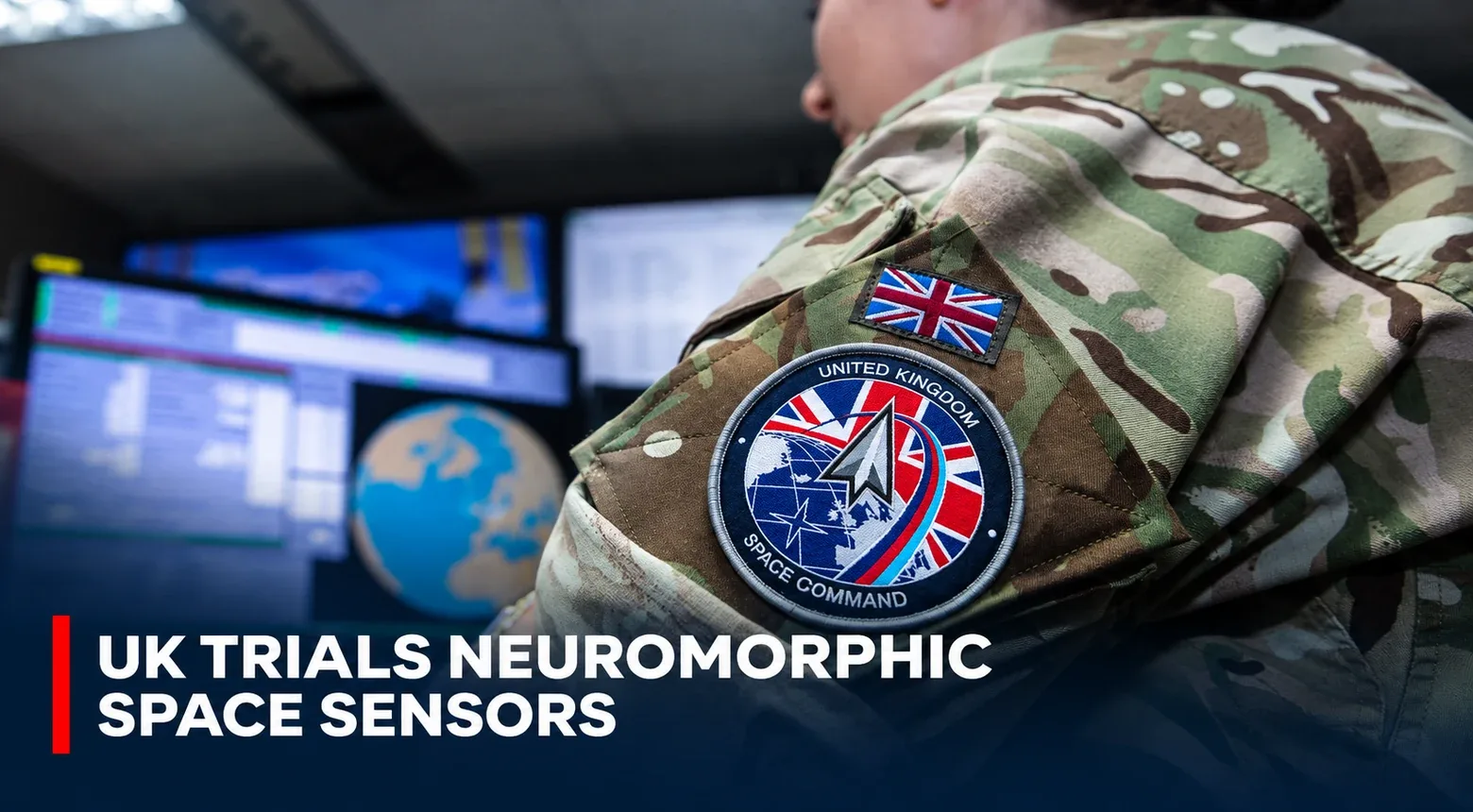
The United Kingdom is evaluating three neuromorphic space sensors through Project Inaros, with UK Space Command expected to complete the trial in April 2027. A parliamentary answer published on 26 November 2026 confirms that an operational decision will follow a further assessment. The experiment matters because it provides a route for emerging optical sensing technology to be evaluated against national requirements before a decision on longer-term adoption.
Project Inaros and the UK's space awareness programme
The Ministry of Defence announcement of 7 November 2026 introduced Inaros alongside confirmation that the British-built Titania satellite had reached orbit. The two initiatives are related through national space policy, but serve different purposes. Titania belongs to the ISTARI satellite programme, while Inaros concerns experimental equipment on the ground. The announcement identifies Optera, a British-Australian technology company, as the sensor developer, working with the National Security Strategic Investment Fund.
The latest clarification appears in the House of Commons written answers for 26 November 2026, page 26, question 45009. The ministerial response confirms that the equipment has been acquired for testing, sets out the expected end of the trial and makes clear that an operational date is not yet available. This distinction is significant: experimental procurement establishes that equipment is available for evaluation, but does not establish that it has met all acceptance conditions or entered routine service.
Neuromorphic optical sensing takes inspiration from biological perception. Rather than treating every observation as equivalent, this family of technologies emphasises changes in the observed scene. Its potential relevance to space awareness lies in how information is collected and processed. However, the public Inaros announcements do not establish comparative detection performance, independently validated reliability figures or the cost of providing an enduring service. The trial should therefore be understood as an evaluation of a technology approach, not proof of a superior operational system.
The wider policy setting is described in the cross-government Space Domain Awareness requirements, updated on 16 June 2026. These describe a combined civil and defence framework for understanding orbital activity and environmental hazards. The National Space Operations Centre, established in May 2024 by the Ministry of Defence and UK Space Agency, is part of that broader effort. Inaros is best understood in this institutional context rather than as a standalone replacement for the country's existing space monitoring arrangements.
The government has allocated approximately £3 billion for a wider four-year defence space investment effort. That figure covers a portfolio and cannot be treated as an Inaros contract value. The cost of the three sensors and their associated support was not identified in the announcements reviewed. DSEI Gateway’s coverage of the trial provides additional reporting on the November announcement, drawing on the same government disclosure.
Technology assurance, procurement risks and next steps
For programme managers, the next stage is principally a question of evidence and assurance. An innovative sensor can demonstrate scientific value without immediately becoming a sustainable public service. Procurement decisions must also account for the quality of supplier documentation, maintenance arrangements, software support, data governance and the costs associated with ownership over time. None of these commercial conditions can be inferred merely from the number of devices undergoing testing.
There is also a distinction between research expenditure and recurring service expenditure. A successful demonstration can justify further assessment without necessarily requiring a large acquisition. Conversely, a decision to continue existing services or commission further research would not by itself mean the experiment had failed. These are separate choices that depend on government requirements, available budgets and the evidence obtained through the evaluation.
Defence Agenda has previously covered Australia’s Viper telescope trial and the UK’s wider space strategy. Both illustrate the importance of examining experimental projects within their wider institutional and industrial context. For commercial suppliers and research organisations, transparent acceptance criteria and a credible route from a trial to a funded programme are particularly important. Government interest should not be mistaken for a commitment to future orders.
Implications / Next: April 2027 is the currently disclosed trial milestone, not a service-entry deadline. Subsequent public reporting should clarify the assessment outcome, any procurement decision, and whether additional funding or contractual arrangements are required. Until then, Project Inaros remains a technology evaluation with an undecided operational future.
Further Reading
- UK Ministry of Defence — Titania and Project Inaros announcement
- UK Parliament — Written answers, 26 November 2026
- UK Government — Space Domain Awareness requirements
- DSEI Gateway — UK launches space sensor trial under Project Inaros
- Defence Agenda — Australia Trials Viper Telescope for Space Surveillance
- Defence Agenda — UK Launches £7.8B Defence-Focused Space Strategy