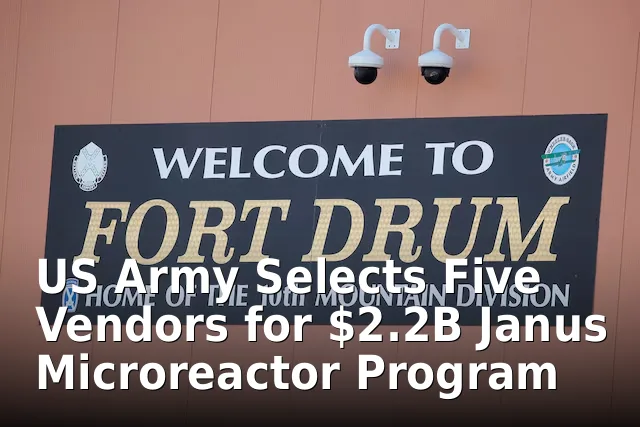
The U.S. Army has selected five nuclear-energy companies for the Janus Program, establishing a milestone-based funding pool of up to $2.2 billion to develop, own, construct and operate nuclear microreactors at military installations.
Antares Nuclear, BWXT Advanced Technologies, General Atomics Electromagnetic Systems, Radiant Industries and Westinghouse Government Services have each been paired with an initial Army base. The Army says the programme combines approximately $2.2 billion in government funding across fiscal years 2027–2031 with significant private-sector capital and is expected to lead to more than 20 microreactors across Department of War installations. The $2.2 billion is a combined programme ceiling, not an amount fully obligated or equally distributed at the time of selection.
Key Facts
- Programme: U.S. Army Janus Program
- Announcement: 26 August 2026
- Government funding framework: Up to $2.2 billion across FY2027–2031
- Selected vendors: Antares Nuclear, BWXT Advanced Technologies, General Atomics Electromagnetic Systems, Radiant Industries and Westinghouse Government Services
- Initial sites: Fort Bragg, Fort Campbell, Fort Hood, Fort Benning and Fort Drum
- Programme objective: More than 20 microreactors across Department of War installations
- First-reactor deadline: At least one Army-regulated reactor operating by 30 September 2028
- Ownership model: Contractor-owned and contractor-operated
Five Vendors, Five Initial Army Installations
| Vendor | Initial installation | Public reactor / technology reference |
|---|---|---|
| Antares Nuclear | Fort Bragg, North Carolina | R1 / TRISO-fuelled heat-pipe microreactor family |
| BWXT Advanced Technologies | Fort Campbell, Kentucky | BWXT Advanced Nuclear Reactor (BANR) |
| General Atomics Electromagnetic Systems | Fort Hood, Texas | GA Tactical Energy System (GA-TES) |
| Radiant Industries | Fort Benning, Georgia | Kaleidos |
| Westinghouse Government Services | Fort Drum, New York | eVinci |
The Army describes these as the first tranche of sites. Additional Army and other-service installations are expected to be announced later as the programme expands.
The $2.2 Billion Is a Milestone-Based Ceiling
The financing structure is more precise than a conventional headline saying the Army has “awarded $2.2 billion” to five companies. The Army says approximately $2.2 billion will be available across fiscal years 2027–2031 through milestone-based agreements.
Vendors receive government payments only after meeting defined technical goals. The Army and Defense Innovation Unit used Other Transaction Authority mechanisms after evaluating technical risk, financial strength, management capability and the suitability of each reactor concept for military-installation energy requirements.
The government has not disclosed how the full $2.2 billion is allocated among all five companies. Radiant is the major exception: the company says its Janus agreement is worth up to $750 million and covers development and deployment of 15 Kaleidos reactors.
The programme also assumes substantial private investment. Army officials told Reuters that the private sector is expected to provide more capital for reactor scale-up than the federal government. That structure shifts part of the manufacturing and commercialisation risk from the government to the developers.
Janus Is Designed for Base Resilience, Not a One-Off Demonstration
The Army’s objective is continuous, high-capacity-factor electricity for military installations, especially when the surrounding commercial grid is unavailable or vulnerable to disruption.
Army officials describe the selected microreactors as systems generating less than 20 megawatts of electricity and requiring less than five acres of land. They are intended to integrate with existing installation grids while maintaining the ability to support critical mission infrastructure during outages, cyber incidents, natural disasters or other disruptions.
The contractor-owned-and-operated model is central to the programme. Instead of the Army becoming the long-term operator of five different commercial reactor designs, the companies are responsible for owning, constructing and operating the systems while the Army defines mission, safety and regulatory requirements.
That model is intended to create commercially viable products rather than bespoke military reactors that have no market beyond the Department of War.
Executive Order 14299 Sets the 2028 Deadline
The Janus Program is the Army’s principal implementation mechanism for Executive Order 14299, signed on 23 May 2025. The order designates the Secretary of the Army as the Department of Defense executive agent for installation and operational nuclear energy.
It requires the Department, through the Army, to commence operation of a nuclear reactor at a domestic military base or installation no later than 30 September 2028.
The policy rationale is mission assurance. The White House identifies advanced computing, artificial intelligence infrastructure and other mission systems as increasingly dependent on dense, reliable electrical power and warns that reliance on vulnerable external grids creates a national-security risk.
Janus therefore links nuclear technology to a wider defence trend: radar, data processing, directed-energy weapons, secure communications, autonomous systems and AI are increasing electrical demand even as military planners seek to reduce vulnerability to civilian-grid disruption.
Project Pele Provides the Technical Predecessor
Janus builds directly on experience from Project Pele, the Department of War’s transportable microreactor demonstrator led by the Strategic Capabilities Office and developed with BWXT at Idaho National Laboratory.
Project Pele was designed as a mobile Generation IV microreactor capable of being transported by road, rail, sea or air and providing resilient electricity in austere locations. The prototype uses TRISO fuel and is intended to demonstrate the safety, transportability and operating characteristics of deployable advanced nuclear power.
The Army describes Janus as taking the “baton” from Pele and the Department of Energy’s Reactor Pilot Program. The distinction is important: Pele is principally a government demonstration programme, while Janus seeks commercially sustainable reactors capable of operating for years at high capacity factors on military installations.
The shift is therefore from proving that a mobile microreactor can work to proving that multiple companies can manufacture, operate and commercially support nuclear systems at repeatable cost and scale.
Antares Brings a Small TRISO Heat-Pipe Architecture
Antares Nuclear has been paired with Fort Bragg. The company’s R1 microreactor family is designed around TRISO-coated particle fuel, graphite, sodium heat pipes and a closed nitrogen Brayton power-conversion cycle.
Antares publishes an electrical output range of approximately 100 kWe to 1 MWe for the R1 family and describes the system as capable of operating for more than six years.
The company achieved first criticality of its Mark-0 reactor at Idaho National Laboratory on 4 June 2026, providing a recent technical maturity point ahead of the Janus selection.
The specific Fort Bragg configuration, number of Antares units and value of the company’s Janus agreement have not been publicly disclosed.
BWXT Extends Its Project Pele Experience to Fort Campbell
BWXT Advanced Technologies will work at Fort Campbell. The company has extensive defence-nuclear experience and is already the principal reactor contractor for Project Pele.
For Janus, BWXT identifies its Advanced Nuclear Reactor, or BANR, as the selected technology. BANR is a factory-fabricated, high-temperature gas reactor using TRISO fuel and is designed for transport by conventional road and rail infrastructure.
BWXT’s published BANR product material describes the design in thermal-power terms and highlights electricity, industrial heat and cogeneration applications. The precise electrical configuration intended for Fort Campbell has not been publicly released.
BWXT’s existing Pele work gives the company relevant experience in microreactor manufacturing, TRISO fuel and Department of War nuclear-safety processes, but the Janus deployment remains a separate commercialisation pathway.
General Atomics Offers a 5–20 MWe Scalable System
General Atomics Electromagnetic Systems has been paired with Fort Hood and will advance its GA Tactical Energy System.
GA-TES is a liquid-metal-cooled microreactor with a published baseline net output of approximately 5 MWe and an architecture scalable to roughly 20 MWe. General Atomics says the plant has a 40-year design life and can be transported in modular form by truck or rail.
The design uses natural-circulation primary coolant flow rather than mechanical coolant pumps, reducing reliance on active circulation systems. General Atomics also highlights black-start capability, allowing the system to restart a local grid without an external electricity source.
The Fort Hood programme will progress through development, testing and site-planning milestones before deployment. The Army has not disclosed the value of the General Atomics agreement.
Radiant Discloses the Largest Individual Janus Award
Radiant has disclosed the most detailed financial commitment among the five selected companies. The company says the Army and DIU executed a binding agreement worth up to $750 million for development and deployment of 15 Kaleidos microreactors.
Kaleidos is a 1 MWe transportable microreactor designed to operate for up to five years before refuelling. Radiant describes a 20-year operating lifecycle and says the reactor can be moved by land, sea or air.
The system is being tested at the Department of Energy’s DOME facility at Idaho National Laboratory. Radiant is also constructing a 300,000-square-foot manufacturing, fuelling and storage campus in Oak Ridge, Tennessee, as it builds a vertically integrated production model.
Fort Benning is the initial Army installation associated with Radiant under Janus. The company says the 15 reactors will ultimately support multiple locations rather than being confined to one base.
Westinghouse eVinci Goes to Fort Drum
Westinghouse Government Services has been selected for Fort Drum with its eVinci heat-pipe microreactor.
Westinghouse’s current commercial product material describes eVinci as a 5 MWe system with a 15 MW thermal core and a design intended to operate for eight or more full-power years before refuelling.
On 24 August 2026, two days before the Janus announcement, Westinghouse completed zero-power criticality testing for eVinci at the Nevada National Security Site in cooperation with Los Alamos and Idaho National Laboratories. The company says the test validated key reactor-physics and core-design assumptions.
Fort Drum officials say the Janus reactor is intended to support critical mission infrastructure while integrating with the local commercial grid. The specific electrical rating of the Fort Drum installation has not yet been publicly confirmed.
Why Military Bases Want On-Site Nuclear Power
Modern military installations depend on civilian electricity networks for communications, command systems, intelligence processing, maintenance, housing, medical facilities and increasingly energy-intensive computing.
Grid dependence creates a single point of vulnerability. Severe weather, physical sabotage, cyberattack, transmission failure or wider regional shortages can interrupt base operations even when military facilities themselves remain intact.
Diesel backup generation provides resilience but creates a logistics burden. Fuel must be stored, transported and replenished, and long-duration outages can exhaust local reserves.
Microreactors are attractive because nuclear fuel contains enough energy to operate for years without routine fuel convoys. The strategic benefit is therefore not simply low-carbon electricity; it is the ability to maintain mission-essential power during long disruptions.
High-Power Weapons and AI Increase the Demand Signal
The military’s electrical requirement is also changing. Directed-energy weapons, advanced radar, high-performance computing, secure data centres and AI processing can create large and persistent power demands.
A fixed installation supporting multiple radar arrays, counter-UAS systems, communications nodes and high-power sensors may require substantially more electricity than bases designed around twentieth-century loads.
This links Janus to a broader force-design problem. Defence Agenda has previously examined how directed-energy systems shift magazine depth from physical ammunition toward electrical generation and thermal management. The same trend increases the strategic value of resilient base power.
Microreactors will not replace every generator, battery or renewable-energy system. They are more likely to become one layer of a diversified installation microgrid combining commercial power, local generation, storage and emergency systems.
Army Regulation Rather Than NRC Licensing Is a Major Policy Choice
One of the most consequential elements of Janus is the regulatory pathway. Executive Order 14299 directs that the first reactor operating on a domestic military installation be regulated by the Army.
Reuters reports that Army officials expect Janus reactors to comply with environmental and safety requirements comparable to commercial systems, but the reactors will not initially be licensed by the Nuclear Regulatory Commission in the same manner as commercial power reactors.
The Army says it is attempting to align its requirements with commercial standards so vendors do not need major redesigns if they later pursue NRC-licensed civilian markets.
This creates a trade-off. A military regulatory pathway may accelerate deployment, but commercial success depends on technologies being able to transition into civilian licensing without expensive redesign or duplicated safety work.
Spent Fuel Will Not Remain Permanently on Army Bases
Fort Drum’s Army announcement provides additional detail on waste handling. The Army says spent nuclear fuel and activated material will remain on an installation only for a federally required cooldown period.
Material would then be moved to designated Department of Energy or national-laboratory facilities for long-term storage or recycling rather than being permanently stored on the Army post.
Vendor-specific fuel-cycle models may differ. Radiant, for example, says it plans to manage fuelling, refuelling and spent-fuel storage at its own facilities. Final waste, transport and refuelling arrangements will therefore depend on each reactor design and its Army authorisation basis.
Cost Remains the Main Economic Question
Microreactors offer resilience and transportability, but they are not expected to beat conventional large nuclear plants on electricity cost alone.
Army official Jeff Waksman told Reuters that no one expects microreactors to be cheaper than large conventional reactors and said one purpose of Janus is to determine how costs can be reduced through commercial production.
The economics become more favourable when the alternative is expensive power in remote or austere locations. Reuters reports that the military currently pays about 40 cents per kilowatt-hour at some Arctic installations.
Radiant told Reuters it expects delivered Kaleidos electricity to cost approximately 20–30 cents per kilowatt-hour because a transportable reactor can avoid some transmission costs. That is a company estimate rather than an Army-validated lifecycle cost.
For major continental bases already connected to reliable low-cost grids, resilience value may matter more than pure electricity price.
Janus Is Also an Industrial-Policy Programme
The Army is explicitly using military demand to help create a domestic commercial microreactor industry.
The programme is designed so selected companies can establish operating records, manufacturing lines, fuel supply chains and maintenance systems that later support civilian customers such as data centres, remote communities, industrial plants and mining operations.
The government therefore acts as an early anchor customer without necessarily funding the entire factory infrastructure. Private investors absorb part of the risk in expectation that technologies validated on military installations can transition into commercial markets.
This is similar to other recent Department of War acquisition models in which government demand signals are used to unlock private capital for manufacturing capacity before full-rate procurement is guaranteed.
Limitations and Counterpoint
The $2.2 billion figure should not be described as money already spent. It is an up-to combined funding framework across FY2027–2031, and vendors are paid against technical milestones.
The Army has not disclosed individual award ceilings for four of the five companies. Radiant’s up-to-$750 million agreement is the only large vendor-specific value publicly identified in the sources reviewed for this article.
The programme objective of more than 20 reactors is also not equivalent to 20 reactors already under construction. Technical, safety, siting, environmental and funding milestones remain before each deployment.
Vendor-published power ratings describe product families, not necessarily the exact configuration that will ultimately be authorised at each Army installation.
Cost claims remain immature. Microreactors may provide valuable resilience while still producing electricity at a premium compared with conventional grid power in many locations.
Finally, the 30 September 2028 deadline is a policy requirement, not proof that all five initial installations will have operational reactors by that date. The requirement is for at least one Army-regulated reactor to begin operation at a domestic military installation.
Implications / Next
The first major programme indicator will be which vendor reaches an operating reactor by the September 2028 deadline. Milestone performance will also determine how much of the $2.2 billion funding ceiling is actually released.
The second indicator is the publication of site-specific reactor ratings, safety authorisations, environmental reviews and construction schedules for Fort Bragg, Fort Campbell, Fort Hood, Fort Benning and Fort Drum.
The third is expansion beyond the Army. The service says additional Army and other-service locations will be announced, and the long-term goal is a Department-wide energy-resilience architecture rather than five isolated installations.
Commercial transition will be equally important. If Janus reactors can later receive civilian licences and secure data-centre, industrial or remote-power customers, the programme may create a sustainable manufacturing base beyond defence procurement.
Conclusion
Janus marks a shift in U.S. military nuclear-energy policy from experimental demonstration toward multi-vendor deployment and commercial scale-up.
The Army is offering up to $2.2 billion in milestone-based government funding, while requiring private companies to contribute significant capital, own the reactors and operate them. Five different reactor developers and five Army bases create parallel technical pathways rather than dependence on a single design.
The strategic logic is clear: military installations need reliable power even when civilian grids fail, and future radars, AI infrastructure and high-energy systems will increase electrical demand. The unresolved questions are cost, licensing, fuel supply, site acceptance and whether the selected vendors can move from prototype maturity to years of reliable operation.
The September 2028 first-reactor deadline will therefore be the critical test of whether Janus becomes an operational energy-resilience programme or remains another advanced-nuclear development initiative.