Türkiye warship construction has reached an unprecedented scale, with 37 naval vessels being built for the Turkish Naval Forces and another 24 for foreign customers, according to Naval Forces Commander Admiral Ercüment Tatlıoğlu.
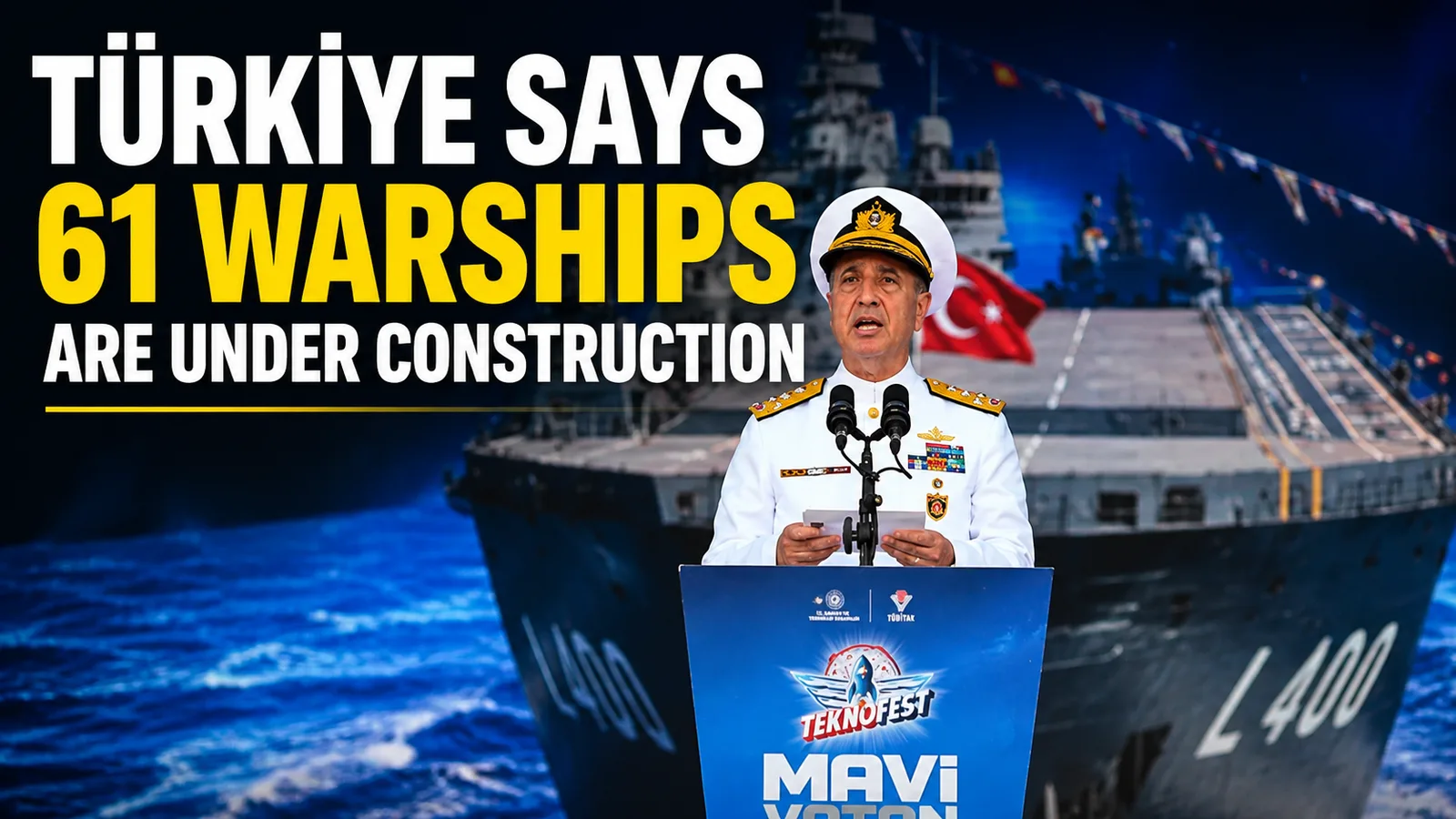
Tatlıoğlu disclosed the figures during the opening of TEKNOFEST Mavi Vatan at Gölcük Naval Shipyard Command on 20 August 2026. Although he described the total as “more than 50 warships,” the two figures provided in the same statement add up to 61 vessels under simultaneous construction.
The significance extends beyond production volume. Türkiye is simultaneously progressing from corvette and frigate construction into an indigenous aircraft carrier, an air-defence destroyer and a national submarine while exporting increasingly complex military vessels to customers across Europe and Asia. The challenge now is whether its public and private shipyards, suppliers and combat-system manufacturers can sustain that production tempo without creating delivery or workforce bottlenecks.
Key Facts
- Statement date: 20 August 2026.
- Turkish Naval Forces: 37 warships under construction, according to Admiral Tatlıoğlu.
- Foreign customers: 24 warships under construction.
- Implied total: 61 vessels, although Tatlıoğlu characterised the figure as “more than 50”.
- Major domestic programmes: MİLGEM/İ-class frigates, MUGEM aircraft carrier, TCG Kocatepe air-defence destroyer and the national submarine programme.
- MİLGEM 6–12: Seven İ-class frigates are being built simultaneously at three Turkish private shipyards.
- Industrial context: President Recep Tayyip Erdoğan said on 20 June 2026 that Türkiye’s active naval projects had reached approximately €25 billion in value.
Türkiye Says 37 Domestic and 24 Export Warships Are in Build
Speaking at TEKNOFEST Mavi Vatan on 20 August 2026, Admiral Ercüment Tatlıoğlu said Türkiye was simultaneously building 37 warships for the Turkish Naval Forces and 24 for foreign customers.
Those figures produce an implied total of 61 vessels.
Tatlıoğlu himself used the broader description “more than 50”, however, and no complete public list identifying all 61 hulls was released alongside the statement.
Defence Agenda therefore treats 61 as the arithmetic total implied by the Naval Forces commander’s breakdown rather than as an independently reconstructed hull-by-hull inventory.
That distinction is important because military shipbuilding statistics can differ depending on whether vessels at steel-cutting, block construction, fitting-out or foreign-yard production stages are included.
The Figure Has Increased From Earlier 2026 Statements
The August disclosure is also higher than figures publicly cited earlier in 2026.
President Recep Tayyip Erdoğan said on 20 June 2026 that Türkiye was manufacturing more than 50 warships, with more than 15 intended for friendly and allied countries.
Two months later, Tatlıoğlu’s breakdown identifies 24 vessels for foreign customers.
The difference may reflect newly activated programmes, different project stages or different counting methodologies. Without a detailed official hull list, it should not automatically be interpreted as nine new export warships having begun construction within two months.
MİLGEM Remains the Production Backbone
The MİLGEM programme remains the clearest example of Türkiye’s transition toward simultaneous serial naval construction.
Türkiye’s Presidency of Defence Industries confirms that seven İ-class frigates under the MİLGEM 6–12 procurement programme are being constructed simultaneously at three separate Turkish private shipyards.
The programme follows TCG İstanbul, the first İ-class frigate and fifth vessel in the wider MİLGEM sequence.
The İ-class design expands the Ada-class corvette architecture into a larger multi-purpose frigate able to conduct surface warfare, anti-submarine warfare, surveillance, air defence and maritime-security missions.
The industrial model is as important as the platform itself. Building several frigates concurrently across different commercial yards distributes workload and expands the number of facilities capable of integrating modern naval combatants.
Türkiye Is Moving Beyond Frigates
Tatlıoğlu’s address also highlighted how Türkiye’s naval ambitions have moved beyond the MİLGEM family.
He said construction was continuing on Türkiye’s indigenous aircraft carrier, its national air-defence destroyer TCG Kocatepe and its national submarine.
These programmes represent three substantially more demanding engineering categories than the corvettes and frigates that established Türkiye’s modern naval-construction base.
Carrier construction introduces requirements in aviation integration, large-block production, propulsion, power generation and flight-deck management.
An air-defence destroyer requires large radar arrays, extensive vertical-launch capacity and high-output electrical and combat-management infrastructure.
A national submarine adds another level of design sensitivity involving acoustic discretion, underwater hydrodynamics, pressure-hull construction and highly integrated propulsion and sensor systems.
MUGEM Is Türkiye’s Largest Naval Construction Programme
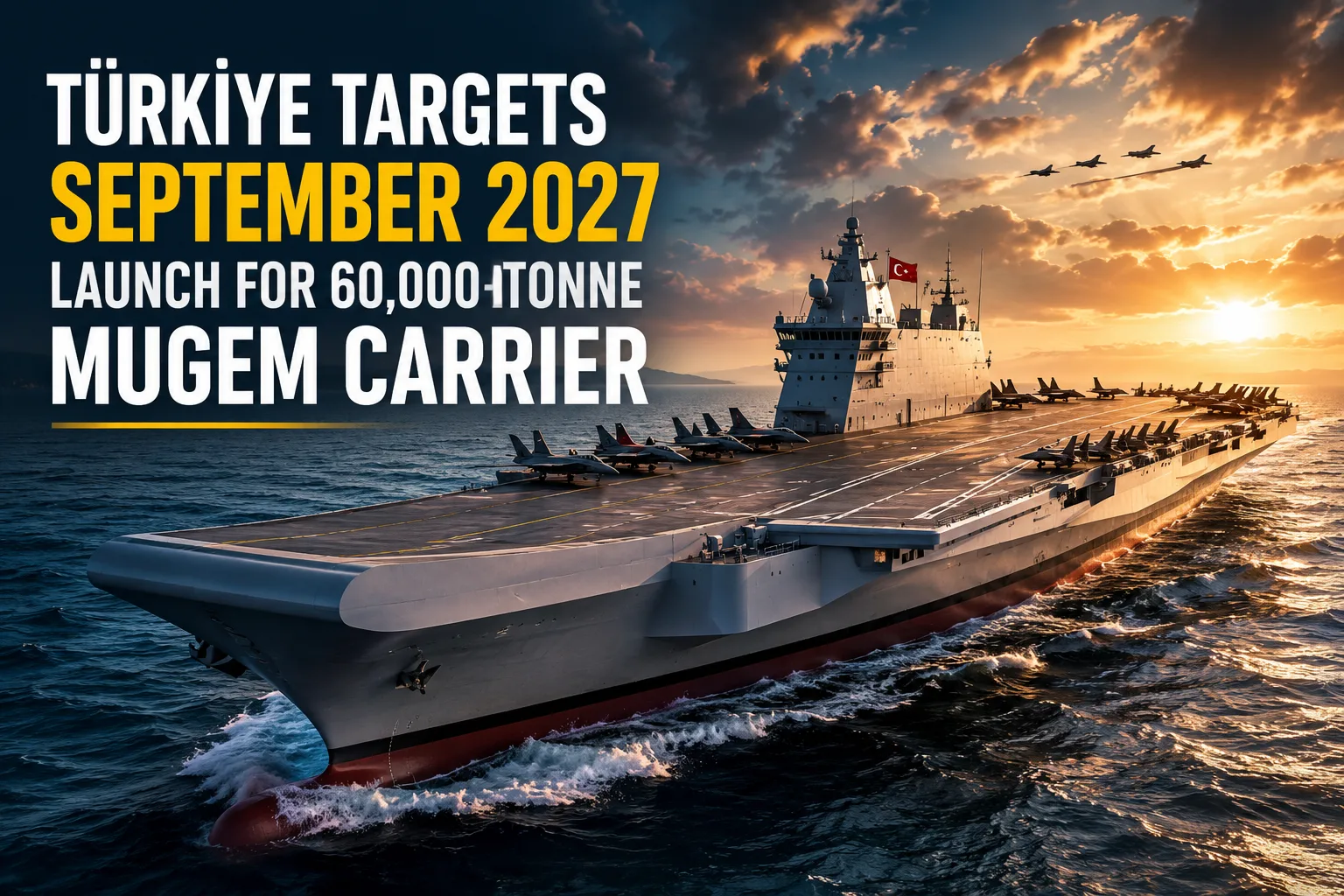
The Milli Uçak Gemisi, or MUGEM, sits at the top of the current shipbuilding hierarchy.
SSB President Haluk Görgün said in early 2026 that the carrier programme covered a vessel of approximately 60,000 tonnes and that production activities had started.
More recent industrial information indicates how far the programme is reaching into Türkiye’s wider manufacturing base.
Anadolu Agency reported on 21 August 2026 that Erdemir is expected to supply approximately 40,000 tonnes of ship steel for MUGEM.
This matters because sovereign naval construction is not determined only by whether a domestic yard can assemble hull blocks. Steel, propulsion, electrical systems, sensors, weapons, software and sustainment capacity determine how much of the programme can genuinely be controlled domestically.
Defence Agenda previously examined the programme together with Türkiye’s air-defence destroyer in MUGEM and TF-2000 Warship Projects.
TCG Kocatepe Moves the Navy Into Area Air Defence
Tatlıoğlu also identified TCG Kocatepe as Türkiye’s national air-defence destroyer currently under construction.
The programme is associated with Türkiye’s long-running TF-2000 / air-defence warfare destroyer effort.
During Mavi Vatan 2026 in April, Tatlıoğlu said the first block of TCG Kocatepe had been placed on the building berth, confirming that the programme had moved beyond design and steel cutting into physical construction.
The destroyer is important because Türkiye’s existing frigates provide more limited area air-defence capacity than a dedicated large combatant designed around long-range radar and vertical-launch systems.
A ship in this category could act as the principal air-defence escort for high-value assets including TCG Anadolu and the future MUGEM carrier.
For additional programme context, see Defence Agenda’s TF-2000 Destroyer Capabilities.
MİLDEN Extends Sovereignty Below the Surface
The third strategic programme highlighted by Tatlıoğlu is Türkiye’s national submarine effort.
During the Kurtaran-2026 exercise earlier this year, the Naval Forces commander referred to the national submarine as Atılay and said construction was progressing alongside the carrier and Kocatepe destroyer.
The programme builds on the industrial experience created through Türkiye’s Reis-class Type 214 submarine construction programme.
Türkiye has used that programme to deepen domestic capability in combat systems, sonar, torpedoes, data distribution and submarine production methods before moving toward an indigenous design.
That transition is covered in greater detail in Defence Agenda’s Türkiye Naval Modernisation: Type 214, ULAQ and MİLGEM.
Twenty-Four Export Ships Change the Industrial Equation
The 24 vessels being built for foreign customers may be the most commercially significant part of Tatlıoğlu’s statement.
Export shipbuilding changes military naval programmes from a largely national procurement activity into a continuing industrial business.
Türkiye has already established several export lines.
Four PN MİLGEM/Babur-class corvettes were contracted for Pakistan under a model combining construction in Türkiye and Pakistan.
Ukraine ordered Ada-class corvettes, while Malaysia selected three LMS Batch 2 corvettes based on Turkish naval engineering.
The third Malaysian LMS Batch 2 vessel was launched in Istanbul on 9 August 2026, following the launch of the first two ships on 24 May and 7 June.
Portugal has also ordered two replenishment and logistics-support ships from STM, with production of the second vessel beginning in June 2026.
These programmes illustrate the diversity of the export portfolio, although publicly available information does not provide a complete reconciliation with Tatlıoğlu’s total of 24 export vessels.
Exports Are Moving Into NATO and EU Markets
Türkiye’s naval exports are also changing geographically.
On 20 June 2026, Türkiye transferred the offshore patrol vessel CAm. Roman to Romania, which President Erdoğan described as Türkiye’s first warship export to a country that is simultaneously a NATO and European Union member.
Portugal’s support-ship programme provides another entry into the European naval market.
This matters because European and NATO contracts place Turkish yards in procurement environments involving alliance interoperability, certification, cybersecurity, documentation and long-term sustainment requirements that extend beyond building the hull itself.
The Export Model Includes Combat Systems, Not Only Hulls
Türkiye’s naval export strategy is increasingly based on exporting integrated systems rather than bare ship designs.
HAVELSAN’s ADVENT combat-management system, ASELSAN sensors, Turkish communications systems and domestically developed weapons are increasingly incorporated into export configurations.
ADVENT has already been delivered to multiple international customers including Pakistan, Ukraine, Qatar, Oman, Nigeria, Malaysia, Chile and Romania.
This creates greater industrial value per ship and can generate decades of follow-on software, integration, maintenance and modernisation work.
It also means Türkiye’s naval-industrial growth is linked directly to its wider defence-electronics and weapons ecosystem rather than to shipyards alone.
ATMACA, AKYA, HİSAR and MALAMAN Complete the Platform Strategy
Tatlıoğlu emphasised this point during his TEKNOFEST address.
Alongside national platforms, he highlighted ATMACA anti-ship missiles, AKYA heavyweight torpedoes, HİSAR naval air-defence missiles and the MALAMAN naval mine.
He also referred to a submarine-launched ATMACA firing conducted in July 2026 against a surface target at approximately 190 km.
The industrial objective is therefore broader than increasing hull numbers. Türkiye is attempting to control the sensors, command systems and weapons that determine the combat value of those hulls.
Uncrewed Systems Are Becoming Part of the Fleet Architecture
Tatlıoğlu also highlighted Türkiye’s growing use of unmanned aircraft, surface vessels and underwater vehicles.
He specifically referenced Bayraktar TB3 operations from TCG Anadolu and VTOL UAVs suitable for use from a broader range of naval vessels.
That theme was visible throughout TEKNOFEST Mavi Vatan, where new systems including KALKAN DİHA, TUFAN, DERİNGÖZ and KILIÇ 10 demonstrated or marked programme milestones.
This suggests Türkiye’s future fleet structure will not be measured only by the number of crewed warships commissioned.
Large crewed platforms are increasingly expected to operate as command, sensor and weapons nodes within a broader network containing airborne, surface and subsurface autonomous systems.
The Core Challenge Is Production Capacity
A portfolio of more than 50 simultaneous naval builds creates a different problem from designing one successful warship.
Serial production requires qualified welders, naval architects, systems engineers, combat-system specialists, suppliers and test personnel across multiple yards.
Equipment such as marine engines, reduction gearboxes, electrical generators, radar arrays, sonars and missile launchers must also arrive in sequence if yards are to avoid incomplete hulls accumulating while waiting for subsystems.
Türkiye’s use of several private yards for the İ-class programme directly addresses part of this capacity problem by distributing work.
However, distributing hull construction does not automatically eliminate bottlenecks in common combat systems or specialist suppliers.
Counterargument: Hull Count Alone Does Not Measure Naval Power
The headline figure of 61 implied vessels should also be interpreted carefully.
A patrol vessel, logistics ship, frigate, destroyer, submarine and aircraft carrier differ radically in complexity, cost and combat value.
Counting all vessels equally can therefore exaggerate what the number itself says about military capability.
Construction-stage definitions also matter. A vessel undergoing early steel work does not represent the same near-term fleet capacity as a ship completing sea trials.
The more meaningful indicators will be delivery rates, on-time completion, localisation of critical systems, operational availability and the ability to sustain ships after commissioning.
Naval Growth Supports Türkiye’s Wider Defence Export Expansion
The shipbuilding surge is occurring alongside rapid growth across Türkiye’s wider defence sector.
Defence Agenda’s Türkiye Defence Industry Transformation analysis documented how defence and aerospace exports rose from $248 million in 2002 to more than $10 billion in 2025.
Naval systems are particularly important within that transition because warships produce long-duration industrial relationships.
A ship export can create follow-on demand for weapons, ammunition, combat-management software, spare parts, training, maintenance and mid-life modernisation for decades after initial delivery.
Implications / Next
The first issue to watch is clarification of the 61-vessel portfolio. A detailed breakdown of the 37 domestic and 24 export builds would allow the production load to be assessed by ship class, yard and construction stage.
The second is İ-class delivery tempo. Seven frigates under simultaneous construction provide one of the clearest tests of Türkiye’s distributed private-yard production model.
The third is MUGEM construction. The carrier will require a far larger supplier and production ecosystem than previous Turkish surface combatants and will become an important test of heavy naval industrial capacity.
The fourth is TCG Kocatepe. Progress from block assembly toward launch will show how quickly Türkiye can transition its first national air-defence destroyer from design into a complete combat system.
The fifth is MİLDEN. A nationally designed submarine represents one of the most technologically demanding steps in Türkiye’s effort to achieve sovereign naval-platform development.
Finally, export deliveries will be critical. The value of the 24-vessel export portfolio will ultimately be measured by whether Turkish yards can maintain schedule and quality while simultaneously meeting the Turkish Navy’s own large procurement requirement.
Conclusion
Admiral Ercüment Tatlıoğlu’s 20 August 2026 statement provides one of the clearest indications yet of the scale of Türkiye’s naval-industrial expansion.
His breakdown of 37 vessels for the Turkish Naval Forces and 24 for international customers implies 61 warships simultaneously under construction, even though the admiral summarised the figure more conservatively as “more than 50”.
The number is significant, but the composition matters more.
Türkiye is no longer concentrating solely on corvettes and frigates. Its active portfolio now extends toward a 60,000-tonne indigenous aircraft carrier, a dedicated air-defence destroyer, a national submarine and an increasingly diverse international export pipeline.
The next phase will test whether Türkiye can convert design capability into sustained serial output across dozens of simultaneous programmes while preserving schedule, localisation and export competitiveness.
Further Reading
- Anadolu Agency: Türkiye Building More Than 50 Warships Simultaneously
- SSB: MİLGEM 5 and 6–12 Procurement Programme
- Anadolu Agency: Türkiye’s Naval Export and Shipbuilding Portfolio
- Anadolu Agency: Türkiye’s MİLGEM Naval Transformation
- Defence Agenda: MUGEM and TF-2000 Warship Projects
- Defence Agenda: Türkiye Naval Modernisation — Type 214, ULAQ and MİLGEM
- Defence Agenda: Türkiye Defence Industry Transformation
- Defence Agenda: TCG Anadolu and Türkiye’s Naval Aviation Transition