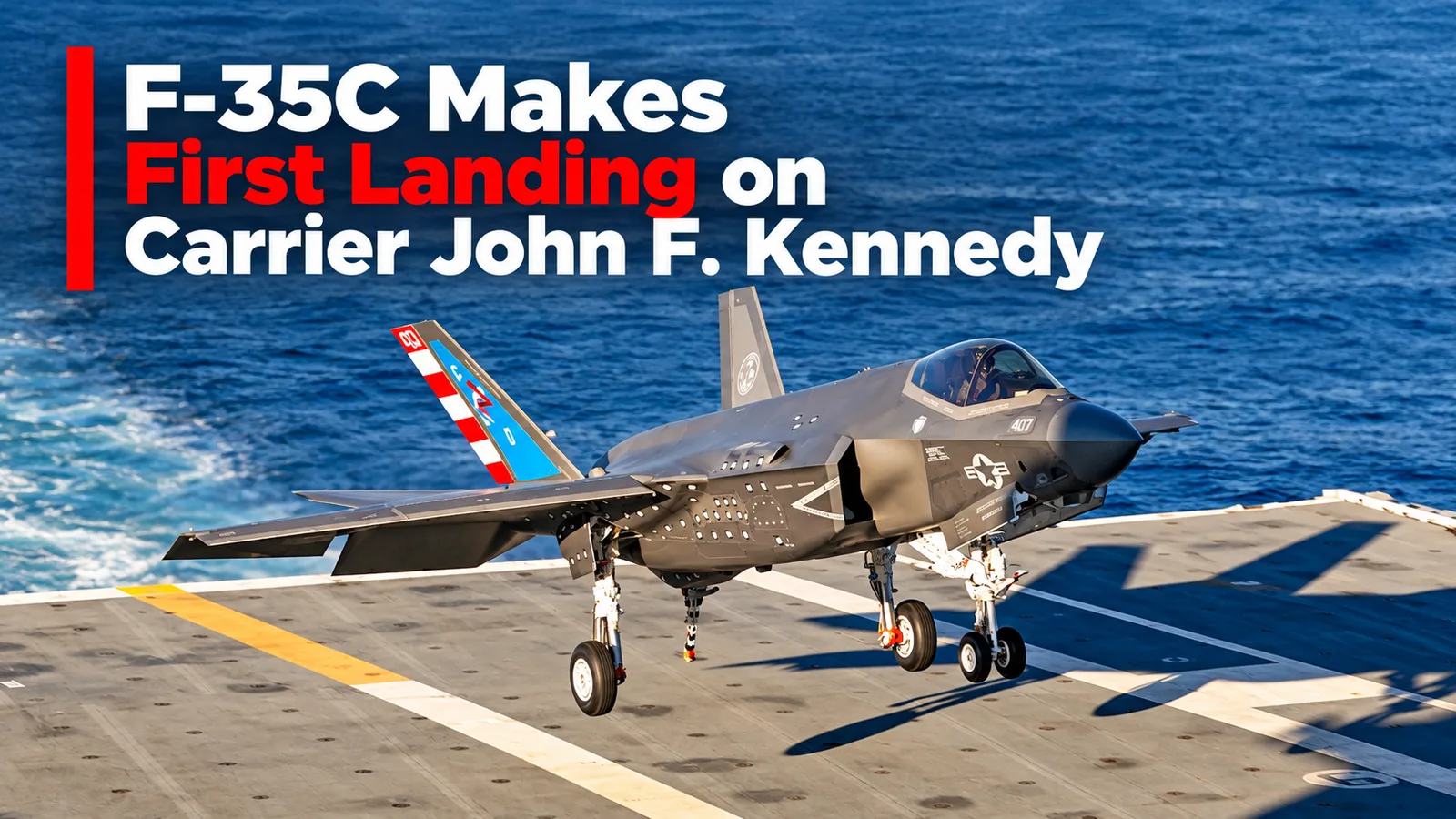
A U.S. Navy F-35C completed the first reported arrested landing aboard the future aircraft carrier John F. Kennedy (CVN-79) on 13 October 2026, followed by a launch during aircraft compatibility testing. The milestone addresses a key aspect of integrating fifth-generation carrier aviation with the second Gerald R. Ford-class ship, but the test is not equivalent to formal ship delivery or deployment readiness.
What VX-23 Demonstrated on the Carrier
The aircraft came from Air Test and Evaluation Squadron 23, the Navy's VX-23 test organisation. U.S. Navy imagery and reporting described an F-35C landing and launching during a trial period in the western Atlantic. The important technical achievement is that the aircraft and carrier's launch-and-recovery arrangement were brought together in an actual at-sea sequence instead of relying only on shore-based equipment tests or engineering simulations.
An arrested landing is a complex interaction among the aircraft's approach controls, landing gear and arresting hook, the deck's arresting system and the ship's motion. A catapult launch introduces a separate set of interface and safety requirements. One successful sequence verifies a defined test point; it does not by itself cover every aircraft weight, wind condition, sea state or emergency case needed for broader certification.
Why John F. Kennedy Has a Distinct Integration Burden
John F. Kennedy is the second ship in the Ford class, a generation of U.S. nuclear-powered carriers introducing new machinery and flight-deck systems. It has faced schedule pressure associated with advanced arresting equipment and weapons elevator integration. The Navy also changed the construction and delivery plan to include F-35C-related modifications before the carrier enters service instead of relying on a later retrofit.
That history makes the landing particularly relevant to acquisition management. The Navy needs an aircraft-capable carrier, not merely a hull that can sail. The aircraft compatibility campaign provides evidence toward closing technical risk in the interfaces between ship equipment, test aircraft and flight-deck crews. It cannot substitute for completion of the other shipboard acceptance, damage-control, weapons-handling and crew-certification activities.
Implications for Fifth-Generation Carrier Operations
The F-35C adds stealth, sensor fusion and networked targeting to the carrier air wing. Successful integration with a new class of ship is therefore important not only for flight operations but also for the planned composition of the carrier's strike and defensive missions. A fifth-generation aircraft requires the carrier to support its maintenance, data, weapons, planning and security needs in addition to physical launch and recovery.
This event should also be distinguished from a carrier conducting an operational deployment with an F-35C squadron. The aircraft participating in testing belongs to a development and evaluation organisation, and the trial concerns a ship still moving through delivery preparation. The Navy has not announced an operational deployment date, a completed air-wing work-up or the carrier's final formal acceptance as part of this milestone.
What the Public Record Does Not Establish
The available reporting does not state the total number of sorties in the compatibility campaign, the arresting-wire loads measured, the configuration and gross weight of the jet, or completion of the ship's entire flight-deck certification. Those details are necessary to assess how much of the risk register has been retired beyond the headline event. Published future delivery dates should also be treated as planning information rather than proof that the ship has transferred to the fleet.
Industrial continuity remains a parallel issue. Newport News Shipbuilding and specialised suppliers must complete complex integration work while the Navy advances follow-on Ford-class carriers. Lessons from the Kennedy trials may inform later production and retrofit decisions, but any asserted changes in cost or schedule require specific contract or programme documentation.
Implications / Next
Watch for additional F-35C launches and recoveries under varied conditions, formal verification of advanced arresting gear, carrier delivery and subsequent fleet integration. The October landing is a clearly defined aviation milestone. Its value lies in measured progress toward a fifth-generation-capable carrier, rather than a claim that John F. Kennedy is already deployed or fully operational.