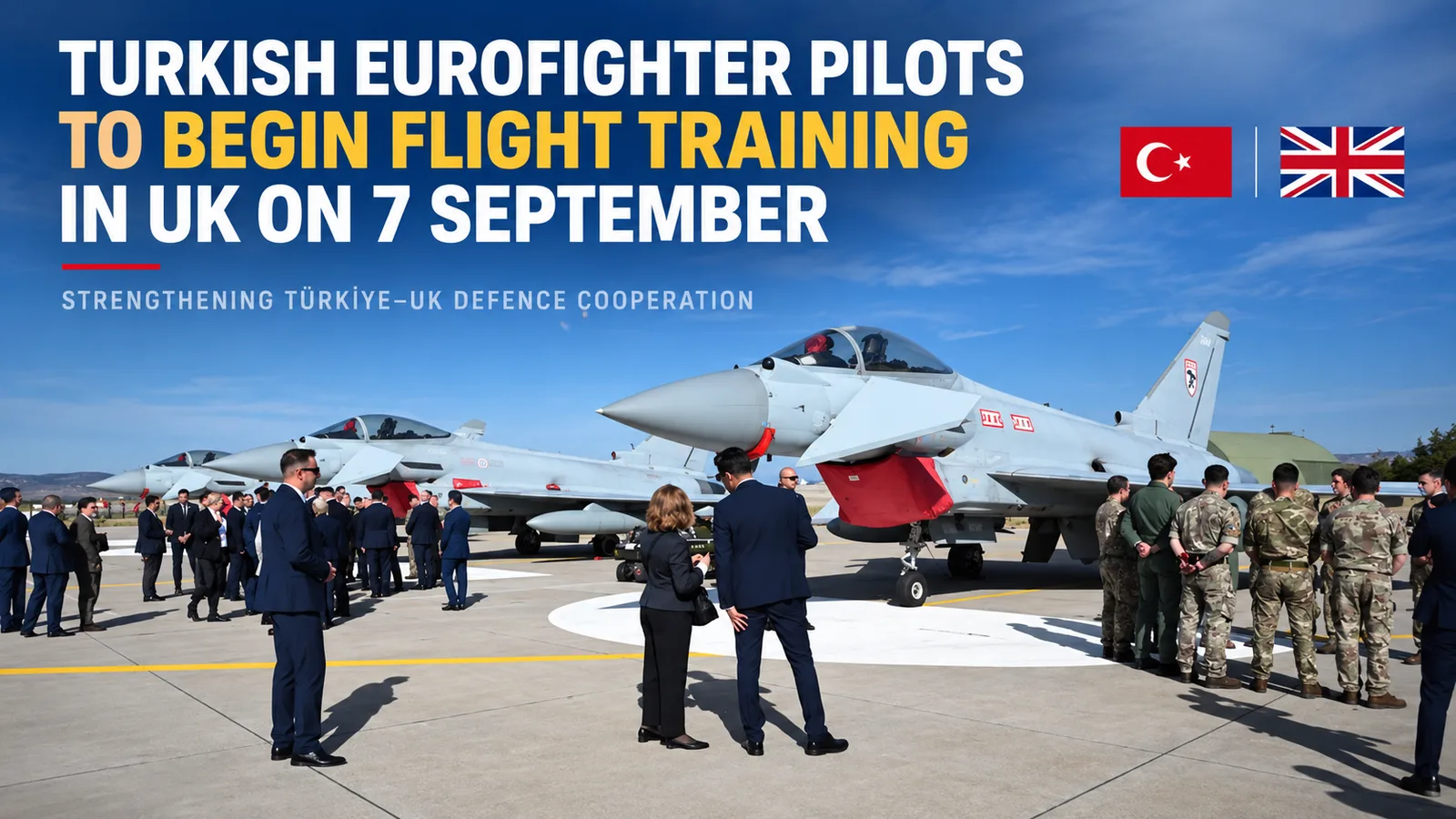
Turkish Air Force pilots are scheduled to begin Eurofighter Typhoon flight training in the United Kingdom on 7 September 2026, moving Türkiye’s 20-aircraft procurement programme from contractual preparation into hands-on operational conversion years before the first new-build aircraft is due for delivery.
Türkiye’s Ministry of National Defence said pilot training began in August with terminology instruction. The next phase will comprise eight months of flight training, followed by three months of instructor-pilot training. Additional pilots will continue to be sent to the programme in batches.
Key Facts
- Programme: Türkiye Eurofighter Typhoon procurement
- Customer: Turkish Air Force Command
- Aircraft: 20 new-build Eurofighter Typhoons
- Flight-training start: 7 September 2026
- Flight-training duration: 8 months
- Instructor-pilot training: 3 months
- Training location: United Kingdom
- Training model: Pilots sent in successive groups
- First new-aircraft delivery: Expected in 2030
- UK headline programme value: Up to £8 billion
The New Milestone Is the Start of Flying Training
The 3 September Ministry of National Defence update provides the most precise training schedule released so far for Türkiye’s Eurofighter transition.
Turkish pilots were sent to the United Kingdom in August and have completed terminology training. The ministry now says the first flying phase is planned to begin on 7 September 2026.
The flight phase will last eight months. After that, pilots will enter a further three-month instructor-pilot course.
This is significant because the programme is not limited to converting an initial group of pilots onto the aircraft. The instructor phase is designed to help Türkiye build a cadre capable of supporting future training inside the Turkish Air Force.
The ministry also said pilots will continue to be sent in batches, indicating that the 7 September start is the beginning of a continuing training pipeline rather than a one-off course.
Training Begins Years Before the First New Typhoon Arrives
The United Kingdom says the first new-build Typhoon for Türkiye is expected to be delivered in 2030.
Starting pilot training in 2026 therefore creates a long preparation period before the new aircraft enter Turkish service.
That is operationally important. Introducing a new fighter type requires more than qualified pilots. Air forces need instructors, maintenance specialists, weapons personnel, mission-system technicians, simulators, spares, technical publications and support procedures before a fleet can generate sustainable combat readiness.
Türkiye’s training programme is therefore beginning well ahead of aircraft delivery to reduce the risk that new jets arrive before the supporting personnel and training system are ready.
The March Support Agreement Built the Training Framework
The September training milestone follows a separate multi-billion-pound training and support agreement signed by the UK and Türkiye on 25 March 2026.
The UK Ministry of Defence said that agreement covers training for Turkish Air Force pilots and ground crews as well as long-term maintenance support.
The British government said the programme would train 10 Turkish pilots and nearly 100 ground-crew technicians in the UK. The technical personnel cover mechanical, avionics, weapons and mission-system disciplines.
BAE Systems separately states that Royal Air Force arrangements are intended to train 10 Turkish instructor pilots and nearly 100 maintenance trainers, supporting Türkiye’s ability to deliver future training and support more independently.
The Ministry of National Defence’s September statement does not identify how many pilots are in the first 7 September flight-training group, so Defence Agenda does not assume that all 10 instructor pilots are beginning the flying phase simultaneously.
Türkiye Ordered 20 New Typhoons in October 2025
The wider procurement was finalised on 27 October 2025, when the UK and Türkiye signed an agreement for 20 new Typhoon fighter aircraft.
The British government described the package as worth up to £8 billion and the largest UK fighter-jet export agreement in a generation.
BAE Systems has described its aircraft, weapons and integration element as approximately £5.4 billion.
These figures should not be presented as contradictory. The £5.4 billion figure refers to BAE Systems’ disclosed aircraft and associated weapons/integration agreement, while the UK government’s up-to-£8-billion headline figure reflects the broader government-to-government package.
The March 2026 training-and-support contract is part of the wider Typhoon relationship and includes spares, simulators, electronic-warfare capabilities, technical support and personnel training.
Production of Türkiye’s Aircraft Is Already Underway
BAE Systems said in March that manufacturing of Türkiye’s new aircraft was already under way in the UK and across the four Eurofighter partner nations.
Final assembly of the Turkish aircraft will take place at Warton in Lancashire.
The Eurofighter industrial model distributes production across the United Kingdom, Germany, Italy and Spain. The UK government says 37% of each Typhoon is manufactured in Britain, with the remaining work shared across the other partner nations.
The Turkish order therefore supports an established multinational production network rather than a single-country aircraft line.
Türkiye Becomes the Tenth Typhoon Operator
Eurofighter formally welcomed Türkiye into the Typhoon community after the October 2025 order.
The consortium identifies Türkiye as the tenth nation to operate the aircraft, joining the four core programme nations and other export customers.
The procurement deepens NATO interoperability because the Turkish Air Force will operate a combat aircraft already used by several allied and partner air forces.
However, Türkiye is an operator and customer rather than one of the four original core industrial nations that own the Eurofighter programme.
The Training Pipeline Is About Sovereign Readiness
BAE Systems says the training and support package is intended progressively to increase Türkiye’s sovereign support capability.
A fighter fleet can remain heavily dependent on the supplying country if pilot conversion, maintenance certification, mission-data support and specialist engineering knowledge are retained abroad.
Training instructor pilots and maintenance trainers creates the basis for Türkiye to internalise part of that knowledge.
The arrangement does not mean every aspect of Typhoon support becomes sovereign. The aircraft remains a multinational European platform with imported engines, radar, avionics, weapons and controlled technical data.
But an indigenous training cadre can reduce recurring dependence on foreign training establishments once the Turkish fleet expands.
Simulators Form a Major Part of the Support Package
The March agreement also includes high-fidelity training simulators.
For modern combat aircraft, simulator capacity is central to operational conversion because it allows pilots to practise emergencies, complex tactical missions and sensor or weapons procedures without consuming live aircraft hours.
Simulation becomes particularly important before the customer’s own aircraft are available in country.
Maintenance Training Covers Multiple Technical Disciplines
The British government’s March announcement specifies that nearly 100 Turkish ground crew technicians will train across mechanical, avionics, weapons and mission systems.
Training those groups before the first aircraft arrives reduces the risk of a bottleneck in maintenance and sortie generation during initial operational introduction.
Electronic Warfare Is Included in the Support Contract
BAE Systems states that the Turkish support contract also includes electronic-warfare capabilities.
The company has not publicly disclosed the detailed Turkish EW configuration, software content or mission-data architecture in the March announcement.
The relevant public fact is that EW capability forms part of the support and integration package.
The Typhoon Will Bridge a Turkish Combat-Air Transition
The Eurofighter acquisition is occurring while Türkiye simultaneously modernises its F-16 fleet and develops the indigenous KAAN fighter.
Typhoon gives the Turkish Air Force another high-performance NATO-standard combat-air platform during that transition.
The aircraft is not a substitute for KAAN in programme terms. Typhoon provides an operationally mature platform with established NATO service, while KAAN is Türkiye’s sovereign next-generation fighter programme.
HÜRJET Will Support the Broader Pilot-Training Pipeline
The Turkish Air Force is also preparing to introduce HÜRJET as its indigenous advanced jet trainer.
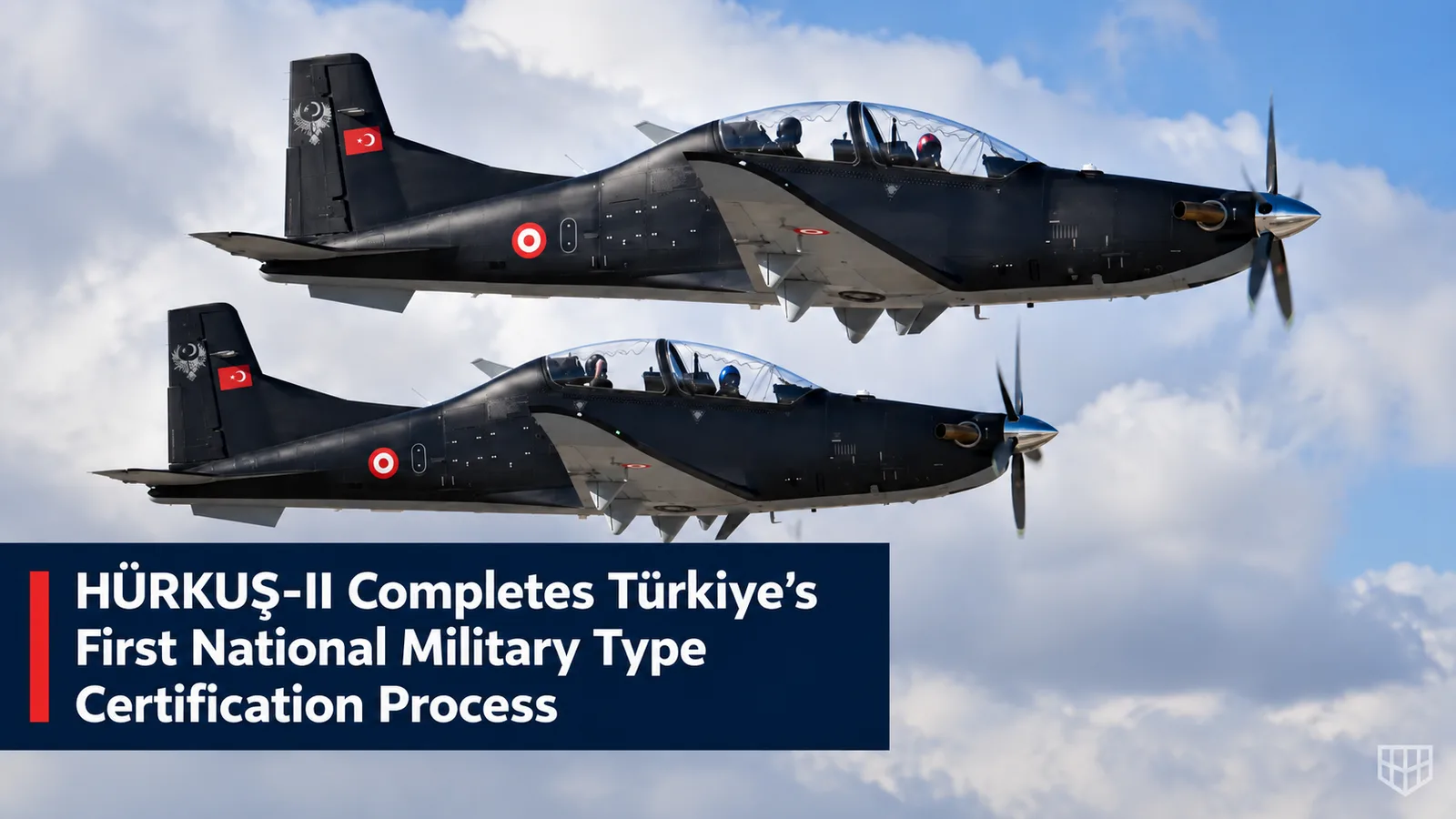
The first HÜRJET intended for Turkish Air Force delivery completed its maiden flight on 30 August 2026.
HÜRJET and Typhoon occupy different roles, but they intersect in the pilot-training architecture. HÜRJET is intended to prepare pilots for advanced fighter conversion, while Typhoon-specific training teaches them to operate the frontline combat aircraft.
Instructor Training Is the More Strategic Part of the Schedule
The eight-month flight-training phase will create aircraft-qualified pilots, but the subsequent three-month instructor course may be more important for long-term force generation.
An instructor cadre allows a customer air force to expand a fleet without sending every new pilot abroad for the complete conversion process.
BAE Systems’ wording indicates that the objective is for Türkiye eventually to train future pilots and ground crew independently.
Limitations and Counterpoint
The 7 September date is a planned training start, not an aircraft-delivery milestone.
The ministry does not disclose the identities or exact number of pilots beginning flight training on that date.
It does not identify the complete RAF base sequence, sortie count, simulator-hour requirement, weapons syllabus or aircraft variant used for each phase.
The public material also does not explain how Türkiye will maintain continuous Typhoon flying proficiency between the 2026–2027 training period and first new-build delivery in 2030.
Finally, headline values require care: the UK government cites the wider deal at up to £8 billion, while BAE Systems describes a roughly £5.4 billion aircraft, weapons and integration element.
Implications / Next
The first milestone is the planned start of flight training on 7 September 2026.
The next steps are completion of the eight-month flying phase, the three-month instructor course, expansion of the maintenance and instructor pipeline, simulator delivery, support-infrastructure build-up and aircraft production toward the first 2030 delivery.
Conclusion
Türkiye’s Eurofighter programme is entering a practical force-generation phase before the first new aircraft arrives.
Pilot training began in August, flight training is scheduled to start on 7 September 2026, and the syllabus then moves through eight months of flying and three months of instructor preparation.
The sequence is designed to create more than a small group of converted pilots. Together with the UK’s training of maintenance personnel and provision of simulators and support equipment, it is intended to establish the people and infrastructure required for a sustainable Turkish Typhoon fleet.