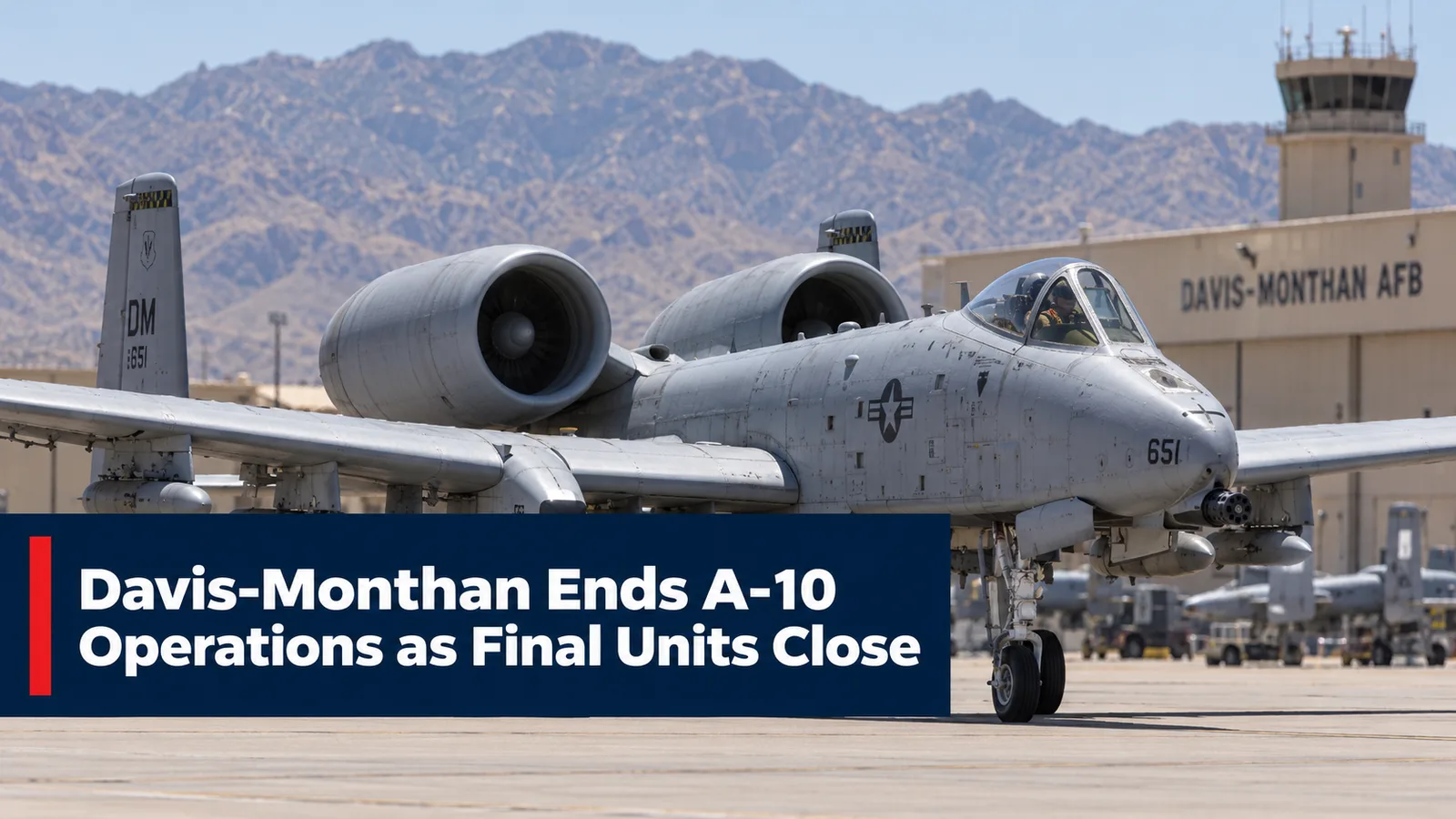
Davis-Monthan Air Force Base ended its A-10 operating mission on 18 September 2026 with the inactivation of four organisations tied to the Thunderbolt II. The ceremony closed the 355th Operations Group, 357th Fighter Squadron, 357th Fighter Generation Squadron and 355th Training Squadron, marking the official end of A-10 operations at the Arizona base.
Four unit inactivations close the Davis-Monthan A-10 chapter
The 355th Wing said the ceremony formally inactivated the organisations that had supported A-10 operations, training and maintenance at Davis-Monthan. The base has been closely associated with the aircraft for decades, and the 355th Operations Group provided A-10 capabilities for close air support, forward air control and combat search and rescue from 1992 to 2026.
The milestone is organisational as well as symbolic. Inactivating operational, training and generation units removes the local structure that sustained routine A-10 flying. It is more consequential than a commemorative final sortie because it changes the base’s force structure and personnel architecture as the Air Force shifts resources toward other missions.
The event is part of a wider drawdown, not the retirement of every A-10
Specialist reporting noted that Davis-Monthan’s last A-10 units closed after the wing’s final A-10 flight earlier in 2026. The Air Force has been reducing the fleet as part of a long-running recapitalisation plan, but the 18 September ceremony should not be described as the final retirement of the A-10 from U.S. service. Aircraft and units outside Davis-Monthan can remain active until their own divestment milestones occur.
That distinction is especially important because the A-10 has been the subject of repeated congressional debate over close-air-support capacity, fleet age and replacement plans. A base-level closure is a verified event; service-wide retirement depends on the status of the remaining inventory and subsequent budget and force-structure actions.
Force structure is shifting faster than one-for-one aircraft replacement
The A-10 drawdown takes place while the Air Force is also managing F-35A procurement, F-15EX fielding, legacy fighter retirements and future collaborative combat aircraft. A recent Congressional Research Service report highlighted broader fighter-inventory pressure, showing why each retirement decision is evaluated not only by platform age but by the capacity that replaces it.
The Air Force’s future close-support approach is not built around a single direct A-10 successor. Precision weapons, multi-role fighters, bombers, remotely piloted aircraft and increasingly autonomous systems can all contribute to joint fires, but they do not reproduce the A-10’s operating model in identical form. The operational question is therefore how the service preserves support to ground forces while restructuring the fleet.
Implications / Next
The next A-10 milestones will be the inactivation or conversion of remaining units, aircraft movements to storage or other organisations and the point at which the Air Force formally ends operational use of the type across the service. Those events should be tracked separately from Davis-Monthan’s closure.
For the base, the transition will be measured by what missions and units replace the A-10 enterprise and how quickly personnel and infrastructure are repurposed. For the wider Air Force, the Davis-Monthan ceremony is another concrete step in a fleet transition whose readiness effects will depend on the pace of new aircraft fielding and the availability of other joint-fire capabilities.
Davis-Monthan’s role also makes the milestone relevant to training and maintenance capacity, not only combat-coded aircraft numbers. When a platform leaves a major operating base, instructor pipelines, maintenance specialties, support equipment and local infrastructure must either be reassigned, retrained or retired. Those changes can continue after the last local A-10 sortie. The service-wide effect will therefore emerge over several budget cycles, as Congress and the Air Force balance legacy divestment against the delivery rates, readiness and training capacity of the fleets intended to carry future combat-air tasks.