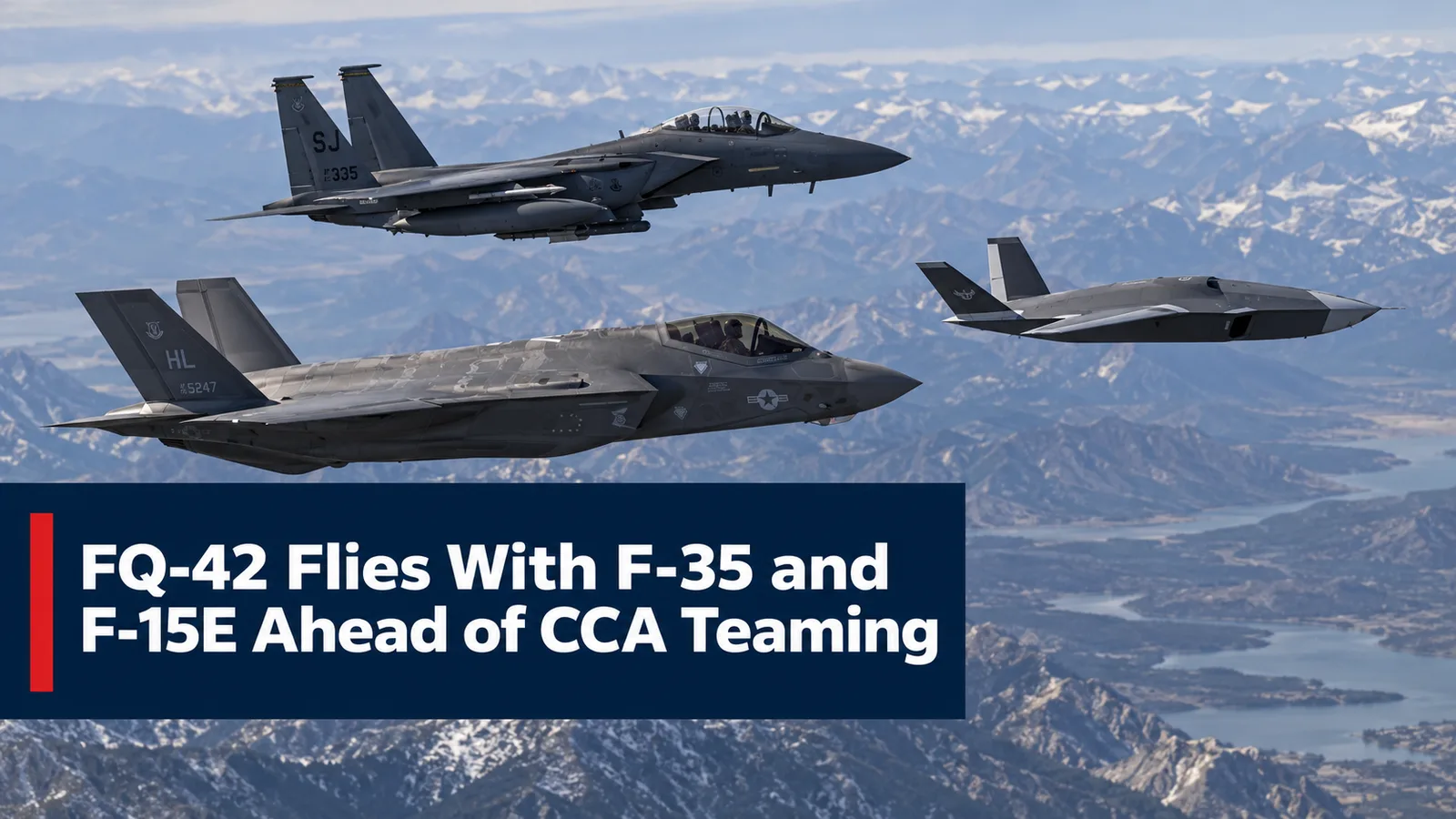
General Atomics Aeronautical Systems has disclosed that the FQ-42 Vengeance Collaborative Combat Aircraft flew in formation with an F-35A Lightning II and F-15E Strike Eagle in preparation for future collaborative-control operations. The company announced the milestone on 21 September 2026, three days after a new FQ-42 arrived at Creech Air Force Base, Nevada, to continue U.S. Air Force test and evaluation.
Formation flight prepares the next control experiments
General Atomics described the FQ-42 formation activity as preparation for collaborative control with crewed aircraft. That wording matters: the disclosed flight demonstrated proximity and formation operations, but the company did not state that the F-35 or F-15E controlled the FQ-42 during the pictured sortie. Defence Agenda therefore treats the event as a test-enabling milestone rather than a completed manned-unmanned teaming demonstration.
The company says its wider autonomous-jet portfolio has already been used for semi-autonomous and autonomous flights with artificial-intelligence pilots and for collaborative-control work involving human fighter pilots. Those earlier demonstrations, including work with the MQ-20 Avenger as a CCA surrogate, provide a path for the Air Force to test control concepts before applying them to the production-representative FQ-42 fleet.
Creech delivery expands the Air Force test environment
A new FQ-42 was delivered to Creech Air Force Base on 18 September for continued experimentation with Air Force test and evaluation units. Creech is closely associated with remotely piloted aircraft operations, but the CCA programme represents a different model: highly autonomous combat aircraft intended to cooperate with crewed fighters rather than depend on traditional remote piloting for every action.
General Atomics was selected in April 2024 to build production-representative CCA flight-test articles. The FQ-42 made its maiden flight in August 2025, and the company received an initial production contract in June 2026. Those milestones move the programme beyond a one-off technology demonstrator, but they do not by themselves establish operational fielding, combat readiness or final fleet size.
Industrial readiness is advancing in parallel with flight testing
General Atomics says it has completed a low-observable paint facility to support CCA production and is positioned to deliver six aircraft per month, with additional manufacturing space available if demand increases. The company also says some production activity is being funded at risk while government funding plans mature. These are industrial-readiness claims from the manufacturer and should be read separately from government procurement quantities or appropriations.
The industrial approach reflects the Air Force’s emphasis on compressing development and production timelines. For CCA, the challenge is to mature airframe production, autonomy software, mission systems and fighter integration on overlapping schedules without allowing early manufacturing momentum to obscure unresolved test risk. The arrival of additional aircraft at Creech gives the service more hardware with which to expose those integration issues.
Implications / Next
The most important next milestone is a clearly documented collaborative-control event in which a crewed aircraft or authorised control architecture commands FQ-42 mission behaviour under representative conditions. Subsequent testing will need to address communications resilience, autonomy boundaries, safety logic, sensor and weapon integration, and the workload imposed on fighter crews.
For now, the formation flight should be read as preparation for that phase. It shows that the FQ-42 is operating with frontline fighter types and that the test programme is broadening, but it does not yet demonstrate the complete operational teaming concept the CCA programme ultimately requires.
The programme will also have to show that collaborative control scales beyond carefully scripted sorties. A useful operational architecture must allow fighters to task uncrewed aircraft without overwhelming pilots, while preserving positive control, safety and mission effectiveness when links are degraded. Those are system-level questions that cannot be answered by formation geometry alone. The FQ-42’s growing test fleet gives the Air Force a way to accumulate the flight hours, software iterations and human-machine interface data needed before it can judge whether the aircraft is ready for more demanding operational evaluation.