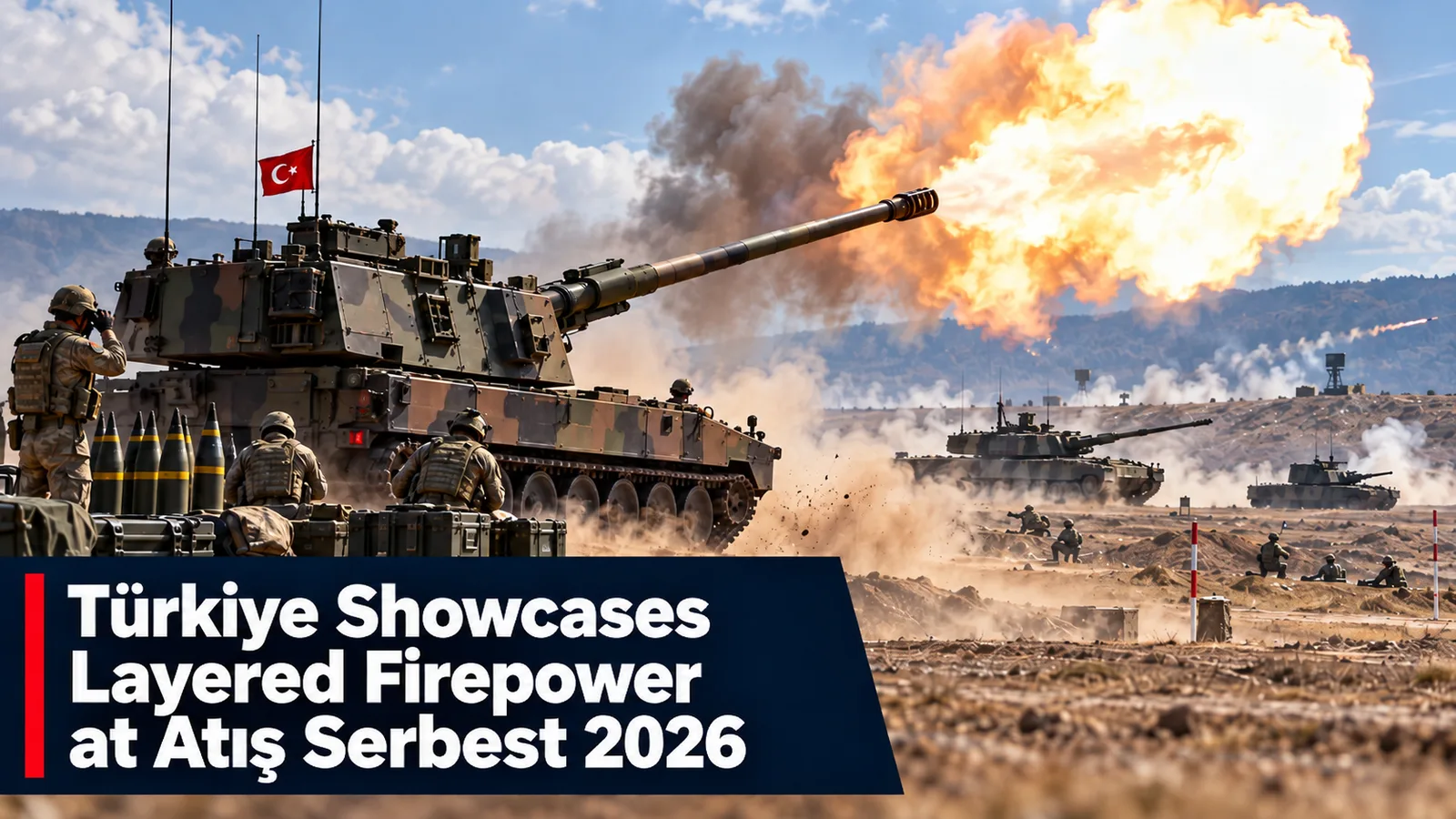
The Turkish Armed Forces are demonstrating a broad live-fire mix at Ateş Serbest 2026 in Polatlı, Ankara, using indigenous sniper rifles, BORAN and PANTER artillery, tanks and the PALEM unmanned ground vehicle ahead of the activity’s Distinguished Observer Day on 15 October. The Ministry of National Defence says the event is intended to show the effects of weapons in the inventory while highlighting autonomous systems, artificial intelligence, electronic warfare and cyber capabilities.
The activity began on 1 September 2026 at the General Nahit Şenoğul Firing and Exercise Area and is scheduled to conclude on 22 October. Elements from the Land Forces, Naval Forces, Air Force and Special Forces Command are participating, making the event a cross-service firepower demonstration rather than a single-branch exercise.
Sniper Teams Opened the Live-Fire Sequence
Anadolu Agency reported that sniper teams engaged small glass targets at 600 metres and 1 kilometre using a mixture of Turkish and imported rifles. Indigenous systems included the 7.62 mm KNT-76 and BORA-12, the 8.59 mm KN-12 and the 12.7 mm KSR-50.
The sequence illustrates one of the core purposes of Ateş Serbest: showing the effect of weapons already in service or being fielded across different engagement distances. The sniper demonstration is therefore best read as an inventory and proficiency display rather than as a new qualification event for the rifles themselves.
BORAN and PANTER Demonstrate Mobile Artillery Firepower
After the sniper engagements, BORAN and PANTER artillery systems fired on designated targets under a time-on-target concept. Anadolu Agency describes the 155 mm PANTER as capable of effective fire to 40 km with a five-person crew and says the system can change position within roughly two minutes.
The 105 mm air-transportable BORAN, which entered inventory from 2022, is described as capable of 360-degree fire, emplacement in about one minute and a firing rate of 6–8 rounds per minute. Its integrated sighting and positioning systems are intended to support both conventional artillery missions and direct-fire or local-security tasks in reduced-visibility conditions.
PALEM Brings an Unmanned Ground Layer Into the Demonstration
The activity also included a casualty-evacuation scenario using the domestically developed PALEM unmanned ground vehicle. According to Anadolu Agency, a tank first generated a smoke screen before PALEM moved to recover the simulated casualty and transport the person to a safer location.
PALEM is described with a three-tonne combat weight, one-tonne payload capacity, electric drive and modular mission architecture. The vehicle can also be configured with ASELSAN’s SARP DUAL remote weapon station and a ROKETSAN KARAOK turret infrastructure, although the presence of those options in a brochure or demonstration should not be interpreted as confirmation that every PALEM configuration carries them.
The Exercise Is Becoming a Showcase for Autonomy and New Battlefield Technologies
The Ministry of National Defence’s official announcement says Ateş Serbest 2026 is intended not only to present inventory weapons and demonstrate their effects, but also to highlight “Uçangöz/GözüKara”, autonomous systems, artificial intelligence, electronic warfare and cyber capabilities. That framing broadens the activity beyond conventional gunnery.
For the Turkish Armed Forces, the operational question is increasingly how these technologies connect with existing artillery, armour, reconnaissance and command structures. Ateş Serbest provides a controlled environment to demonstrate that integration in front of military observers while giving domestic defence companies a visible route from product development to field use.
15 October Will Be the Main Public Capability-Signalling Event
MSB has scheduled the Distinguished Observer Day for 15 October 2026. The ministry’s stated objectives include presenting weapons and systems in the inventory, demonstrating their target effects and showing how contemporary battlefield realities are shaping Turkish capabilities.
The most useful indicators from the observer day will be which newer systems are shown in live use, whether additional autonomous or electronic-warfare scenarios are demonstrated, and whether officials announce new inventory, integration or procurement milestones. Until then, the 9 October media activity provides a preview rather than the final capability picture for Ateş Serbest 2026.
What the Demonstration Does — and Does Not — Prove
Successful live firing in an organised exercise confirms that systems can be used together under the demonstrated conditions, but it does not automatically establish combat effectiveness across every threat environment. Nor does a demonstration prove that every displayed configuration has completed qualification or entered full-rate service.
That distinction matters particularly for newer unmanned, autonomy and multi-mission configurations. Defence Agenda therefore treats Ateş Serbest primarily as a force-integration and capability-signalling event, with system-specific maturity assessed separately against procurement, acceptance and operational evidence.