MKE 155 mm ammunition capacity is set for a major expansion as Türkiye’s state-owned defence manufacturer advances a $1.5 billion investment programme covering new machinery, automated production infrastructure, energetic materials and higher-volume ammunition manufacturing.
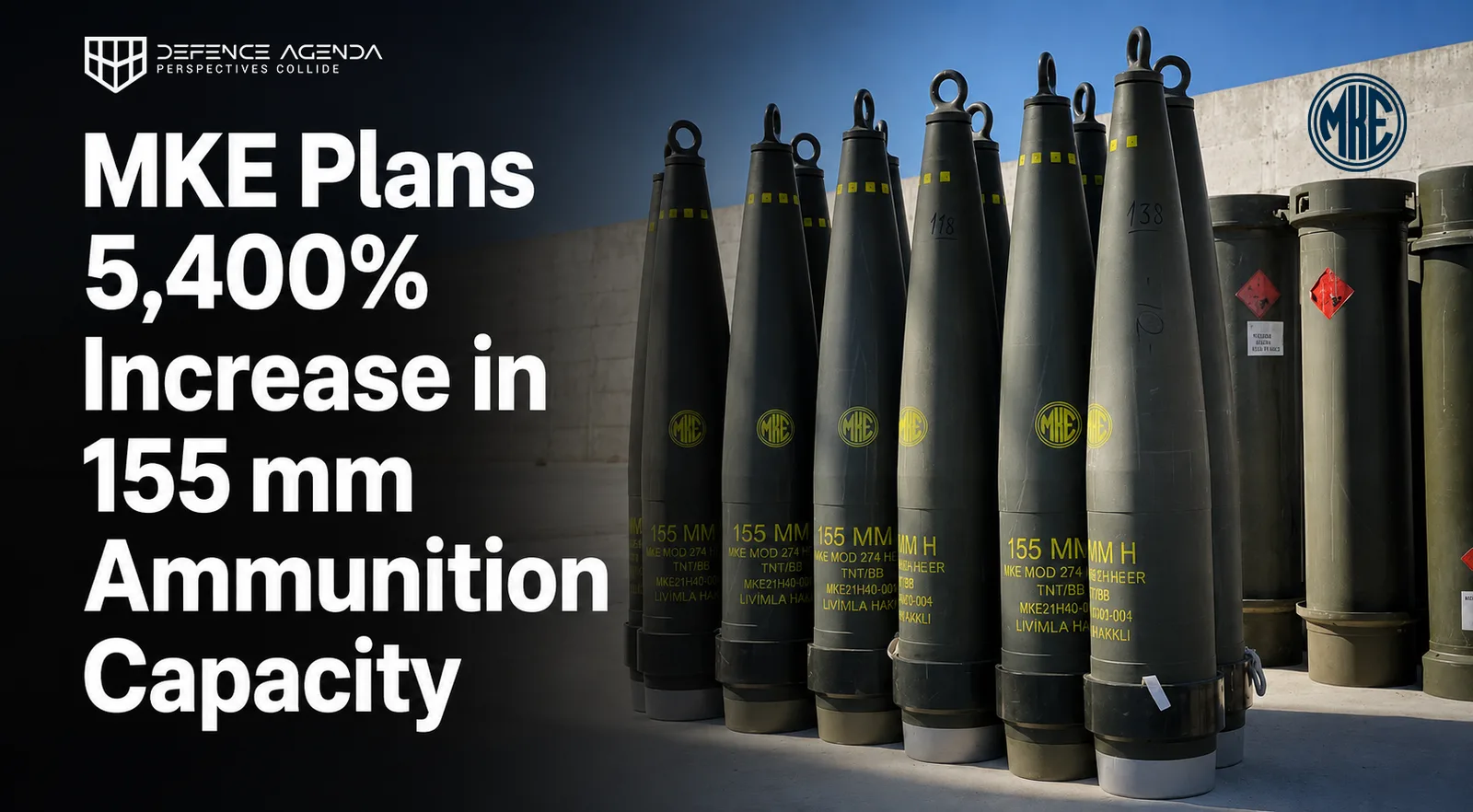
In an interview published by Haber7 on 18 April 2026, MKE General Manager İlhami Keleş said the company was implementing a 5,400% capacity increase in 155 mm ammunition as part of a broader industrial transformation driven by Turkish Armed Forces requirements and rising international demand.
The scale of the programme is strategically important because 155 mm artillery ammunition remains one of the most heavily demanded conventional munitions across NATO and partner militaries. For Türkiye, expanding capacity is therefore not only an export opportunity but also an industrial-readiness requirement built around domestic control of ammunition, propellant, weapon and material supply chains.
Key Facts
- Total investment programme: MKE says approximately $1.5 billion in industrial investment is under way.
- 2026 investment: Keleş identified approximately $818 million of investment for 2026.
- 155 mm ammunition: MKE is targeting a 5,400% increase in production capacity.
- Factory network: MKE operates 10 factories across eight locations, according to the April 2026 interview.
- Modernisation: Keleş said 351 new machine tools were being acquired alongside automation infrastructure.
- Industrial integration: MKE produces artillery ammunition, propellants, weapon systems and specialised defence-grade materials within its wider industrial network.
- Near-term milestone: A large part of the current ammunition and raw-material investment programme is intended to be completed during the final quarter of 2026, with a limited portion extending into 2027.
MKE 155 mm Ammunition Capacity Becomes a Strategic Priority
The centrepiece of MKE’s current industrial expansion is the sharp increase planned for large-calibre ammunition production.
Keleş identified 155 mm artillery ammunition as one of the areas experiencing particularly strong demand and said MKE was implementing a 5,400% increase in capacity.
The company has not publicly provided the baseline annual 155 mm production figure associated with that percentage in the sources reviewed by Defence Agenda. For that reason, the percentage should not be converted into an assumed annual round count without additional official production data.
The direction, however, is clear: MKE is preparing for an industrial environment in which artillery ammunition is required in substantially larger quantities than the production model that characterised much of the post-Cold War period.
$1.5 Billion Investment Programme Reshapes MKE
The ammunition expansion forms part of a broader $1.5 billion industrial investment programme.
Keleş said approximately $818 million of that programme falls within 2026, covering factory modernisation, new production infrastructure and serial-production capacity for systems entering MKE’s portfolio.
He also said MKE was acquiring 351 machine tools while installing supporting automation infrastructure.
MKE’s own corporate data provides additional evidence of the scale of this modernisation. In its 2026 outlook, the company said it had implemented an investment plan covering 384 new machines, production lines and facilities during 2025.
The investment therefore represents more than a temporary increase in overtime or utilisation of existing factories. MKE is changing the physical production base on which future output will depend.
Why 155 mm Ammunition Matters
155 mm artillery remains a central NATO-standard land-warfare calibre and is used across a broad range of self-propelled and towed artillery systems.
Türkiye operates several systems in this calibre, including the Fırtına self-propelled howitzer and Panter family, while MKE also produces 155 mm weapon systems, ammunition and modular propellant solutions.
MKE’s official product portfolio includes several 155 mm artillery ammunition configurations, while its propellant infrastructure supports both domestic artillery requirements and the wider ammunition production chain.
The importance of capacity has increased as sustained high-intensity warfare has demonstrated that artillery forces can consume ammunition much faster than traditional peacetime procurement systems replace it.
Türkiye Is Building an Integrated Ammunition Supply Chain
MKE’s competitive position is based partly on the breadth of its production chain.
The company operates dedicated ammunition, powder, explosives, steel, brass and heavy-weapons facilities. This allows several critical stages of conventional weapon and ammunition production to remain inside the same industrial group.
Its Powder Factory, for example, produces propellants for small- and large-calibre ammunition as well as 120 mm and 155 mm combustible cases and related components.
MKE’s ammunition factory meanwhile covers a wide portfolio ranging from air-defence and mortar ammunition to tank, artillery, aerial, naval and UAV munitions.
This vertical depth does not eliminate all supply-chain risk. Specialised machinery, chemicals, electronics and upstream industrial inputs can still create bottlenecks. However, domestic control of several major production stages can reduce exposure to external disruptions.
Energetic Materials Are Central to the Expansion
Increasing shell-body output alone is not enough to expand artillery ammunition production.
Propellants, energetic materials and filling capacity must grow alongside machining and final assembly. This makes upstream chemical capacity one of the most strategically important parts of the MKE investment programme.
MKE is constructing the Hüseyin Kahya Energetic Materials Factory in Kırıkkale as part of this strategy.
During a 2026 visit by Presidency of Defence Industries Secretary Haluk Görgün, MKE said the facility was planned to enter operation during 2026 and was intended to strengthen Türkiye’s independence in strategic explosive materials.
The facility adds an important upstream layer to the ammunition expansion because high-volume output is only sustainable if energetic-material production grows at a compatible rate.
MKE Is Modernising More Than Ammunition Lines
Keleş framed the investment programme as a transformation of MKE rather than a single-calibre capacity project.
The company continues to manufacture conventional weapons and ammunition while simultaneously integrating newer technologies into its portfolio and building the serial-production infrastructure required for them.
That transition is visible in programmes ranging from new artillery systems to counter-UAS technologies.
Defence Agenda previously examined the MKE TOLGA short-range air-defence system, which reflects the company’s attempt to move beyond its traditional role as an ammunition and gun manufacturer toward integrated defence systems.
The industrial challenge is therefore twofold: MKE must increase output of established high-demand products while creating factories and supply chains for newer systems at the same time.
2025 Deliveries Show the Existing Production Base
MKE entered the expansion phase with an already significant production portfolio.
According to MKE’s official 2026 outlook, the company delivered more than 95 million rounds of small-arms ammunition during 2025.
It also reported deliveries of more than 990,000 rockets, explosives and heavy-weapon munitions, over 2,950 aerial bombs, more than 17,000 small arms and over 450 heavy weapons and weapon systems.
MKE reported approximately $1.2 billion in revenue and said it had risen four places to 80th in the 2025 Defense News Top 100 ranking.
The new capacity programme therefore aims to scale an existing industrial base rather than establish large-calibre ammunition production from the beginning.
Export Demand Is Reinforcing Domestic Capacity Investment
Keleş linked the expansion to both Turkish Armed Forces requirements and international demand.
Türkiye’s own military requirements remain the company’s stated priority, but international ammunition shortages have created opportunities for producers able to offer NATO-compatible calibres and associated production technology.
Defence Agenda has tracked this trend through Türkiye–Poland cooperation on 120 mm and 155 mm ammunition production, part of a broader effort by European states to strengthen sovereign munitions capacity.
This is strategically different from conventional exports of finished ammunition. Technology partnerships and overseas production facilities can position Turkish companies inside allied industrial bases while spreading production geographically.
Global Artillery Demand Has Changed the Economics of Capacity
For decades, ammunition plants faced a recurring investment problem: governments wanted surge capacity during crises but often procured at much lower rates during peacetime.
That made large investments in additional factories difficult to justify commercially.
The current security environment is changing that calculation. NATO members are rebuilding inventories, increasing readiness targets and placing greater emphasis on the ability to sustain high-intensity operations.
Higher and more predictable demand allows manufacturers to justify new equipment, automation and upstream material capacity that would have appeared excessive under earlier procurement assumptions.
Capacity Is Not the Same as Output
One important distinction is that installed capacity does not automatically translate into equivalent delivered ammunition.
Factories require qualified workers, raw materials, energetic inputs, testing capacity and confirmed orders to sustain high utilisation.
A 5,400% increase in nominal capacity therefore represents an industrial ceiling rather than a guarantee that production will immediately operate continuously at that level.
The more useful metrics after the investment programme is completed will be actual annual output, customer delivery volumes, utilisation rates and the availability of upstream materials.
Automation Could Become a Major Productivity Driver
MKE’s acquisition of hundreds of new machine tools also points toward greater automation.
Modern production equipment can support tighter process control, repeatability and higher throughput while reducing dependence on some labour-intensive manufacturing stages.
For defence procurement agencies, consistency is as important as speed. Large ammunition orders still require each production lot to meet safety, reliability and performance standards.
The industrial objective is therefore not simply to manufacture more units but to increase production while preserving qualification and quality-control requirements.
The Main Opportunity Is Sovereign Surge Capacity
The strategic benefit for Türkiye is the ability to increase ammunition output during periods of elevated demand without relying primarily on foreign factories.
A vertically integrated industrial base covering steel, weapon systems, ammunition and energetic materials can provide greater control over production priorities during a crisis.
It can also support export commitments without making domestic military readiness entirely dependent on external suppliers.
Defence Agenda’s earlier assessment of MKE deliveries to the Turkish defence ecosystem demonstrated how the company already links artillery, armour, naval defence and ammunition supply chains.
The current investment programme is designed to widen that industrial margin substantially.
The Main Risk Is Synchronising the Entire Supply Chain
The largest execution risk is that different parts of the ammunition chain expand at different speeds.
Increasing machining capacity offers limited benefit if energetic materials, propellant, packaging, testing or another critical industrial input becomes the new bottleneck.
The same applies to workforce and qualification. New equipment must be commissioned, integrated into approved production processes and operated by qualified personnel.
MKE’s strategy of investing simultaneously in machinery, automation, ammunition and upstream energetic-material capacity appears designed to address that system-level challenge.
Implications / Next
The first milestone to watch is the final quarter of 2026, when MKE expects a major portion of the current ammunition and raw-material investment programme to be completed.
The second will be commissioning of the Hüseyin Kahya Energetic Materials Factory and the extent to which the facility reduces Türkiye’s dependence on imported strategic energetic inputs.
The third will be production data. Absolute annual 155 mm output figures would provide a clearer measure of how the announced 5,400% capacity increase translates into delivered ammunition.
Export contracts and overseas production partnerships will be another indicator. Strong international demand could allow MKE to maintain higher utilisation rates after the new capacity enters service.
Finally, the wider test will be whether the investment creates a sustainable industrial structure rather than temporary crisis-driven overcapacity.
Conclusion
MKE’s planned 5,400% increase in 155 mm ammunition capacity is one of the clearest indicators of how Türkiye is responding to the renewed strategic importance of ammunition production.
The programme combines a $1.5 billion investment cycle, hundreds of new machines, automation, large-calibre ammunition expansion and new energetic-material infrastructure.
The approach is significant because artillery production is a system rather than a single factory line. Shell bodies, propellants, energetic materials, weapon compatibility, testing and qualified labour all have to expand together.
If MKE completes the major projects planned for late 2026 and translates installed capacity into sustained output, Türkiye could enter 2027 with materially greater sovereign ammunition surge capability and a stronger position in the international 155 mm market.
The next question is therefore no longer whether MKE intends to expand. It is how quickly the new industrial infrastructure can move from investment and commissioning into repeatable, high-volume deliveries.
For further Defence Agenda coverage, read our defence industry, defence procurement and land warfare sections. Related coverage includes MKE’s production-to-delivery cycle, Türkiye–Poland ammunition production cooperation and the MKE TOLGA short-range air-defence system.
Further Reading
- Haber7: MKE outlines major production-capacity expansion
- MKE: 2026 outlook and 2025 production data
- MKE: Production investments and Hüseyin Kahya Energetic Materials Factory
- MKE: Ammunition Factory capabilities
- Defence Agenda: MKE Accelerates Deliveries
- Defence Agenda: Poland and Türkiye Advance Ammunition Production Cooperation
- Defence Agenda: MKE TOLGA Short-Range Air Defence System