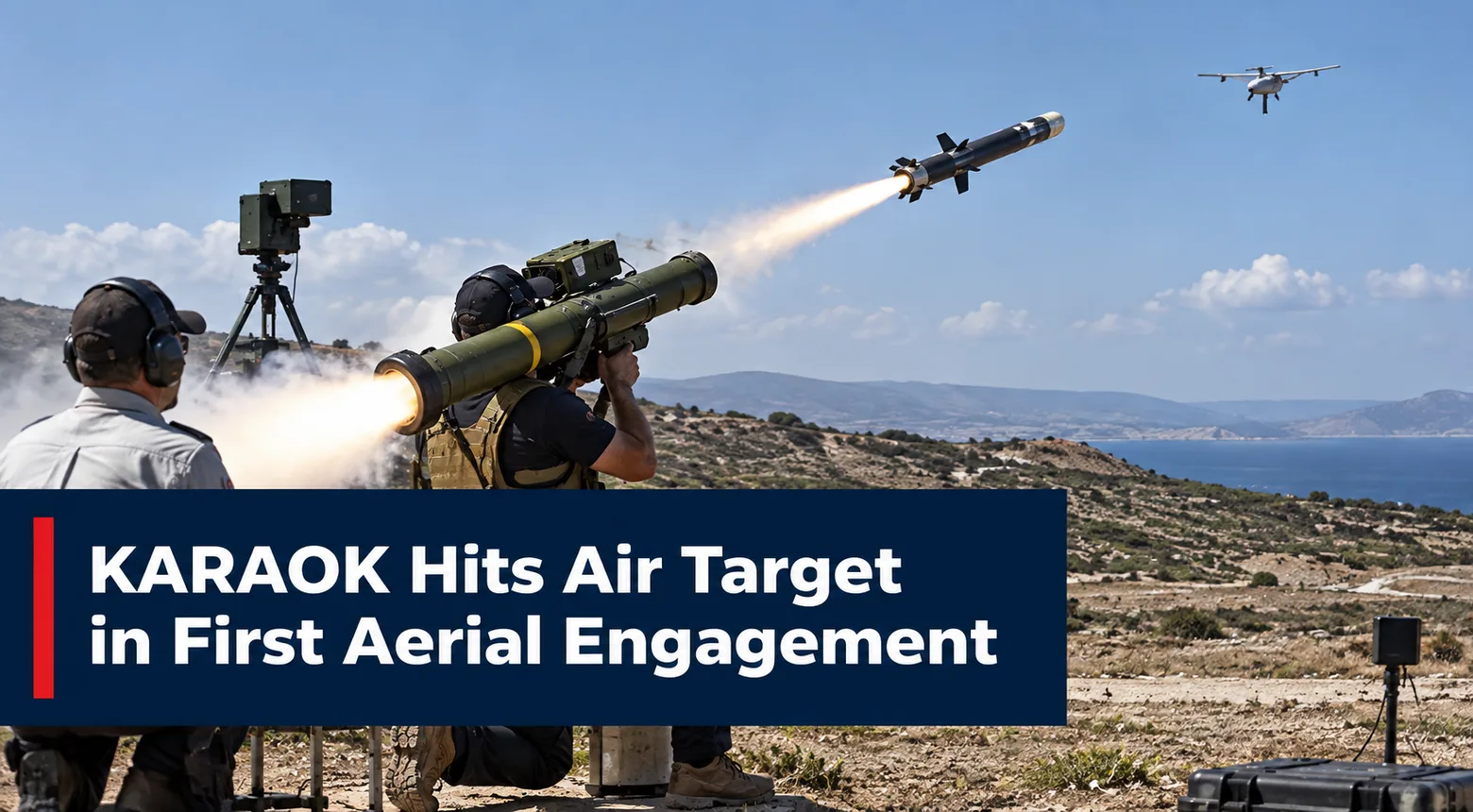
ROKETSAN announced on 23 September 2026 that its KARAOK Short-Range Anti-Tank Weapon System successfully hit an aerial target for the first time. The firing expands the missile’s demonstrated target set beyond its original anti-armour role, but the company has not disclosed the target type, engagement geometry or whether the event formed part of a formal air-defence qualification campaign.
ROKETSAN describes the event as an expansion of KARAOK’s role
ROKETSAN said the successful aerial engagement extended KARAOK’s effectiveness from ground targets to air targets and strengthened the system’s ability to address different threats. General Manager Murat İkinci similarly described the firing as an expansion of the weapon’s operational scope as the company adds capabilities in response to changing battlefield requirements.
The public announcement is important for what it does not disclose. No target class, speed, altitude, range, manoeuvre profile or launch-cueing method has been published. There is also no statement that KARAOK has completed qualification for a counter-UAS or short-range air-defence mission. The September firing should therefore be described as a successful test milestone rather than as fielding of a new operational air-defence layer.
KARAOK remains, by design, a short-range anti-tank missile
ROKETSAN’s current product data describes KARAOK as a man-portable, fire-and-forget anti-tank guided missile with a 2.5 km published range and a 125 mm diameter. The missile uses an imaging-infrared seeker for day and night operation, carries a tandem armour-piercing warhead and supports direct-attack and top-attack modes. The manufacturer lists fixed and moving ground targets, including armoured vehicles and fortifications, as its conventional target set.
Those characteristics help explain why an aerial engagement is technically significant. An imaging seeker and autonomous terminal guidance provide a basis for following a moving target after launch, but airborne targets impose different closing speeds, aspect changes and engagement timelines from tanks or other ground vehicles. A successful hit under one set of conditions cannot establish the full aerial engagement envelope.
The missile already had field-exercise exposure in its original role
KARAOK was not a laboratory-only article before the aerial test. ROKETSAN stated that the weapon was used during EFES-2026, where Turkish Armed Forces units and elements employed company systems in exercise scenarios with participants and observers from dozens of countries. That earlier use is relevant to maturity in the missile’s anti-armour role.
It does not, however, transfer automatically to the new mission. Counter-UAS or low-altitude air defence may require different target detection, cueing, identification and rules of engagement. The launcher also needs a practical way to acquire and hand off rapidly moving airborne targets if the capability is to move beyond a controlled demonstration.
A multi-role effector could add flexibility at the tactical edge
The battlefield demand behind the test is clear. Small drones are forcing land units to look for additional short-range effectors, while dedicated air-defence missiles can be scarce or comparatively expensive. If an existing weapon can engage selected airborne targets without major hardware changes, it could give units an additional option when the threat and engagement conditions are suitable.
That possibility should not be overstated. KARAOK’s primary design remains anti-armour, and ROKETSAN has not published a dedicated air-target range or claimed that the system replaces SUNGUR, BURÇ or other purpose-built air-defence solutions. The more defensible conclusion is that the company has demonstrated a new use case that may broaden tactical flexibility if follow-on testing confirms repeatability.
Implications / Next
The next milestones to watch are repeated firings against representative target classes, disclosure of the sensor or cueing chain, trials under electronic-warfare conditions and any formal qualification statement. Tests against different speeds, altitudes and approach aspects would be particularly useful because they would define whether the capability is limited to specific drone profiles or can address a wider set of airborne threats.
Until those steps occur, KARAOK should be reported as a short-range anti-tank missile that has successfully completed its first publicly announced aerial-target engagement. The firing is a meaningful capability-development milestone, but it is not yet evidence of serial procurement or operational fielding in a dedicated counter-air role.