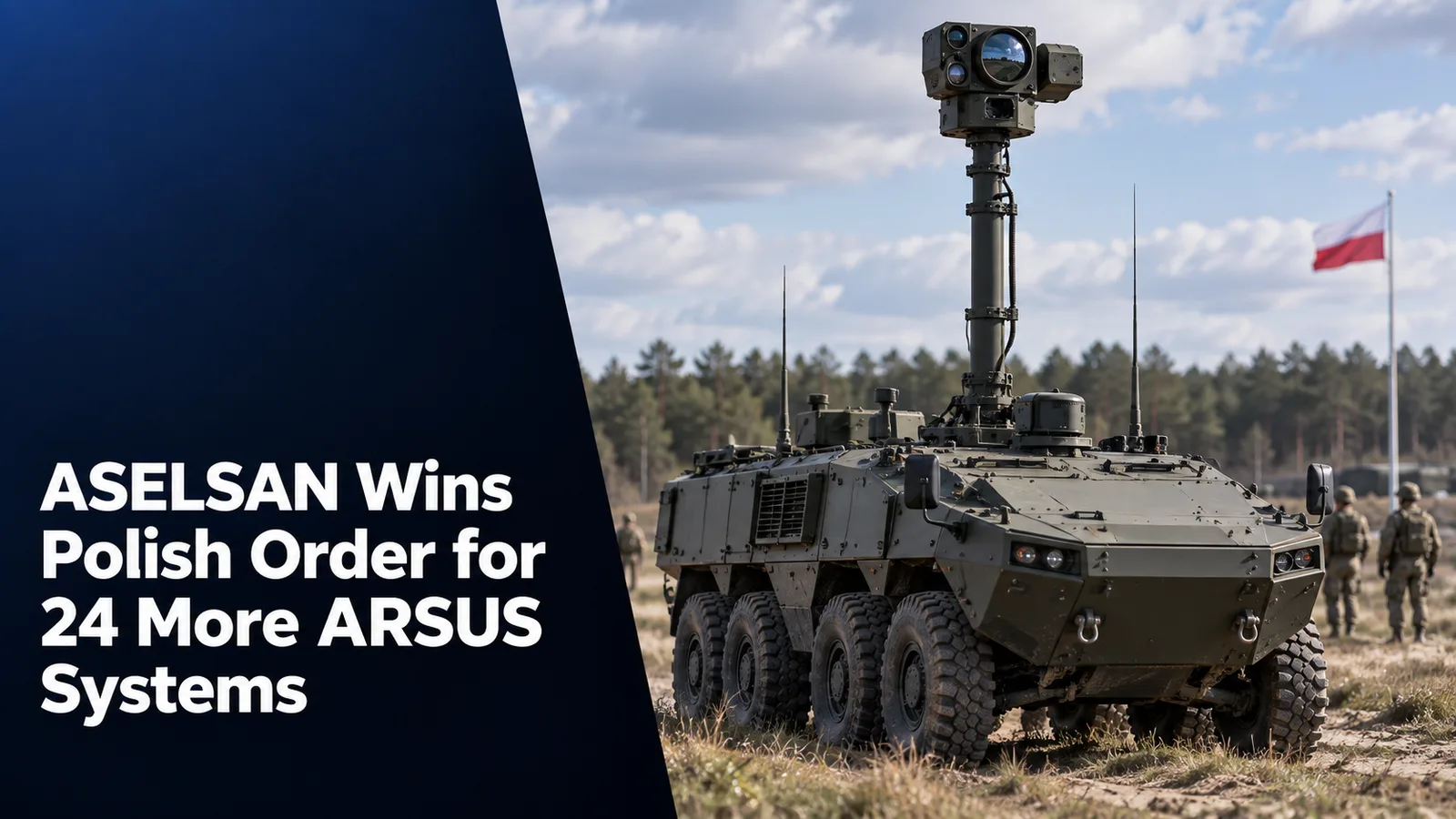
ASELSAN and Polish vehicle manufacturer AMZ Kutno signed a new export contract at MSPO 2026 for 24 additional ARSUS reconnaissance and surveillance system sets for the Polish Armed Forces. EDR Magazine reports that deliveries are planned between 2028 and 2029. The new order builds on a framework agreement signed in 2024, under which further deliveries are planned over a longer period extending through 2035.
ASELSAN and AMZ Kutno Expand an Existing Polish Programme
The distinction between the 24-set order and the framework is important. The new agreement confirms an additional defined quantity, while the earlier framework establishes the wider cooperation structure and potential delivery pipeline. Public sources reviewed for this package do not disclose the value of the new contract, so no unit-cost estimate should be derived from the quantity alone.
ARSUS Gives Reconnaissance Vehicles an Elevated Sensor Layer
ARSUS is designed for reconnaissance, surveillance and target-detection missions using a vehicle-mounted sensor architecture. Reporting on the Polish integration identifies the system with AMZ Kutno's LOTR Kleszcz 4x4 reconnaissance vehicle, derived from the Bóbr-3 platform. An elevating mast allows sensors to operate above surrounding terrain and vegetation, improving line of sight while the vehicle remains in a more concealed position.
That type of sensor mast can be operationally valuable because a reconnaissance crew does not always need to expose the full vehicle to observe a sector. Day/night observation and target-location functions can support artillery, manoeuvre units and wider command networks. The military effect, however, depends on data quality, communications, sensor fusion and the ability to pass observations quickly to users who can act on them.
The Deal Deepens Türkiye-Poland Defence-Industrial Links
ASELSAN has been expanding its presence in Poland through a local office, programme activity and partnerships with Polish companies. The ARSUS order is a concrete example of that strategy because the Turkish sensor system is integrated into a locally produced reconnaissance platform rather than sold as an isolated stand-alone product. That structure gives the Polish side vehicle-level ownership while retaining ASELSAN technology in the mission package.
For Türkiye, the programme provides an export reference inside a NATO member with a rapidly expanding defence budget and strong localisation requirements. For Poland, the arrangement diversifies sensor suppliers while keeping vehicle production and integration in the domestic industrial base. The long delivery horizon through the framework agreement also creates a sustainment relationship that may matter more than a single exhibition announcement.
Deliveries and Fleet Integration Are the Next Test
The immediate milestone is production and delivery of the 24 additional sets in 2028–2029. Acceptance on LOTR Kleszcz vehicles will provide a better measure of programme execution than the contract signature itself. Public sources do not yet specify whether every set will be identical or whether software and sensor configurations will evolve during the delivery period.
Future reporting should also distinguish this contract from other ASELSAN activities at MSPO 2026. The company is presenting a broad portfolio in Poland, but the ARSUS action is a specific export order tied to AMZ Kutno and the Polish Armed Forces. Its significance lies in repeat business, local platform integration and a defined additional quantity rather than in a new standalone Polish surveillance programme.
Implications / Next
The next publication-grade milestone will be the first independently verifiable event that changes the programme status described above, such as a delivery, acceptance event, production start, exercised option, operational test or formal fielding decision. Defence Agenda will continue to separate these maturity stages and will not treat an announcement, contract or first test as proof that the full capability has already entered operational service.