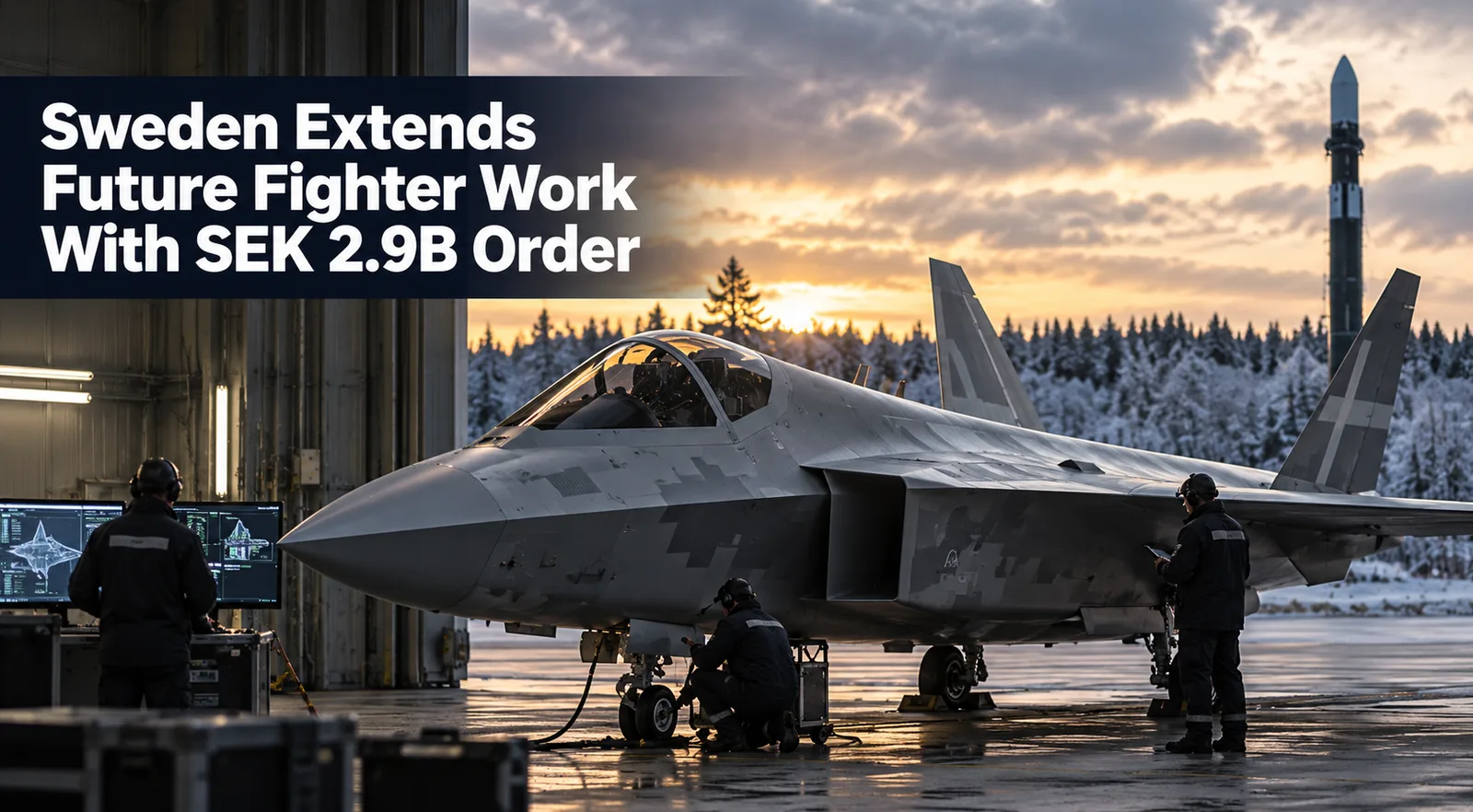
Saab has received an order worth approximately SEK 2.9 billion from the Swedish Defence Materiel Administration, FMV, for continued concept work on Sweden’s future fighter system. The contract covers 2026–2028 and includes options for 2029 and 2030. Saab says the work will further develop and demonstrate technologies through flying and ground-based demonstrators, advanced studies and future system concepts for both crewed and uncrewed combat-air systems.
The New FMV Order Extends Sweden’s Technology-Demonstrator Path
The award is not a production contract for a selected sixth-generation fighter. It funds risk-reduction activity that allows Sweden to test technologies, architectures and industrial approaches before committing to a final future combat-air configuration. That distinction is central because Sweden is deliberately preserving freedom of action while evaluating how Gripen, autonomous aircraft, sensors and future crewed platforms could fit into a system-of-systems architecture.
Autonomy, Signature and Propulsion Are Now Explicit Workstreams
Saab identifies systems integration, autonomy, signature adaptation, propulsion, digital development and future production capability among the areas strengthened by the programme. These are precisely the technology domains that tend to drive cost and schedule risk in next-generation combat-air programmes. Demonstrator activity can expose integration problems before they become embedded in a much larger development contract.
Sweden’s approach also gives industry a way to mature uncrewed combat-air technologies without declaring that any current concept will become an operational product. Saab’s A3-001 concept illustrates one possible high-end collaborative aircraft direction, but Saab has described it as a company concept rather than an approved Swedish procurement programme. The FMV contract therefore supports a broader technology base than any single public model.
The Programme Preserves Strategic Choice Between National and Multinational Paths
Sweden has a long record of maintaining sovereign combat-air design and integration competence through the Gripen family. The future-fighter studies are partly about preserving that national ability while Europe and other allies pursue programmes such as FCAS and GCAP. A credible domestic technology base gives Stockholm more leverage whether it eventually chooses a largely national solution, a partnership or a hybrid approach built around selected foreign subsystems.
That strategic flexibility has industrial consequences. Advanced aerostructures, flight control, mission systems, autonomy, electronic warfare and propulsion integration all require specialised engineers whose skills can erode if there is a long gap between programmes. Continued demonstrator work keeps those teams active and creates a bridge between Gripen E/F development and whatever combat-air architecture Sweden selects for the 2040s.
Demonstrator Results, Not Concept Art, Will Determine Programme Direction
The most important near-term outputs will be flying demonstrators, ground rigs, software maturation and evidence that technologies can be integrated under realistic constraints. Low-observable shaping, autonomy and propulsion concepts can look convincing in presentations but must eventually demonstrate stability, maintainability, cost control and mission-system interoperability. The 2026–2028 contract provides a funded window in which Sweden can turn those questions into test data.
The next publication-grade milestones are therefore demonstrator configuration disclosures, first-flight events, option exercise for 2029–2030 and any government decision narrowing the future-fighter architecture. Until then, the order should be treated as a technology-development and concept-demonstration contract rather than evidence that Sweden has selected or ordered a new operational fighter.
A further programme-management issue is the relationship between the announced milestone and the supporting infrastructure needed to turn it into repeatable capability. Training, maintenance, software configuration, supply-chain availability and acceptance standards can all become schedule drivers after the public announcement. For that reason, Defence Agenda will track follow-on evidence from the customer, supplier and relevant government authority rather than treating the initial milestone as the end of the acquisition cycle.
Implications / Next
The next Defence Agenda update should be tied to a dated, independently verifiable event that changes programme maturity: a delivery, exercised option, completed test, production milestone, operational acceptance or new contract action. Until that occurs, the current announcement should remain the baseline and should not be extrapolated into undisclosed quantities, performance or fielding status.