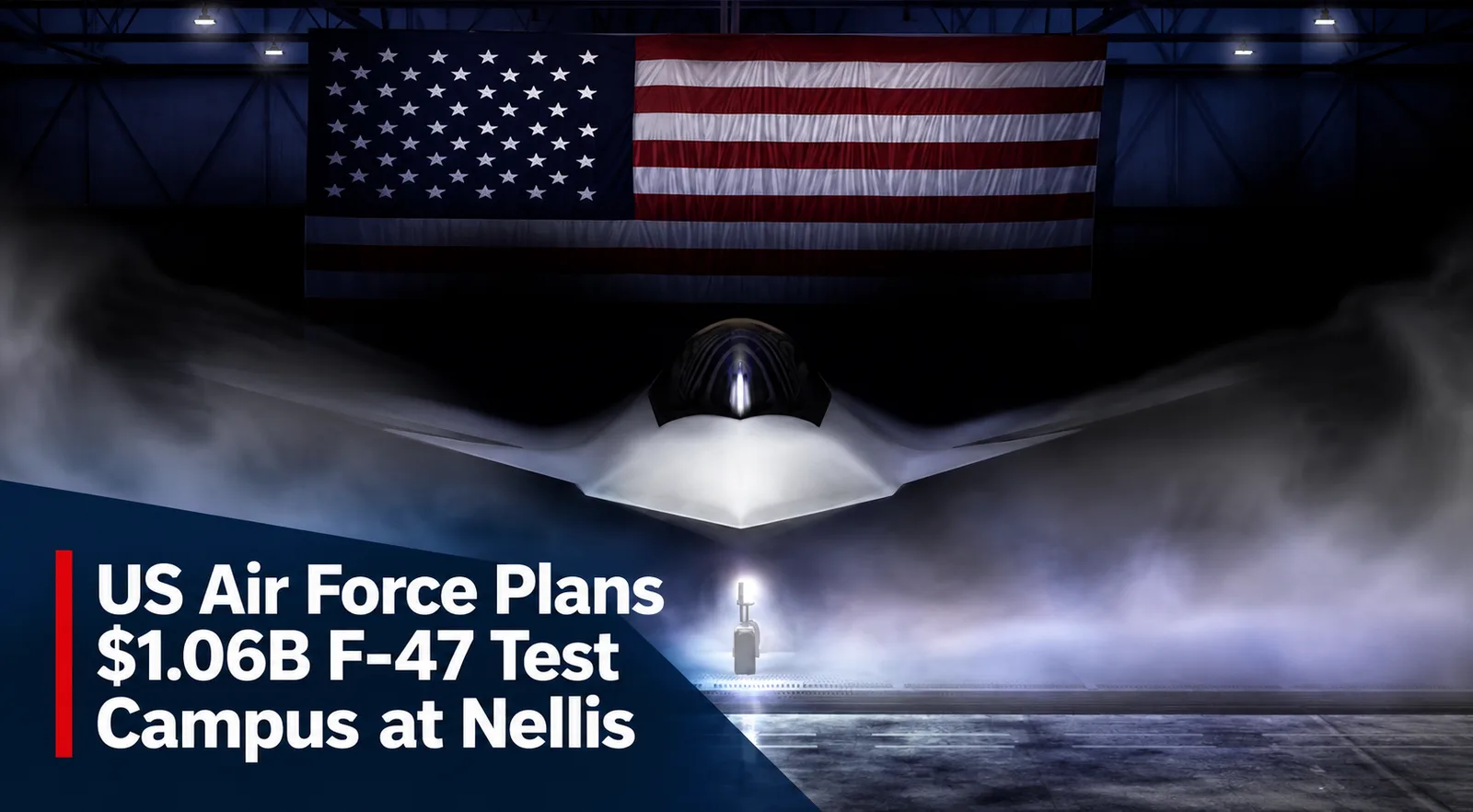
A draft solicitation and FY2027 budget material outline an approximately $1.057 billion F-47 operational-test campus at Nellis Air Force Base. The proposed facilities would support the next-generation fighter, but the plans do not constitute completed construction or an operational F-47 deployment. The Air Force is planning flight-test infrastructure before the fighter reaches service, showing how maintenance, low-observable repair and range access constrain the timetable for a sixth-generation capability.
A campus for operational testing, not a fighter delivery
The proposed F-47 operational-test campus at Nellis would combine specialised maintenance areas, hangars, laboratories, mission-training facilities and the utilities needed to keep a highly classified fighter programme in test. The FY2027 project data identify approximately $1.0572 billion in authorisation and $730.7 million in appropriations requested for the initial programme. Those budget figures represent a request and planned construction scope, not a statement that the Air Force has spent the full amount or awarded a single contract of that size. The Nevada location also provides proximity to a large instrumented test and training environment, which is essential for assessing an aircraft within realistic combinations of air, ground and electromagnetic threats.
Why the infrastructure must be ready before the aircraft
Flight testing a sixth-generation fighter requires much more than a runway and a conventional shelter. Low-observable treatments need dedicated processes, configuration-sensitive equipment requires controlled maintenance and software loads, and classified mission systems need secure data spaces. Simulators and training facilities have to mature alongside the aircraft so test crews, maintainers and analysts can work through failures without confusing ground-system readiness with airframe performance. Nellis is associated with complex combat-aircraft test and tactics development, but the existence of that test ecosystem does not establish an F-47 first-flight date or demonstrate production readiness. Construction phasing will have to align with the evolving aircraft design and government certification requirements.
Procurement and delivery-risk implications
The financial figures should be read in stages. Authorisation sets a legislative ceiling or permission for specified construction, appropriations provide budget authority, competitive solicitations seek a delivery mechanism, and executed construction contracts establish obligations. Collapsing those stages into a claimed $1 billion award would overstate the procurement position. The construction market also imposes its own risks: high-security facilities, specialised mechanical systems, electrical resilience and long-lead equipment can affect the campus schedule independently of Boeing’s aircraft engineering work. Defence planners will therefore need separate indicators for F-47 airframe milestones and for the usability of the operational-test environment.
What happens next
The consequential next documents will be an awarded construction arrangement, a phased facility schedule and evidence that individual test areas are being commissioned. The Air Force also has to complete aircraft development and progressively expand flight-testing before operational evaluation can establish reliable mission performance. A planned completion target around the early 2030s for campus elements should not be treated as an F-47 initial operating capability date. Equally, the budget material published earlier in 2026 must not be presented as if the entire infrastructure project was newly conceived on 26 October. The October reporting concerns the more detailed solicitation step in an existing facilities plan.
Industrial and programme assessment
Programme managers should maintain two independent readiness tracks: one for the aircraft and its flight-test instrumentation, and another for the site that supports testing. A delay in secure laboratories, hangar utilities or specialised maintenance processes can consume schedule margin even when the flight article progresses. Conversely, a completed campus cannot demonstrate the aircraft is technically ready. The design and construction record should be reconciled with actual Air Force budget appropriations and later awards, rather than with an optimistic development timetable.
What remains unreported is equally important: there is no open, definitive construction-award value for the entire campus, no proof that all test facilities are usable and no publicly certified operational performance for the F-47. Programme offices should resist treating a budget authorisation request as a final contract award. The coming procurement documents will provide better evidence for schedule and cost once the government selects a construction approach and suppliers. The aircraft and the campus should continue to be reported as connected, but distinct, programmes.
Implications / Next
For procurement and industry stakeholders, the critical future evidence will be primary-source confirmation of funded work, validated technical progress and a demonstrable transition to delivered or operational capability. In this case the immediate checkpoint is specific: an awarded facilities contract and commissioned test infrastructure. The disclosed milestone should be updated only when those events occur, not assumed from the present announcement.
Further Reading
Sixth-generation fighter programmes
Next Generation Adaptive Propulsion development
US Air Force FY2027 military construction justification