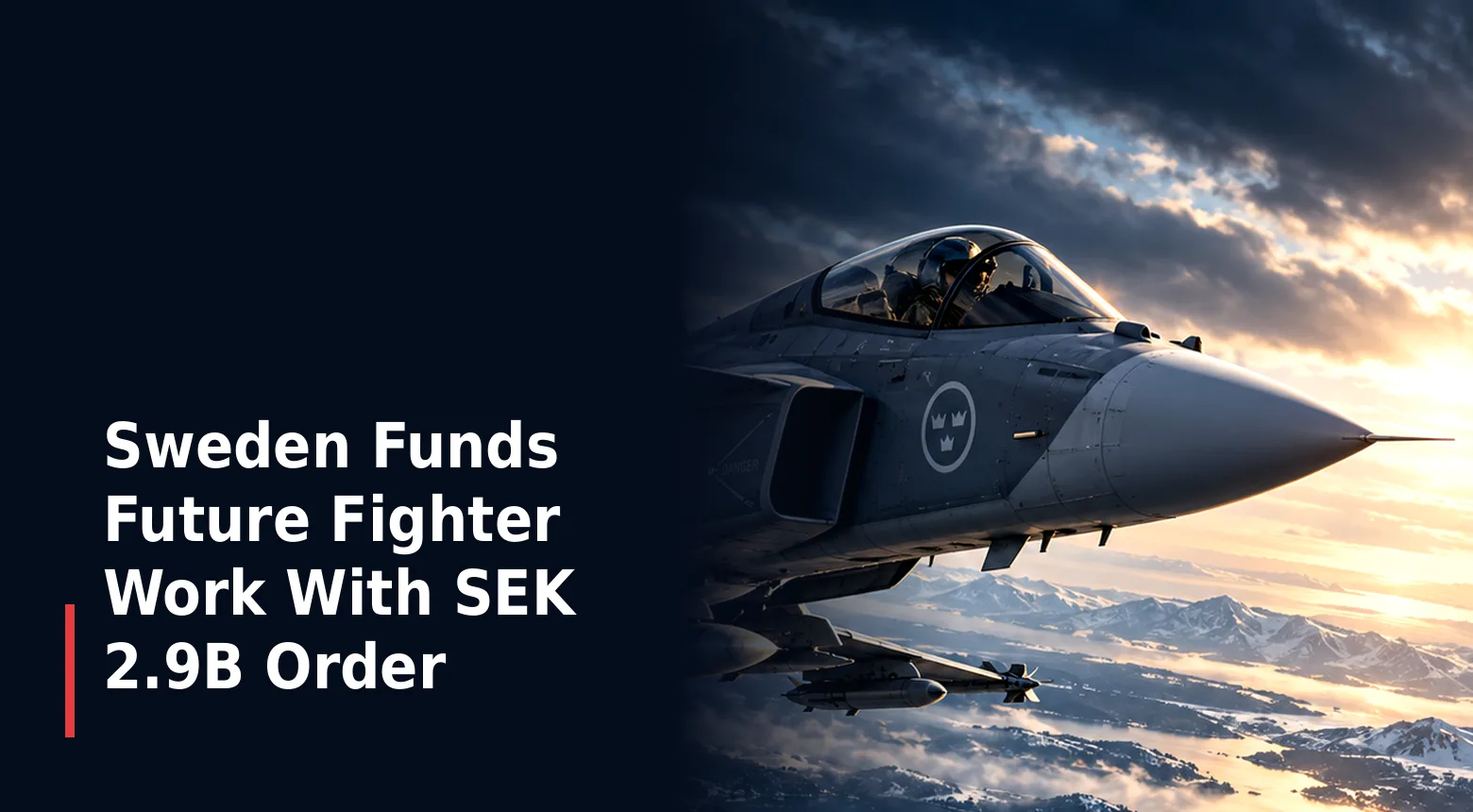
Saab announced on 9 September 2026 that Sweden's Defence Materiel Administration (FMV) had placed an approximately SEK 2.9 billion order for further future-fighter concept work. The 2026–2028 programme includes airborne and ground demonstrators for crewed and uncrewed systems, giving Stockholm additional technical evidence before choosing the long-term direction of its combat-air capability.
FMV extends concept work rather than selecting a fighter
Saab described the September award as a continuation of orders issued in 2024 and 2025. The contract covers studies and technology demonstrators, not serial production of a replacement for Gripen. That difference determines what can be concluded about the programme: Sweden is funding the evidence needed to compare architectures, while preserving the ability to make subsequent decisions on national development, international participation or a different acquisition model.
The headline value is approximately SEK 2.9 billion for the 2026–2028 period. Saab also identified contract options in 2029 and 2030, but options must not be treated as already exercised work or expenditure. The manufacturer did not disclose a firm production quantity, operational entry date or a final aircraft design. The procurement milestone is an order for development and demonstration activity under FMV oversight.
Crewed and uncrewed systems are part of one development path
The announced scope spans flying and ground-based demonstrators, advanced studies and concepts for both crewed and uncrewed aircraft. Saab highlighted systems integration, autonomy, signature adaptation, propulsion, digital development and future production capability. Each area raises different engineering questions, and the contract provides a means to collect data before they become expensive dependencies inside a full-scale aircraft programme. A successful laboratory or demonstrator result alone would not validate an entire combat-air system.
Saab's separate A3-001 collaborative-aircraft concept has attracted attention, but it should not be identified as the aircraft being bought under this order. Published concepts are useful indicators of industrial thinking, not evidence that the Swedish government has approved their acquisition. The relationship between uncrewed wingmen, long-range sensors and future crewed fighters will depend on communications resilience, autonomy assurance, electronic survivability and human control arrangements.
Industrial sovereignty is a central objective
Sweden has maintained an unusually broad domestic combat-air engineering base through Saab's aircraft programmes. The FMV order helps keep specialist teams active across flight controls, mission systems, survivability and systems integration during an interval when strategic choices remain open. That continuity is significant because engineering capability can be lost quickly if complex programmes end without follow-on design work or meaningful test activity.
Reuters characterised the approximately SEK 2.9 billion award as a new investment in future military aircraft technology rather than a decision to field a new fighter. A sustained technology base strengthens Sweden's bargaining position in potential international cooperation, but it does not guarantee that a wholly sovereign next-generation platform will be affordable. Decisions about engines, weapons, sensors and certification will also influence the supply-chain independence actually achieved.
Demonstrations must resolve programme choices
A flying demonstrator can produce evidence on handling qualities, autonomy, propulsion integration and signature management that a digital model cannot fully supply. Ground test rigs can mature the software and hardware interfaces that would otherwise threaten schedule during aircraft development. Together they reduce uncertainty; they do not remove cost or lifecycle-support risks associated with a future combat-air fleet.
The next decision points are therefore specific and observable: completion of test articles, results from flight and ground trials, any exercised 2029–2030 options, and an FMV or government announcement on architecture and partnership choices. Until those steps occur, Sweden's September 2026 announcement remains a funded concept and demonstrator contract, not an IOC forecast or confirmed production programme.
Implications / Next
Track the exact content of demonstrator deliveries, technical progress disclosed by FMV and the fate of the contract options. A future fighter procurement decision should be covered as a separate milestone if and when it occurs.