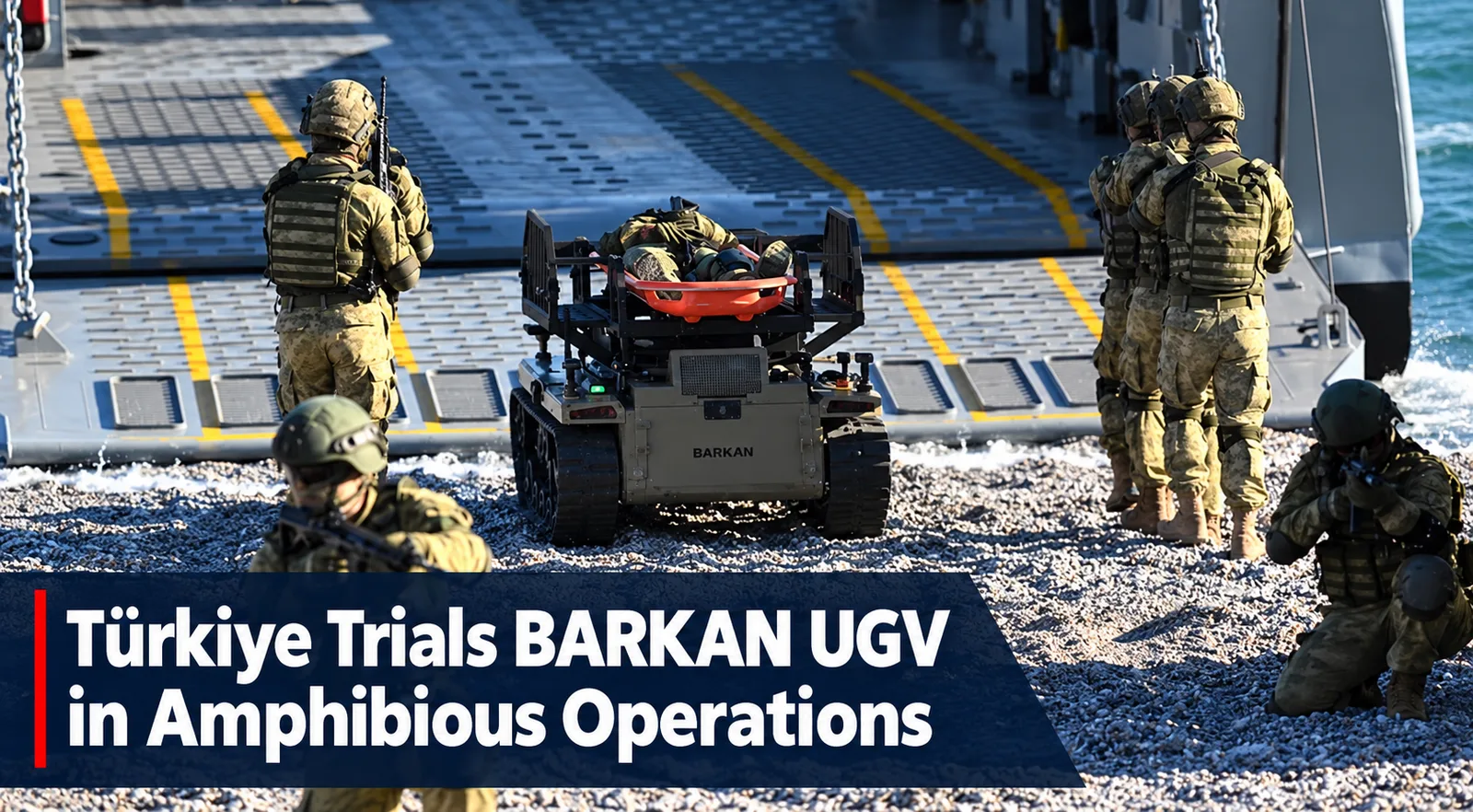
Türkiye’s Naval Forces have demonstrated HAVELSAN’s BARKAN unmanned ground vehicle in an amphibious and urban-operation scenario during TURNAs-2026. Reported tasks included accompanying troops and evacuating simulated casualties, adding a land-robotics dimension to the naval exercise rather than establishing a new fleet-wide fielding milestone.
BARKAN adds a land phase to a maritime exercise
TURNAs-2026 began on 19 October around the Gulf of Antalya and the eastern Mediterranean, bringing crewed naval units and several unmanned categories into a common exercise. Defence Blog reported on 24 October that BARKAN supported amphibious raid and urban-warfare phases and later evacuated simulated wounded personnel. No live combat deployment is implied by an exercise scenario.
Anadolu Agency, citing Ministry of National Defence information, reported participation by 18 ships, 11 conventional aircraft, nine UAVs, seven unmanned underwater vehicles and nine unmanned surface vessels, alongside 41 systems from 17 Turkish companies. These are exercise participation figures rather than an inventory count of operationally qualified systems.
Why amphibious units need robotic support
An amphibious landing involves changing mission conditions as forces move from ship to shore, consolidate a beachhead and operate in constrained terrain. A compact unmanned ground vehicle can potentially carry equipment, perform reconnaissance, inspect dangerous areas or retrieve casualties while limiting some exposure for personnel. Its usefulness depends on mobility, control links and reliable coordination with the landing force.
Casualty evacuation in particular is a demanding demonstration because the vehicle must carry a load, manoeuvre around obstacles and remain accessible to medical teams. A successful scripted run is useful engineering evidence, but it does not establish how the system would perform under enemy interference, damaged roads, limited communications or prolonged combat operations.
HAVELSAN’s wider digital-unit concept
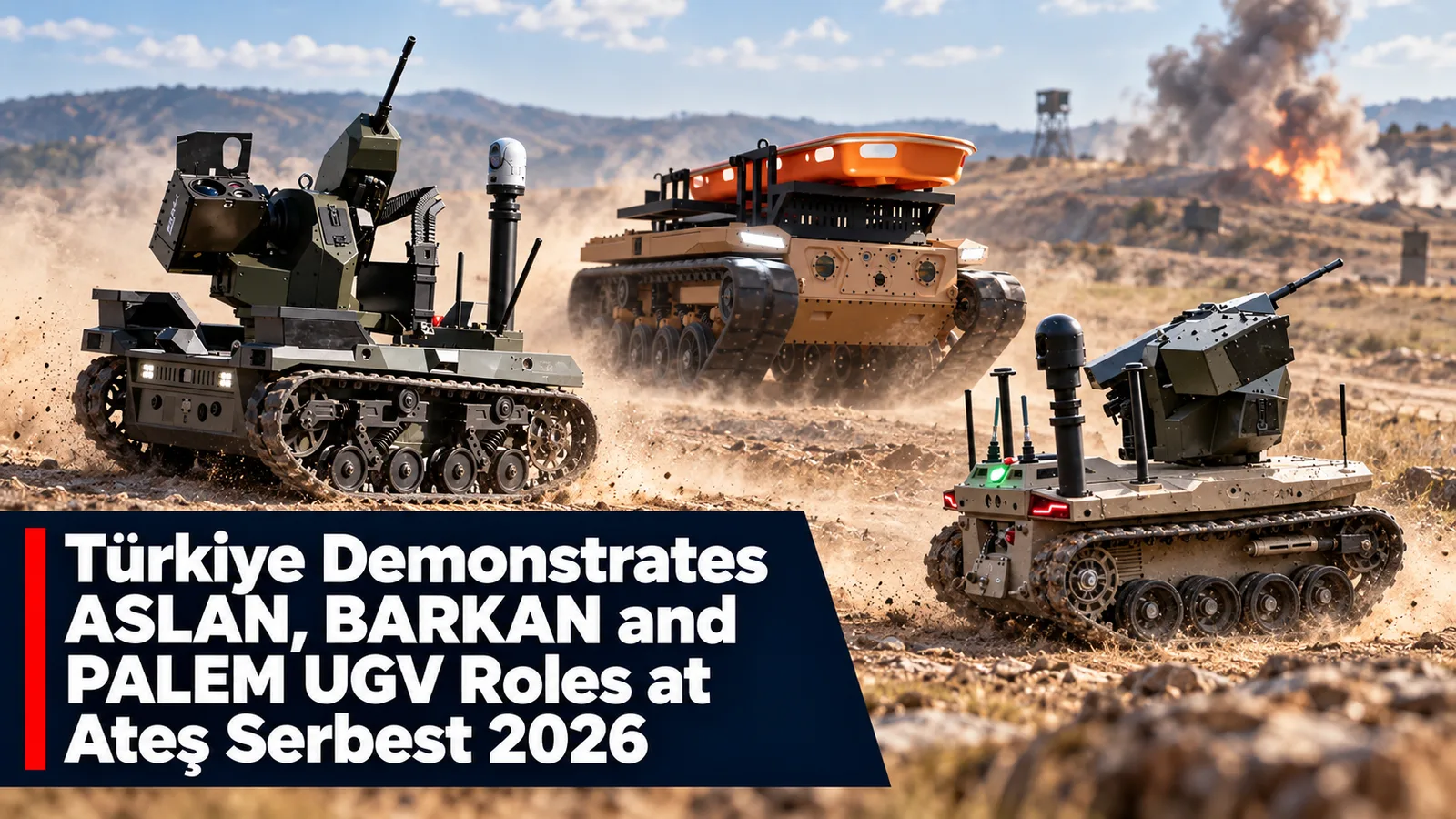
HAVELSAN has promoted BARKAN as one element of a wider autonomous and remotely operated force architecture rather than a replacement for manned vehicles. The company previously demonstrated armed and support roles, including at Ateş Serbest 2026. The relevant development path is integration between dissimilar platforms and commanders, not simply the number of payloads that can be mounted on one chassis.
Naval operations add distinct requirements: embarked storage, deck handling, salt-water exposure, getting equipment ashore and maintaining data links after a landing craft departs. Public accounts of TURNAs do not quantify BARKAN’s landing-to-shore transfer method, networking architecture or sea-state envelope, so those details should not be assumed.
Exercise results are not fielding decisions
BARKAN’s programme has already progressed through earlier demonstrations and industrial milestones; this exercise does not restart that history. The new observation is employment in a combined naval scenario with a simulated casualty task and accompanying amphibious troops. That may help operators identify practical tactics, training needs and payload arrangements.
The Navy’s future decisions would be visible through formal user qualification, approved tables of equipment, disclosed platform configurations or additional maritime training events. Without those records, the defensible outcome is a role-focused demonstration inside a major unmanned-systems exercise rather than proof of routine deployment by amphibious units.
There is also a practical command responsibility associated with the shift to robotic evacuation and support. Exercise controllers must decide when an unmanned vehicle can move near infantry, who has priority over the control channel and how an operator recovers control when navigation or communications degrade. In a real amphibious setting, electromagnetic interference, obstacles, soft ground and limited lines of sight can turn a manageable demonstration into a difficult safety and reliability problem. The value of TURNAs therefore lies partly in exposing these integration constraints before units attempt more complex missions. Future published results would be most informative if they separated autonomous navigation from remote driving and recorded casualty load, mobility and link performance under representative conditions. Those technical indicators would say more about practical deployment readiness than another display of payload options.
Implications / Next
Follow post-exercise reports for launch and recovery arrangements, reliability, command-and-control interoperability, casualty-handling metrics and any formal Navy acceptance. The exercise was scheduled to continue into late October, so activity reported on 24 October is not a final programme evaluation.