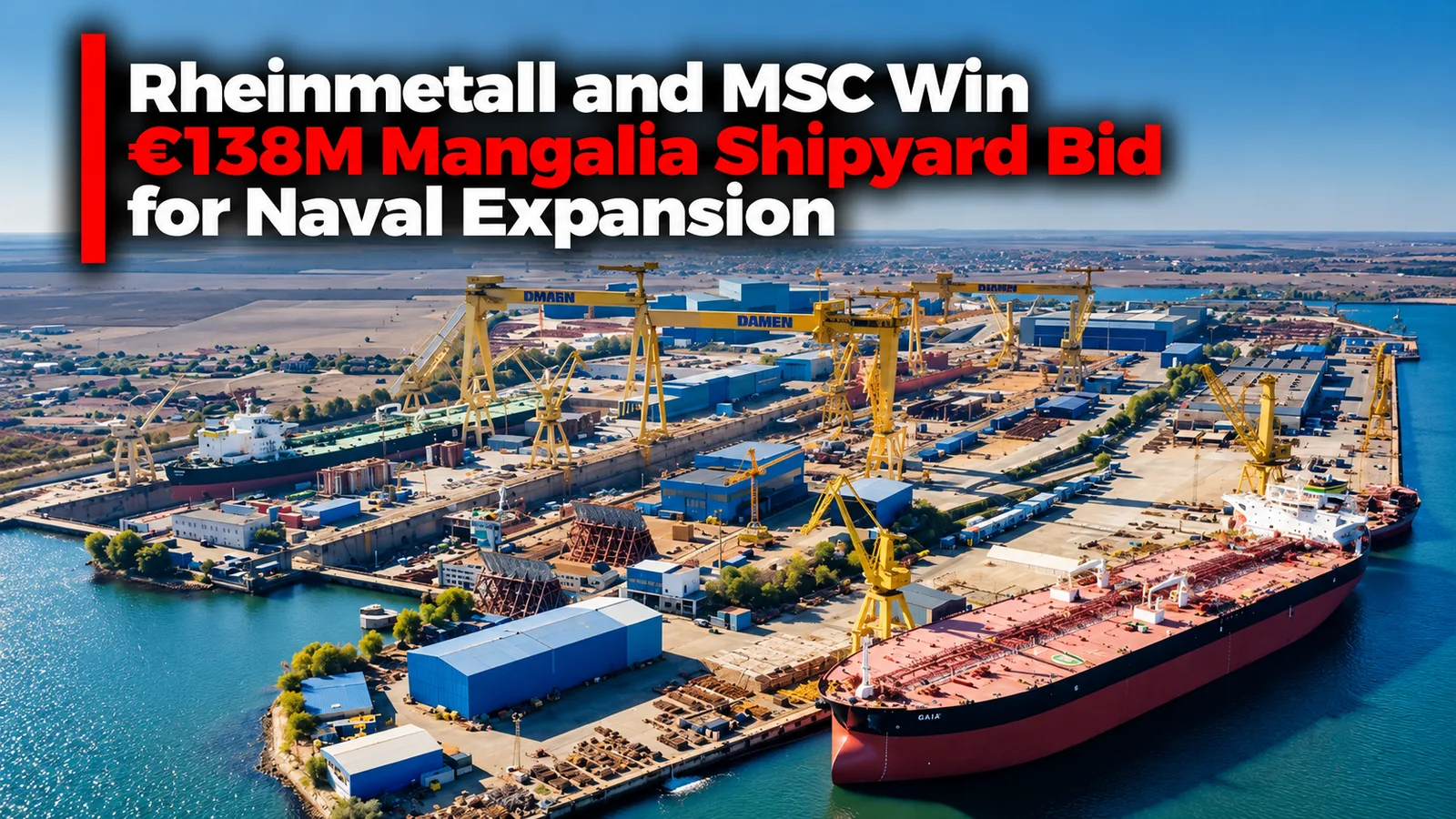
Rheinmetall and Swiss shipping group MSC have won the auction for Romania’s Mangalia shipyard, agreeing to a joint purchase price of approximately €138 million. The partners intend to redevelop the Black Sea facility into a dual-use production centre that can serve commercial shipping customers and military naval programmes. Rheinmetall said on 19 October 2026 that it expects the acquisition to be finalised in several weeks.
Located south of Constanța, the shipyard is expected to support the construction of four naval vessels ordered by Romania: two 96-metre offshore patrol vessels and two 43-metre diver support vessels. The military shipbuilding role is part of Rheinmetall Naval Systems’ broader expansion into Southeastern Europe, according to the company’s official announcement.
The Auction Has Been Won, but Completion Is Still Pending
Rheinmetall and MSC have been awarded the winning bid following an auction. Reuters described the transaction as a joint acquisition on 19 October, but Rheinmetall’s release is more specific about timing: the purchase remains subject to finalisation expected within weeks. That means the transaction has progressed beyond an expression of interest, without establishing that legal transfer and full operational control were completed on the announcement date.
The approximately €138 million figure is the joint acquisition consideration, not a separately disclosed Rheinmetall-only payment. Neither the two partners’ ownership split nor a definitive post-acquisition capital-expenditure budget was provided in the announcement. Dividing the sum into company shares or reporting it as committed shipyard modernisation spending would therefore be unsupported.
Mangalia Will Be Divided Into Commercial and Military Production Zones
The intended operating model is dual-use shipbuilding. Rheinmetall and MSC plan to accommodate civilian and military contracts in parallel, serving both domestic and international customers. Rheinmetall said the yard will be reorganised into distinct production sectors and security zones to accommodate the different requirements.
This structure could make better use of shipyard infrastructure across fluctuating military workloads while keeping naval projects within dedicated controlled areas. That is an industrial rationale, not a demonstrated outcome: no definitive production schedule, capacity allocation or commercial order book for the relaunched facility has been published.
Four Romanian Navy Vessels Form the Immediate Defence Link
The most concrete military requirement connected to Mangalia is Romania’s four-ship order. Rheinmetall’s announcement lists two 96-metre offshore patrol vessels and two 43-metre diver support vessels and says the shipyard will play an important part in their construction.
The Romanian Ministry of National Defence had already signed the procurement contract with NVL B.V. & Co. KG, a Rheinmetall group company, on 29 May 2026. In its official contract announcement, the ministry specified two maritime patrol vessels and two diver intervention ships. The designation differs slightly in wording but refers to the same four-vessel procurement described by Rheinmetall.
Rheinmetall has not published a precise workshare assigning every hull, outfitting phase and system-integration task to Mangalia. The company describes the yard as an important production site; that should not be converted into a claim that every ship will be built entirely there.
The €920M Ship Order Is Separate From the €138M Shipyard Bid
Romania’s four-vessel contract has a value of €920 million excluding VAT and is financed under the European Union’s Security Action for Europe (SAFE) mechanism, according to the Ministry of National Defence. This value represents naval vessel procurement and is not the price paid to acquire the Mangalia facility.
The distinction changes how the announcement should be read. Rheinmetall and MSC are taking over an industrial site for approximately €138 million, while a separate Romanian government contract provides an existing military-production demand signal worth €920 million. The two figures should not be added together and presented as one acquisition transaction, nor should the full procurement value be treated as revenue guaranteed specifically to the Mangalia yard.
Rheinmetall Is Extending Its Naval Systems Footprint
The Mangalia step follows Rheinmetall’s expansion into naval shipbuilding through its integration of NVL. Rheinmetall said in May that its naval operations and MSC’s maritime transport experience could be combined to restore the long-established Romanian yard. The German group already operates in Romania through Rheinmetall Automecanica in Mediaș.
In June 2026, Rheinmetall announced a wider €5.7 billion Romanian defence package spanning armoured vehicles, air defence, ammunition and naval vessels. That programme provides important industrial context, but it is a group-wide set of procurement contracts rather than a Mangalia-only investment allocation. Rheinmetall’s existing naval business and local Romanian supply network are therefore relevant to the takeover without making every announced Romanian order part of the shipyard purchase.
What MSC Adds to the Partnership
MSC brings commercial shipping, maritime operations and logistics expertise to a project that is explicitly intended to retain civilian shipbuilding alongside naval work. Rheinmetall would lead the military-oriented industrial opportunity through its Naval Systems business, while the partners seek a production model broad enough for civilian and defence demand.
Rheinmetall’s announcement does not set out legally binding operational responsibilities, the equity split, or a detailed division of future vessel contracts between MSC and Rheinmetall. Those details will need confirmation once the transaction closes and the operating arrangements become public.
Shipyard Renewal Will Require More Than Acquisition
Rheinmetall Naval Systems CEO Tim Wagner said the company intends to upgrade infrastructure, production conditions and capacity after taking over the facility. The May announcement had described a larger ambition for training, research and potentially several thousand long-term jobs, but these were projections dependent on redevelopment rather than confirmed headcount commitments.
The industrial execution test will be whether the new owners can restore shipyard capacity, establish secure naval production areas, retain skilled labour, coordinate with component suppliers and transition the four-vessel programme into an executable construction schedule. No completed yard redevelopment, employment increase or vessel launch date was announced on 19 October.
Why the Black Sea Location Matters
A Black Sea shipyard serving a NATO and EU member state adds a potentially valuable regional construction and support location at a time when European states are expanding naval procurement. The immediate benefit is industrial geography and local production access; future military utility will depend on what is actually built, maintained and delivered from Mangalia.
For Romania, the planned arrangement links an existing government order to domestic industrial work rather than treating warship procurement solely as an overseas delivery. For Rheinmetall, it could form a Southeastern European production base with opportunities beyond the initial four vessels. Neither outcome is guaranteed before ownership transfer and construction milestones are verified.
What Has Not Yet Been Disclosed
The 19 October announcement did not specify the ownership percentages of Rheinmetall and MSC, the definitive closing date, the shipyard’s post-acquisition investment budget, an approved recruitment target, the detailed distribution of production between partners, or a firm schedule for individual shipbuilding milestones at Mangalia.
The next verifiable developments will be legal completion of the acquisition, disclosure of the operating structure, the site’s modernisation plan and evidence of construction activity on the Romanian vessels. Until then, the confirmed event is a €138 million winning acquisition bid and a declared dual-use industrial plan, backed by an existing but separate Romanian naval procurement contract.