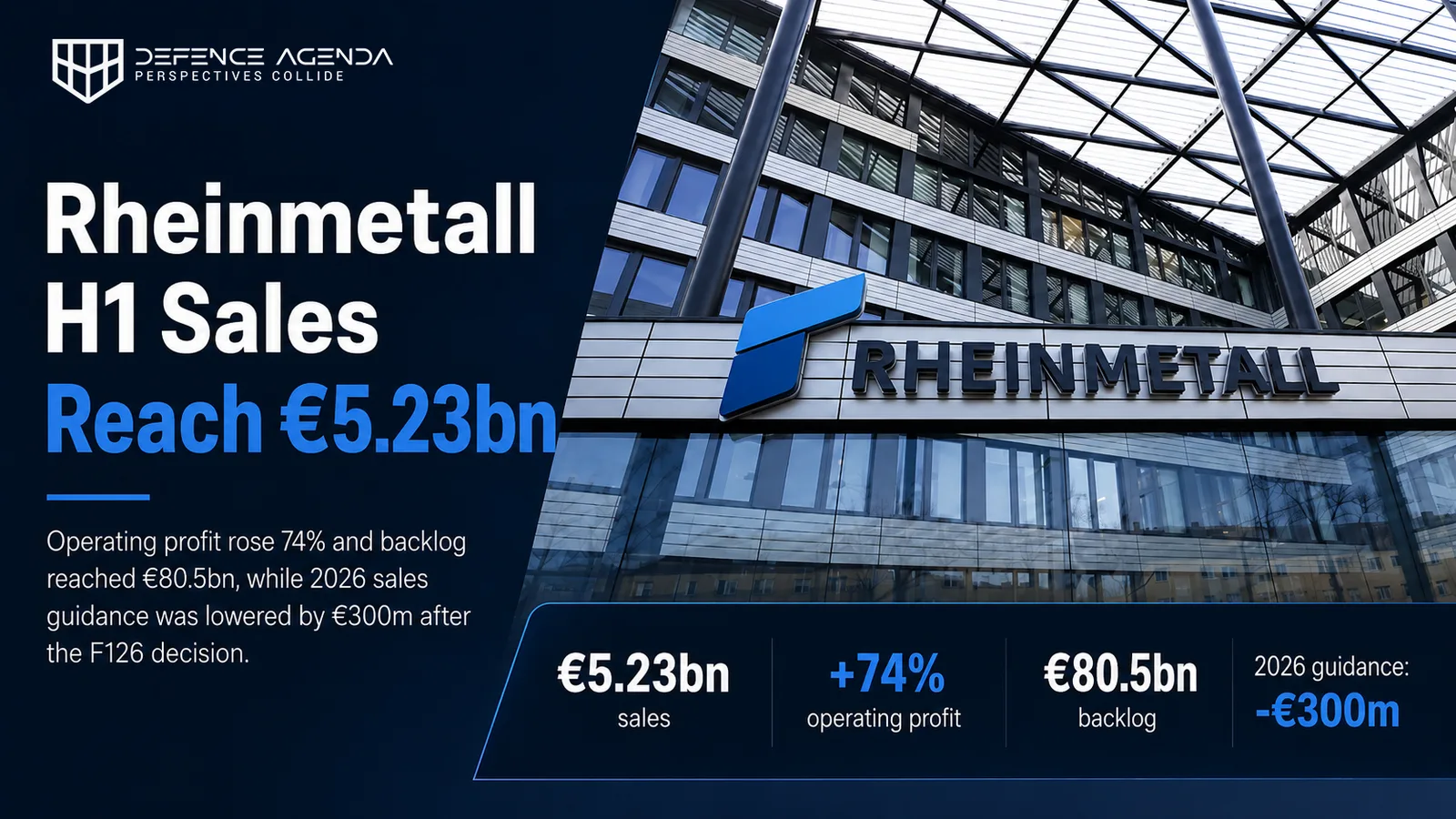
Rheinmetall H1 2026 results show a 39% increase in consolidated sales and a 74% rise in operating profit as European defence demand, higher production volumes and an expanding order book continued to support the German defence group.
Rheinmetall reported first-half sales of €5.227 billion, compared with €3.749 billion during the same period of 2025. The consolidated operating result rose from €453 million to €786 million, while the operating margin increased from 12.1% to 15.0%.
The company’s official half-year financial release also reported an €80.5 billion backlog and €16.2 billion in Rheinmetall Nomination.
Rheinmetall reduced its full-year sales forecast by €300 million following the cancellation of the F126 frigate programme. The revised guidance now calls for sales of between €13.7 billion and €14.2 billion, while the expected operating margin remains around 19%.
Key Facts
- Reporting period: Six months ended 30 June 2026.
- Consolidated sales: €5.227 billion.
- Sales growth: 39% year on year.
- Operating result: €786 million.
- Operating-result growth: 74% year on year.
- Group operating margin: 15.0%.
- Second-quarter operating margin: 17.1%.
- Earnings per share: €8.43 from continuing operations.
- Rheinmetall Nomination: €16.2 billion.
- Rheinmetall Backlog: €80.5 billion.
- Operating free cash flow: Negative €1.616 billion.
- Germany share of sales: 38%.
- International share of sales: 62%.
- Revised 2026 sales guidance: €13.7 billion to €14.2 billion.
- Expected 2026 operating margin: Around 19%.
- F126 impact: Up to €300 million reduction in 2026 sales.
What Did Rheinmetall Report for the First Half of 2026?
Rheinmetall generated €5.227 billion in consolidated sales during the first six months of 2026.
This represented an increase of €1.477 billion from the €3.749 billion reported in the first half of 2025.
Operating profit increased more rapidly than sales. The consolidated operating result reached €786 million, compared with €453 million a year earlier.
The company attributed the improvement to a favourable product mix and operating leverage created by the significant increase in production volumes.
| Group Indicator | H1 2026 | H1 2025 | Change |
|---|---|---|---|
| Consolidated sales | €5.227 billion | €3.749 billion | +39% |
| Operating result | €786 million | €453 million | +74% |
| Operating margin | 15.0% | 12.1% | +2.9 percentage points |
| Earnings per share | €8.43 | €4.69 | Higher by €3.74 |
| Operating free cash flow | €-1.616 billion | €-631 million | Down by €985 million |
| Rheinmetall Nomination | €16.2 billion | €12.7 billion | +28% |
| Rheinmetall Backlog | €80.5 billion | €56.0 billion | Approximately +44% |
Why Did Operating Profit Grow Faster Than Sales?
Rheinmetall’s operating result increased by 74%, nearly twice the rate of sales growth.
The company identified two principal reasons:
- A more favourable mix of products and programmes
- Leverage effects from higher utilisation of expanded production capacity
When production volumes rise, fixed costs can be distributed across a larger number of products. This can improve margins when pricing, programme execution and production efficiency remain supportive.
The second-quarter operating result reached €562 million, more than double the €262 million recorded in the same quarter of 2025.
Rheinmetall stated that its second-quarter operating margin reached 17.1%, which the company described as a new high.
What Is Rheinmetall Nomination?
Rheinmetall Nomination is a company-defined indicator combining traditional order intake with the value of newly awarded framework agreements.
The figure reached €16.2 billion during the first half of 2026, compared with €12.7 billion during the same period of 2025.
The indicator is broader than conventional order intake because a framework agreement may establish a potential purchasing volume without requiring the customer to order the complete amount immediately.
Rheinmetall Nomination should therefore not automatically be treated as revenue, cash flow or a guaranteed future delivery volume.
What Does the €80.5 Billion Backlog Represent?
Rheinmetall Backlog increased from €56.0 billion at the end of June 2025 to €80.5 billion at the end of June 2026.
The company’s backlog measure includes conventional order backlog and expected call-offs from existing framework agreements.
This means that the €80.5 billion figure is not equivalent to sales that have already been recognised.
The conversion of backlog into revenue will depend on customer orders, delivery schedules, funding approvals, production capacity, programme execution and the contractual conditions of individual framework agreements.
How Did Rheinmetall’s Business Segments Perform?
| Segment | H1 Sales | Sales Growth | Operating Result | Operating Margin | Backlog |
|---|---|---|---|---|---|
| Vehicle Systems | €2.431 billion | 28% | €275 million | 11.3% | €28.829 billion |
| Weapon and Ammunition | €1.757 billion | 33% | €417 million | 23.7% | €25.274 billion |
| Air Defence | €478 million | 62% | €76 million | 16.0% | €4.218 billion |
| Digital Systems | €820 million | 23% | €63 million | 7.7% | €20.646 billion |
| Naval Systems | €334 million | Not directly comparable | €33 million | 9.8% | €6.255 billion |
Segment sales should not be added together to recreate consolidated group revenue. The simple total does not account for consolidation, group-level activities or intersegment eliminations.
What Drove Vehicle Systems Growth?
Vehicle Systems generated €2.431 billion in sales, an increase of €533 million or 28%.
Rheinmetall attributed the growth primarily to:
- Tactical-vehicle programmes for Germany
- Wheeled armoured-vehicle deliveries for German and European customers
- Logistics vehicles for the German customer
Vehicle Systems recorded €6.691 billion in Rheinmetall Nomination.
The order volume was supported by a second batch of 200 additional Puma infantry fighting vehicles for Germany and an order for 298 Lynx infantry fighting vehicles for Romania under the European SAFE programme.
The segment’s operating result increased from €179 million to €275 million, while the operating margin improved from 9.4% to 11.3%.
How Did Weapon and Ammunition Perform?
Weapon and Ammunition sales increased by 33% to €1.757 billion.
The principal sales drivers identified by Rheinmetall were an ammunition package for Hungary and artillery and medium-calibre ammunition for Ukraine.
New orders included:
- Medium-calibre ammunition for Romania under the SAFE programme
- Tank ammunition for Poland
- Artillery shells for Germany and Eastern European customers
- Artillery weapon systems for Germany and Eastern European customers
The segment produced the highest operating margin among Rheinmetall’s reported divisions at 23.7%, compared with 21.2% in the previous year.
Investment totalled €184 million, with spending directed towards production expansion in the United Kingdom, construction of a new plant in Lithuania and increased powder capacity at Nitrochemie Aschau.
Why Was Air Defence the Fastest-Growing Segment?
Air Defence sales increased by 62% to €478 million, making it the fastest-growing reported segment by sales percentage.
The company linked the increase to progress in Skynex and Skyranger projects for European customers.
Rheinmetall Nomination in Air Defence increased by 517% to €1.534 billion. Major orders covered additional Skyranger and Skynex systems for one European and one international customer.
The segment’s backlog increased by 80% to €4.218 billion.
Its operating result more than doubled from €36 million to €76 million, while the margin improved from 12.4% to 16.0%.
What Was the Performance of Digital Systems?
Digital Systems generated €820 million in sales, an increase of 23%.
The segment covers armed-forces digitalisation, satellite technology, crewed and uncrewed aircraft systems and simulation.
Sales growth was supported by the TaWAN and D-LBO digitalisation programmes and the ramp-up of short- and very-short-range air-defence projects.
Rheinmetall Nomination fell by 52% to €4.702 billion because the comparative period included several exceptionally large framework agreements.
The decline in nomination therefore does not represent a corresponding decline in sales or backlog. Digital Systems backlog increased by 80% to €20.646 billion.
The division also secured a framework agreement worth billions for FV-014 loitering-munition systems, a German reconnaissance-vehicle order and a role in an international consortium digitalising British military training.
How Did the New Naval Systems Segment Perform?
Naval Systems was reported as an independent segment for the first time following the completion of Rheinmetall’s takeover of the naval business at the end of February 2026.
The segment generated €334 million in sales during the four months included in the group’s first-half reporting.
Sales were mainly associated with:
- FDB424 intelligence vessels
- Braunschweig-class K130 corvettes
- MBV707 replenishment oilers
- Bulgarian MMPV90 patrol vessels
- Repair work on the frigate Rheinland-Pfalz
Naval Systems recorded €1.004 billion in Rheinmetall Nomination, including a €920 million Romanian order for four vessels financed through the SAFE programme.
The segment reported an operating result of €33 million and an operating margin of 9.8%.
Why Was Operating Free Cash Flow Negative?
Operating free cash flow fell to negative €1.616 billion, compared with negative €631 million in the first half of 2025.
Rheinmetall identified four main factors:
- A shift in the timing of customer advance payments
- Continued investment in production capacity
- Higher inventories for deliveries planned in later quarters
- Increased receivables following a large volume of sales invoiced at the end of the quarter
Negative operating free cash flow should not be confused with a negative operating result.
The group remained profitable during the period, but cash was absorbed by working capital and investment before some customer payments and future deliveries were completed.
How Did the F126 Decision Change Rheinmetall’s Guidance?
Rheinmetall previously expected 2026 consolidated sales of between €14.0 billion and €14.5 billion.
Following the cancellation of the F126 frigate programme, the company reduced the expected range by €300 million to between €13.7 billion and €14.2 billion.
| 2026 Guidance Indicator | Previous Guidance | Revised Guidance |
|---|---|---|
| Consolidated sales | €14.0–€14.5 billion | €13.7–€14.2 billion |
| Change to sales range | Not applicable | Reduced by €300 million |
| Organic sales growth | 28–31% | 28–31% |
| Operating-result margin | Around 19% | Around 19% |
The company stated that the F126 decision could reduce Naval Systems sales by up to €300 million during 2026.
Rheinmetall retained its other guidance assumptions and said it would continue to pursue existing maritime orders and international opportunities.
Does the Revised Guidance Mean Rheinmetall Expects Sales to Fall?
No. The revised sales range remains substantially above Rheinmetall’s 2025 consolidated sales of €9.935 billion.
The adjustment reduces the expected level of 2026 growth but does not change the company’s expectation of a significant year-on-year increase.
The forecast remains a forward-looking estimate rather than a guarantee. Actual results will depend on customer call-offs, production schedules, programme execution, acquisitions, investment and the timing of deliveries and payments.
What Do the Results Not Prove?
- The €80.5 billion backlog is not the same as recognised revenue.
- Framework agreements may not be called off in full or on a fixed schedule.
- Rheinmetall Nomination is not identical to cash received or binding order intake.
- Negative free cash flow does not mean the company recorded an operating loss.
- The revised annual sales guidance is not a guaranteed outcome.
- Segment sales cannot be added directly to reconstruct consolidated sales.
- High group growth should not be attributed to a single product or customer.
- A programme award does not mean that its full value will be recognised in one financial year.
What Should Be Watched During the Second Half of 2026?
- Conversion of the €80.5 billion backlog into scheduled deliveries
- Timing and level of customer advance payments
- Reduction of inventories and receivables
- Progress towards the approximately 19% annual operating margin
- Production ramp-up in ammunition and propellant capacity
- Delivery of Puma and Lynx vehicle programmes
- Further Skyranger and Skynex orders
- Call-offs under the FV-014 loitering-munition framework
- Integration and performance of Naval Systems
- Replacement maritime orders following the F126 cancellation
- Impact of European SAFE financing on order conversion
- Full-year operating free cash flow and cash conversion
Conclusion
Rheinmetall’s first-half 2026 results show that sales growth is increasingly translating into higher operating profitability.
Consolidated sales rose 39% to €5.227 billion, while the operating result increased 74% to €786 million.
Vehicle Systems remained the largest reported segment by sales, Weapon and Ammunition produced the highest operating margin and Air Defence recorded the strongest percentage growth.
The €80.5 billion backlog provides substantial visibility but includes expected framework-agreement call-offs and should not be interpreted as completed or guaranteed revenue.
The principal weakness in the period was negative operating free cash flow, driven by investment, inventory, receivables and the timing of advance payments.
The F126 programme cancellation reduced the full-year sales forecast by €300 million, but Rheinmetall retained its organic-growth assumptions and approximately 19% operating-margin target.