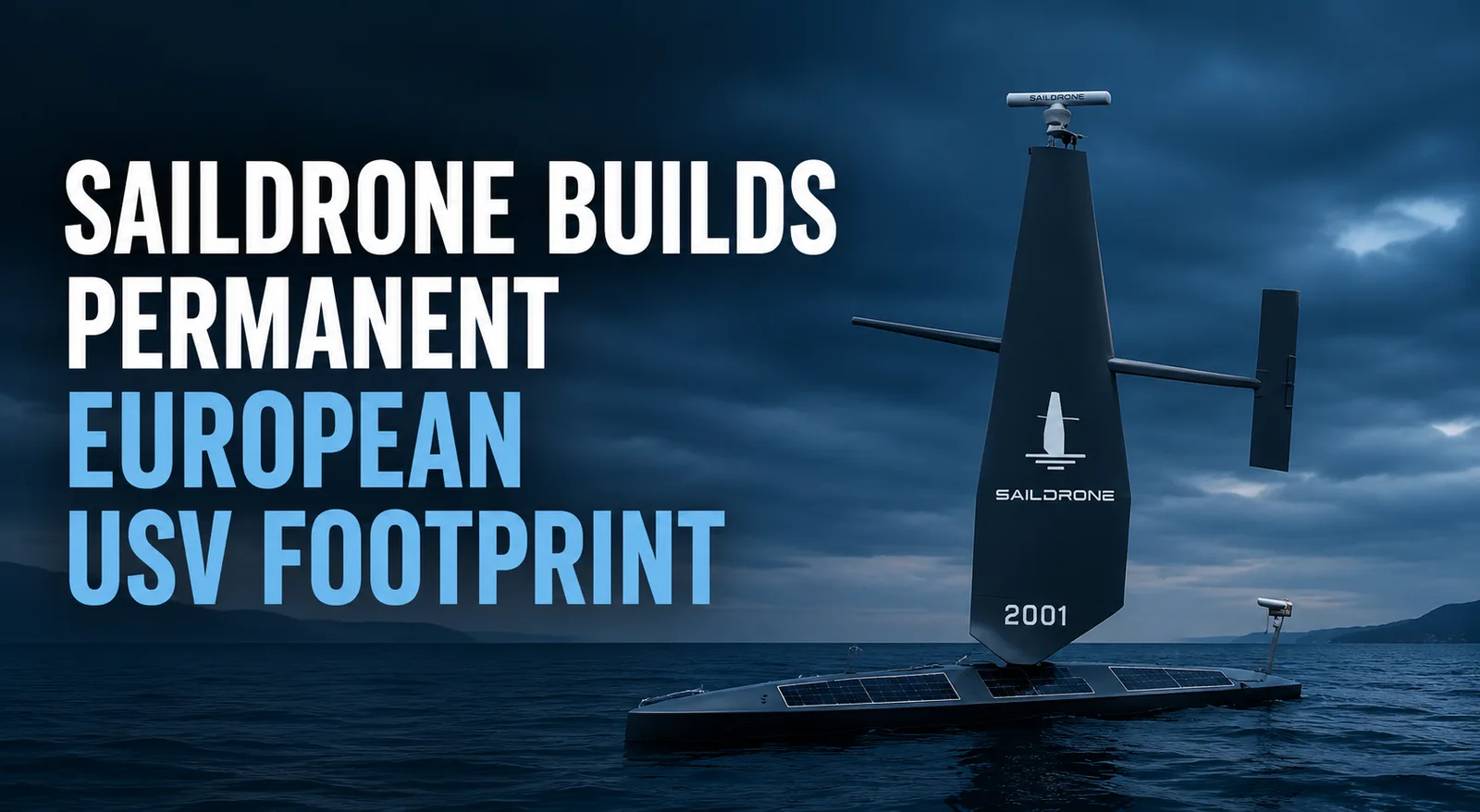
Saildrone Europe expansion is moving from regional deployments to a permanent industrial and operational footprint, with the autonomous maritime company opening its European headquarters in Copenhagen and establishing new unmanned surface vessel manufacturing capacity across the Netherlands, Norway and Poland.
Saildrone announced the expansion on 18 August 2026, saying its Copenhagen headquarters will support business development, maintenance, mission operations and piloting while three separate European build agreements create regional manufacturing capacity for its larger Surveyor and Spectre platforms.
The move matters because Saildrone is no longer approaching Europe primarily as an export market for U.S.-built autonomous vessels. The company is attempting to create a locally manufactured, operated and supported maritime-autonomy ecosystem at a time when NATO countries are moving uncrewed surveillance systems from experimentation into persistent Baltic and North Sea operations.
Key Facts
- EU headquarters: Saildrone formally opened its Copenhagen headquarters at Quintus Bastion in Holmen on 17 August 2026.
- Netherlands: The first European-built 52-metre Saildrone Spectre will be manufactured at Van Der Valk Shipyard.
- Norway: Umoe Mandal will build the next generation of the 20-metre Saildrone Surveyor.
- Poland: Southern Spars will manufacture Surveyor wings.
- Operational role: The Copenhagen hub will support maintenance, mission management, piloting, technical operations and regional deployments.
- Baltic record: Four Voyager USVs operated for Denmark for six months, recording 92% fleet uptime, more than 20,000 nautical miles and over 170,000 unique contacts.
- Strategic context: NATO Task Force X-Baltic is moving from experimental fleets toward nationally procured systems capable of persistent regional operations.
Saildrone Europe Expansion Moves Into Manufacturing
The most consequential element of Saildrone’s announcement is the move into European manufacturing.
The company announced three separate build arrangements covering the Netherlands, Norway and Poland.
Van Der Valk Shipyard in the Netherlands will build the first European-manufactured version of Saildrone’s new Spectre platform.
The vessel is considerably larger than the Saildrone platforms currently best known for long-duration maritime surveillance.
Saildrone describes Spectre as a 52-metre multimission USV designed for high-end naval operations including anti-submarine warfare, intelligence, surveillance and reconnaissance, electronic warfare and modular mission payloads.
The platform is therefore a substantial expansion beyond the small autonomous surveillance craft associated with Saildrone’s earlier commercial and government operations.
Europe Will Build the 52-Metre Spectre
Spectre is Saildrone’s largest platform to date.
The company lists a 52-metre hull length, a maximum payload exceeding 70 metric tonnes and configurations designed for both long-endurance sensing and higher-speed naval missions.
Saildrone currently presents two variants.
Spectre Silent Endurance retains the company’s characteristic wing architecture and is optimised for quiet, persistent anti-submarine warfare and ISR missions.
Spectre Stealth removes the wing, lowering the vessel’s profile and prioritising higher-speed operations and modular mission payloads.
The manufacturer lists potential payload categories including ASW, electronic warfare, air and missile defence, C5ISR and kinetic effects.
These remain manufacturer-described mission options rather than confirmation that the European-built vessel has been ordered with every listed payload.
No European Spectre Quantity Has Been Announced
The industrial announcement should not be interpreted as confirmation of a large European Spectre fleet.
Saildrone states that the first European-built 52-metre Spectre will be constructed at Van Der Valk Shipyard, but the company has not publicly disclosed the total number of Spectres covered by the arrangement.
No contract value or delivery schedule was provided in the 18 August announcement.
Those details will be important in determining whether the Dutch agreement represents an initial industrialisation step or the beginning of a larger European production run.
Norway Will Produce the Next Surveyor Generation
Norway forms the second production node.
Saildrone says Umoe Mandal will manufacture the next generation of its Surveyor unmanned surface vessel.
The current Surveyor is a 20-metre long-endurance USV designed for maritime ISR, ocean mapping and distributed maritime missions.
It combines radar, electro-optical and infrared sensing, AIS, satellite communications and machine-learning-based detection with accommodation for customer-provided mission payloads.
Saildrone lists endurance of approximately 100 days between service stops for the current configuration.
The company has not yet publicly detailed how the European-built “next generation” Surveyor will differ technically from the current platform.
Poland Adds a Specialist Component Production Node
The third industrial agreement takes Saildrone into Poland.
Southern Spars will manufacture wings for the Surveyor platform there.
The arrangement illustrates a distributed European manufacturing model rather than concentrating complete platform production in one country.
For European customers, that approach can broaden regional industrial participation and potentially reduce dependence on transatlantic logistics for major components.
It can also make future fleet support easier if spare structures and replacement components are manufactured closer to operating areas.
Copenhagen Becomes the European Mission-Control Hub
The Copenhagen expansion is equally important operationally.
Saildrone first announced a Danish subsidiary in April 2025, but the 2026 move adds a more permanent technical and operational structure.
The new headquarters will support business development, maintenance operations and piloting activities across Europe.
Saildrone also says technical teams based in Copenhagen will be able to deploy, operate and maintain the company’s growing regional USV fleet.
This matters because an autonomous vessel still requires substantial shore-side infrastructure.
Mission planning, fleet monitoring, maintenance, communications, sensor management, data processing and technical support remain essential even when no sailors are permanently aboard the vessel.
The HQ Occupies a Former Royal Danish Navy Site
The headquarters is located at Quintus Bastion in Holmen, Copenhagen.
The historic location previously served as a Royal Danish Navy headquarters and places Saildrone’s European operation inside one of Denmark’s longstanding maritime districts.
The office formally opened on 17 August 2026.
Saildrone said three employees were already based in Copenhagen and that it was recruiting four additional technical roles covering Mission Management, Vehicle Assembly & Service, Technical Operations and the Pilot Team.
The small initial workforce indicates that the European organisation remains in an expansion phase rather than representing a fully mature large-scale operations centre on day one.
Baltic Operations Provided the Proof Point
The permanent investment follows a significant operational deployment rather than a short demonstration.
Four Saildrone Voyager USVs operated in support of the Danish Ministry of Defence Acquisition and Logistics Organisation and Royal Danish Navy in Baltic waters for six months.
Saildrone reports that the four-vessel fleet maintained 92% operational uptime despite difficult Baltic weather and sea states.
The fleet sailed more than 20,000 nautical miles and detected more than 170,000 unique contacts.
Those figures are significant because they measure the complete operational system — vessels, communications, maintenance, mission management and data delivery — across months rather than hours or days.
Voyager Is the Current European Operational Workhorse
The 10-metre Voyager has provided the operational foundation for Saildrone’s European expansion.
Saildrone describes Voyager as a coastal surveillance and nearshore mapping USV capable of approximately 100 days between service stops.
The vessel combines radar, PTZ infrared cameras, AIS, satellite communications and environmental sensors with a modular architecture for mission-specific payloads.
This combination makes the platform useful for maritime domain awareness rather than simply navigation or oceanographic data collection.
In the Baltic, the operational requirement is persistent recognition of vessel activity across shipping routes, infrastructure corridors and areas where crewed patrol ships cannot remain continuously on station at reasonable cost.
Critical Undersea Infrastructure Is Driving European Demand
Europe’s growing interest in autonomous maritime surveillance is closely linked to critical infrastructure security.
The Baltic and North Seas contain dense networks of communications cables, energy interconnectors, pipelines and offshore infrastructure.
Repeated disruption and damage incidents have increased pressure on governments to maintain persistent surveillance around these assets.
Saildrone has consequently expanded Voyager sensing beyond surface traffic monitoring.
In March 2026, the company demonstrated a Voyager equipped with an Innomar sub-bottom profiler for Baltic operations, allowing the platform to contribute information about conditions below the seabed as well as on the surface.
The objective is a more persistent picture of activity around cables, pipelines and other infrastructure that conventional surface surveillance may not fully explain.
NATO Task Force X Is Moving From Trials to Procurement
Saildrone’s investment also coincides with a major NATO transition.
NATO’s Task Force X-Baltic programme began as a rapid experiment testing whether commercially available uncrewed systems could be moved into operational maritime surveillance quickly.
By February 2026, Denmark, Estonia, Finland, Germany, Latvia, Lithuania, Poland and Sweden had signed a letter of intent taking the programme into Phase II.
The new phase shifts emphasis from temporary experimentation fleets toward nationally owned capabilities that can be tasked through NATO and contribute persistent Baltic coverage.
NATO Allied Command Transformation said on 23 July 2026 that participating states are moving directly into procurement and operational deployment.
This is exactly the market transition Saildrone’s European production network is positioned to address.
European Manufacturing Changes the Sovereignty Equation
For European ministries of defence, domestic or regional production has become increasingly important alongside platform performance.
A U.S.-designed autonomous vessel can provide valuable capability, but dependence on American production and maintenance capacity creates additional logistics and sovereignty considerations for a large European fleet.
Saildrone explicitly describes its new European footprint as creating an “enduring sovereign capability” for regional customers.
The claim should be interpreted carefully because Saildrone remains a U.S.-headquartered company and its proprietary software architecture remains central to operations.
Nevertheless, manufacturing vessels, maintaining them locally and operating them from a European mission-control centre materially increases regional autonomy compared with importing complete systems and returning them overseas for support.
EIFO Helped Anchor Saildrone in Denmark
Danish state-backed investment played an important role in creating that footprint.
EIFO said the investment formed part of a broader funding round worth almost DKK400 million and was strategically connected to Saildrone establishing its European base in Denmark.
At the time, Saildrone CEO Richard Jenkins described an ambition to expand persistent maritime intelligence into additional NATO countries and support continuous monitoring of critical infrastructure in the Baltic and North Seas.
The August 2026 manufacturing and operations announcement represents a concrete industrial step toward that objective.
Saildrone Is Expanding From Surveillance Toward Naval Missions
The company’s European expansion also coincides with a significant change in its product strategy.
Earlier Saildrone platforms built their reputation primarily around long-duration environmental data collection, mapping and maritime surveillance.
The 52-metre Spectre pushes the portfolio deeper into high-end naval missions.
Saildrone lists persistent ASW, ISR, electronic warfare and modular kinetic missions among the platform’s intended applications.
This means the European manufacturing network could eventually support requirements beyond coastguard-style maritime awareness and infrastructure protection.
However, no European government acquisition of an armed Spectre configuration was announced on 18 August.
ASW Could Be Particularly Relevant to Northern Europe
The Silent Endurance version of Spectre is designed around anti-submarine warfare.
Saildrone says the configuration combines electric and diesel propulsion with its wing architecture to provide quieter operation during long-duration missions.
The company advertises near-silent electric propulsion at speeds up to 12 knots for this configuration.
The Baltic, North Atlantic and Norwegian Sea all create persistent ASW requirements for NATO.
Uncrewed vessels carrying distributed acoustic sensors could supplement frigates, submarines and maritime patrol aircraft by maintaining lower-cost sensing presence across larger areas.
This wider force-design logic is examined in Defence Agenda’s USV Technology Drives the Navy’s Hybrid Fleet, where uncrewed vessels increasingly extend the sensing and payload capacity of conventional fleets rather than simply replacing crewed ships.
Baltic Surveillance Is Already Becoming a Persistent Network
The European deployment environment is therefore moving rapidly toward persistent unmanned coverage.
Defence Agenda previously examined NATO experimentation in Baltic Sea Drone Surveillance: NATO Enhances Naval Monitoring Strategy.
The central challenge identified in that transition remains interoperability.
Individual countries can procure different USVs, UUVs and autonomous sensors, but those systems need to feed information into common operational pictures if NATO commanders are to exploit them efficiently.
Task Force X-Baltic Phase II explicitly places Allied Command Transformation in the role of facilitator and integrator for those nationally owned systems.
European Operations Reduce the Logistics Burden
The move to local operations is also driven by practical fleet-management requirements.
Persistent USVs can remain at sea for long periods, but they are not maintenance-free.
Sensors require calibration, propulsion and communications systems need servicing, and vehicles must periodically be recovered for inspections and upgrades.
A Copenhagen operations centre supported by regional manufacturing and maintenance reduces the need to move vessels or technical teams repeatedly between Europe and the United States.
That becomes increasingly important as fleet size rises.
What is manageable for four experimental Voyagers becomes considerably more demanding if several governments deploy persistent fleets simultaneously across the Baltic, North Sea, Atlantic and Mediterranean.
The Mediterranean Broadens the Market Beyond NATO’s Northeast
Saildrone explicitly identifies the Mediterranean as part of its European mission set.
The security requirement there differs from the Baltic.
While northern European demand is heavily influenced by critical infrastructure, Russian maritime activity and NATO surveillance requirements, Mediterranean customers also face irregular migration, trafficking, fisheries enforcement and wider border-security missions.
The same long-endurance platform can therefore be configured around different data and sensor requirements depending on customer priorities.
This dual defence and homeland-security market broadens the potential commercial base supporting European production.
The Main Industrial Risk Is Demand Visibility
The central industrial question is how quickly European demand will convert into firm production orders.
Three manufacturing arrangements create capacity, but Saildrone has not disclosed production quantities associated with them.
European navies are clearly increasing experimentation and procurement of maritime autonomous systems, yet requirements remain fragmented between national services and missions.
Manufacturing economics improve significantly if governments move from small trial fleets into repeatable multi-year acquisitions.
Task Force X-Baltic Phase II may provide one route toward that scale by turning NATO experimentation into coordinated national procurement.
Software Sovereignty Remains a Counterargument
Local hull production does not automatically create complete technological sovereignty.
Saildrone’s value proposition depends heavily on its autonomous control software, mission-management infrastructure, sensor integration and machine-learning-based data processing.
European customers will therefore need to assess data ownership, software access, cybersecurity, sovereign mission control and integration with national and NATO command systems alongside local manufacturing content.
This is a wider issue across autonomous defence procurement.
The physical vehicle can increasingly be produced by several shipyards. The harder strategic dependency often resides in the software architecture that allows the fleet to navigate, classify contacts, share information and receive mission tasking.
The Main Opportunity Is Persistent Coverage at Fleet Scale
The strongest operational argument remains persistence.
Crewed patrol ships and maritime patrol aircraft provide capabilities that a small autonomous vessel cannot reproduce, but they are expensive assets with limited availability.
USVs can maintain a lower-cost sensing layer across wide areas, allowing higher-value platforms to respond selectively when the autonomous network identifies activity requiring closer investigation.
The Danish deployment’s 92% uptime over six months provides a useful operational data point for that concept.
If similar availability can be maintained as European fleet size grows, uncrewed platforms could become a persistent baseline layer beneath conventional naval surveillance.
Implications / Next
The first milestone will be construction of the first European-built Spectre at Van Der Valk Shipyard.
Saildrone has not yet announced a completion date, customer or final mission configuration for that vessel.
The second is the next-generation Surveyor programme at Umoe Mandal. Technical differences between the new European version and the current 20-metre Surveyor have yet to be published.
The third is expansion of the Copenhagen technical team and whether additional regional maintenance or mission-control sites are established as European operations grow.
The fourth is NATO procurement. Task Force X-Baltic is now designed to convert operational experimentation into national fleets capable of contributing to Alliance surveillance.
The fifth is customer disclosure. Firm European orders, contract values and production quantities will determine how quickly the newly announced industrial footprint moves from capacity-building into sustained output.
Finally, Spectre will be a critical indicator of Saildrone’s strategic evolution. Building Voyagers for persistent maritime awareness and building 52-metre unmanned naval platforms for ASW and other high-end missions represent materially different industrial and regulatory challenges.
Conclusion
Saildrone’s 18 August announcement marks a larger shift than the opening of another European defence office.
The company is establishing a distributed European industrial architecture: headquarters and mission control in Denmark, Spectre production in the Netherlands, Surveyor production in Norway and specialist component manufacturing in Poland.
That expansion follows six months of real Baltic operations in which four Voyagers achieved 92% fleet uptime while monitoring more than 170,000 unique maritime contacts.
The timing also aligns closely with NATO’s shift from experimenting with maritime drones toward buying and deploying persistent autonomous surveillance capability across the Baltic.
The unresolved question is scale. Saildrone has established the infrastructure needed to manufacture and operate USVs in Europe, but it has not yet disclosed the order quantities that will fill those production lines.
If national procurement follows NATO’s Task Force X-Baltic trajectory, Saildrone could evolve from a specialist U.S. autonomy supplier into a locally supported European maritime-systems provider spanning surveillance, undersea sensing, ocean mapping and eventually higher-end naval missions.
For further Defence Agenda coverage, read Baltic Sea Drone Surveillance: NATO Enhances Naval Monitoring Strategy, USV Technology Drives the Navy’s Hybrid Fleet, Naval USV Autonomous Launch & Recovery Advances and Threats to Undersea Infrastructure in Seabed Warfare.
Further Reading
- Saildrone: Permanent European Operational and Manufacturing Expansion
- NATO ACT: Task Force X Moves From Technology to Operations
- NATO ACT: Task Force X-Baltic Phase II
- EIFO: Investment in Saildrone and Danish European Headquarters
- Defence Agenda: NATO Expands Baltic Sea Drone Surveillance
- Defence Agenda: USV Technology Drives the Navy’s Hybrid Fleet
- Defence Agenda: Naval USV Autonomous Launch & Recovery Advances
- Defence Agenda: Threats to Undersea Infrastructure in Seabed Warfare