Drone-launching robot boats are moving closer to operational use as the Pentagon seeks production-ready unmanned surface vessels that can deploy aerial reconnaissance and attack drones against low-cost maritime threats.
The initiative, known as Suitable Warfighting Adaptive Payloads for Unmanned Surface Vessels, or SWAP-USV, is being managed by the Defense Innovation Unit through a 12-month competition offering up to $100 million in prize funding.
According to the official Defense Innovation Unit solicitation, the Pentagon wants mature unmanned boats integrated with at least two market-ready aerial drones. The combined system must detect, identify, track and support the defeat of hostile surface or low-altitude threats.
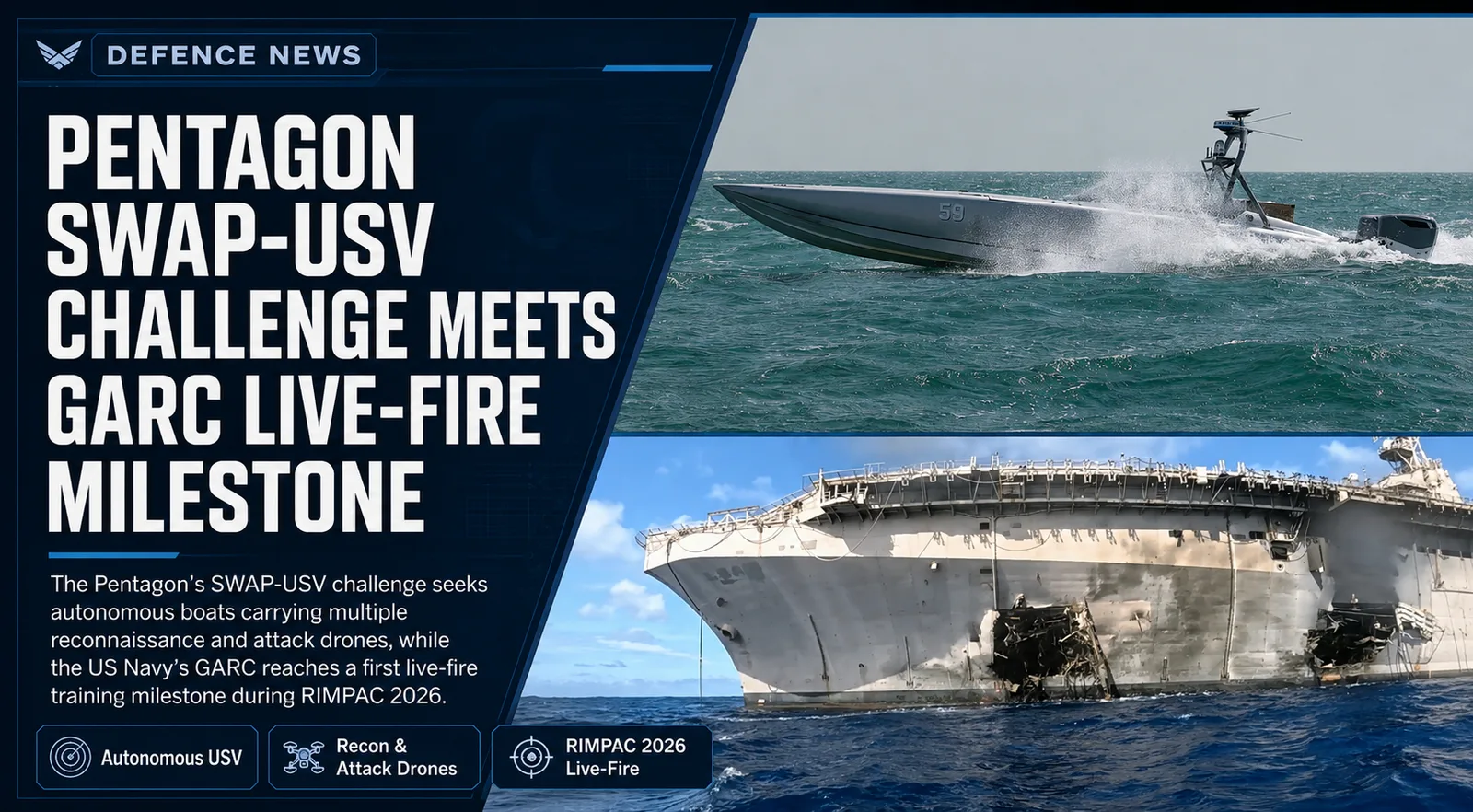
The requirement emerged as the US Navy demonstrated a separate but related autonomous maritime capability. Defense News reported that a Global Autonomous Reconnaissance Craft, or GARC, participated in its first live-fire training exercise during the sinking of the decommissioned USS Peleliu at RIMPAC 2026.
The two developments demonstrate different stages of the Pentagon’s maritime-autonomy effort. SWAP-USV defines a future system combining surface vessels and aerial drones, while GARC is an existing small unmanned surface vessel already being used for experimentation, surveillance, escort, maritime-domain awareness and modular payload testing.
Key Facts
- Programme: Suitable Warfighting Adaptive Payloads for Unmanned Surface Vessels, or SWAP-USV.
- Organisation: Defense Innovation Unit.
- Submission deadline: 10 August 2026 for Sprint 1.
- Prize funding: Up to $100 million across three competition sprints.
- Follow-on funding: Up to $200 million for eligible prototype, production and operational-integration agreements.
- USV requirement: Minimum operational range of 200 nautical miles.
- Sustained cruise speed: At least 10 knots.
- Drone capacity: At least two aerial drones.
- Kinetic requirement: At least one drone must support a kinetic payload of 2 kg or more.
- Drone mix: Recoverable, reusable and one-way-attack systems are encouraged.
- Mission areas: ISR, communications relay, electronic warfare, payload delivery and precision engagement.
- Operational environments: Blue water, littoral and brown water.
- Urgency: Sprint 1 targets forward operational fielding within 120 days.
- Testing readiness: Selected Sprint 1 systems must be ready for evaluation within 29 days of down-selection.
- Related Navy milestone: GARC participated in its first reported live-fire training exercise during RIMPAC 2026.
What Is the SWAP-USV Programme?
SWAP-USV is a Pentagon competition intended to identify affordable and rapidly deployable combinations of unmanned surface vessels and unmanned aerial systems.
The programme is focused on complete mission-ready systems rather than conceptual designs. Participating companies are expected to provide vessels, drones, command-and-control architecture, sensors and integration capability mature enough for near-term in-water testing.
The solicitation is open to US and international companies. Maritime manufacturers, autonomy developers, sensor companies and drone manufacturers may submit integrated solutions or participate through industry partnerships.
Standalone USV, UAS and payload suppliers can also submit proposals, provided that they supply sufficient interface documentation for subsequent government-directed integration.
Why Does the Pentagon Want Robot Boats That Launch Drones?
The requirement is driven by the increasing use of inexpensive and difficult-to-detect threats in contested maritime environments.
The DIU solicitation identifies explosive unmanned surface vessels, Group 1–3 aerial drones, high-speed smuggling boats and semi-submersible vessels among the threats that existing naval forces may need to detect and intercept.
Using large warships, crewed aircraft or expensive missiles against relatively cheap targets creates an unfavourable cost-exchange ratio. A low-cost unmanned boat carrying several drones could maintain surveillance and deliver an operational effect without continuously committing a destroyer, helicopter or maritime-patrol aircraft.
The surface vessel provides range, endurance, fuel, communications equipment and payload capacity. The aerial drones extend the system’s sensor horizon, investigate contacts and potentially engage targets beyond the direct line of sight of the boat.
What Must a SWAP-USV System Be Able to Do?
The Pentagon wants the complete system to perform persistent maritime search, tracking, interdiction and operational-effect missions with limited personnel and logistics requirements.
- Navigate autonomously or under remote control to user-defined waypoints
- Patrol designated maritime areas
- Loiter on station for extended periods
- Reposition in response to operator commands or changing objectives
- Detect, identify and track surface vessels
- Launch at least two aerial drones
- Control drones through beyond-line-of-sight links
- Provide real-time situational awareness to operators
- Support battle-damage assessment
- Conduct ISR, communications relay and electronic-warfare missions
- Deliver payloads or conduct precision engagement under operator command
- Operate in open-ocean, coastal and riverine environments
- Return to base or be recovered after the mission
Autonomous following, shadowing and interception of non-cooperative manoeuvring vessels are desired capabilities, although the solicitation does not make fully autonomous execution mandatory.
How Many Drones Must the Robot Boat Carry?
Each proposed surface vessel must carry, launch, control and employ at least two aerial drones.
The Pentagon encourages a mixed aerial package rather than multiple identical aircraft. A mission configuration could combine a recoverable surveillance drone with a smaller expendable or one-way-attack aircraft.
The solicitation states that the aerial package must support kinetic strike and battle-damage assessment. Under the primary attributes, at least one drone must be capable of carrying a kinetic payload of 2 kg or more.
Systems carrying a larger number of drones, higher payloads or aircraft able to engage both surface and low-altitude aerial threats will receive more favourable consideration.
Will the Drones Be Recoverable?
SWAP-USV may combine recoverable, reusable, attritable and expendable aerial systems.
If a proposed drone is recoverable, it should be able to return to the surface vessel while the boat is underway and in representative sea conditions with minimal operator intervention.
Recovering a small aircraft on a moving and pitching vessel presents significant technical challenges. The drone must locate the vessel, match its movement, compensate for wind and sea state and connect with a landing or capture mechanism.
Expendable or one-way-attack drones avoid the recovery problem but increase magazine and resupply requirements. DIU also requires mission-abort and safety mechanisms intended to reduce unexploded-ordnance hazards.
What Is the GARC Unmanned Surface Vessel?
The Global Autonomous Reconnaissance Craft is a compact unmanned surface vessel developed by Baltimore-based BlackSea Technologies.
The manufacturer describes GARC as a production-ready tactical vessel with modular payloads, autonomous and remote-control modes and support for third-party mission systems.
BlackSea identifies ISR, communications relay, mine countermeasures, strike, survey and interdiction among the missions that can be supported by the platform.
Defense News reports a length of approximately 16 feet, a payload capacity of up to 1,000 pounds, a maximum range of around 700 nautical miles and a speed of approximately 22 knots. These figures are attributed to company information.
The US Navy’s small-USV fact file confirms that GARC vessels have been acquired through rapid-procurement mechanisms and used by multiple customers to test payloads and concepts of employment.
What Happened During the GARC Live-Fire Exercise?
A GARC operated during the RIMPAC 2026 sinking exercise involving the former USS Peleliu on 17 July 2026.
Unmanned Surface Vessel Division 32, or USVDIV-32, conducted the GARC activity during the exercise. The unit’s commanding officer described the event as the Navy’s first GARC live-fire operation.
The vessel provided a close-range unmanned perspective and supported targeting or observation of the decommissioned amphibious assault ship during the multinational SINKEX.
The official US Navy RIMPAC release confirms that USS Peleliu was sunk on 17 July in waters more than 50 nautical miles north of Kauai. It also confirms that the former cruiser USS Mobile Bay was sunk during a separate event on 12 July.
The Navy release lists participating US and allied forces but does not provide a detailed account of GARC’s specific payload, control mode or contribution to the engagement sequence.
Did GARC Fire a Weapon During the SINKEX?
The available sources do not establish that GARC itself launched a missile, explosive charge or aerial attack drone during the Peleliu SINKEX.
Defense News describes the vessel as participating in targeting the hulk and identifies the event as GARC’s first live-fire training exercise. The official Navy release confirms the wider SINKEX but does not attribute a weapon launch to GARC.
The milestone should therefore be described as GARC’s first participation in a live-fire training event rather than its first confirmed autonomous weapons engagement.
This distinction is important because surveillance, target tracking, strike support and direct weapons employment represent different levels of operational and legal responsibility.
SWAP-USV Requirements and GARC Comparison
The comparison below places publicly reported GARC characteristics alongside the SWAP-USV threshold requirements. GARC has not been publicly identified as a SWAP-USV competitor, and the comparison does not establish that it complies with every requirement.
| Capability Area | SWAP-USV Requirement | GARC Published or Reported Baseline | Assessment |
|---|---|---|---|
| Programme status | Production-ready integrated USV-UAS system | Production USV used for Navy experimentation and exercises | GARC is mature as a surface platform, but SWAP-specific aerial-drone integration is not confirmed |
| Operational range | Minimum 200 nautical miles | Approximately 700 nautical miles, according to Defense News citing BlackSea | The reported GARC figure exceeds the SWAP-USV threshold |
| Sustained speed | At least 10 knots | Approximately 22 knots, according to Defense News citing BlackSea | The reported speed exceeds the programme threshold |
| Surface-vessel payload | Sufficient capacity for multiple drones, sensors and launch equipment | Up to 1,000 pounds, according to reported company data | Physical payload capacity appears significant, but usable drone-launch volume is not disclosed |
| Aerial-drone capacity | At least two UAS | No confirmed multi-UAS launch configuration in the cited GARC sources | Compliance cannot be established from public information |
| Kinetic aerial effect | At least one UAS with a payload of 2 kg or more | GARC live-fire participation confirmed, but direct weapons or attack-drone launch not established | No confirmed match to the SWAP-USV kinetic-UAS requirement |
| Autonomy | Autonomous navigation, patrol, loiter and desired autonomous interception | Supports autonomous and remote operations, waypoint navigation and target following | Broad conceptual alignment exists, subject to test verification |
| Mission architecture | Open architecture and multi-vendor payload integration | Modular payload design and integration of third-party tools | Potential alignment, but SWAP interface compliance has not been disclosed |
| Production readiness | Active production line and surge capacity | BlackSea states that its Baltimore line can complete one GARC per day | GARC appears to meet the intended level of surface-platform production maturity |
| Operational record | Prior demonstrations and proven system integration required | Navy experimentation, underway launch trials, BALTOPS, Obangame Express and RIMPAC participation | GARC has a developing exercise and experimentation record |
How Does the SWAP-USV Competition Work?
The competition is divided into three rolling sprint cohorts. More mature systems may enter the earliest sprint, while platforms requiring additional integration may be assigned to later phases.
| Sprint | Submission Window | In-Water Testing | Primary Objective | Maximum Prize |
|---|---|---|---|---|
| Sprint 1 | 10 August 2026 | Autumn 2026 | Immediate forward operational fielding within 120 days | Up to $40 million |
| Sprint 2 | Autumn 2026 | Early 2027 | Expanded payloads, improved autonomy and multi-vendor integration | Up to $40 million |
| Sprint 3 | Spring 2027 | Summer 2027 | Objectives to be announced | Up to $20 million |
Companies that successfully complete the test programme may become eligible for prototype, follow-on production and theatre-integration agreements supported by a separate $200 million government budget.
Why Is the 120-Day Fielding Target Significant?
The 120-day target indicates that the Pentagon is seeking an immediate operational capability rather than beginning a conventional multiyear development programme.
Sprint 1 proposals must involve systems with established production lines, prior demonstrations and complete command-and-control architectures.
Selected companies must make a mission-ready vessel available for evaluation within 29 days of down-selection. This requirement leaves little time for major redesign, new airframe development or first-time integration.
The schedule favours companies that have already integrated drones with surface vessels or formed mature partnerships before submitting their proposals.
How Will the Robot Boats Operate Without GPS?
The solicitation requires operations in denied, disrupted, intermittent and limited communications environments.
Systems must retain resilient communications with operators and be capable of determining their position when satellite navigation is jammed, degraded or spoofed.
Alternative navigation may involve inertial systems, radar navigation, visual localisation, terrain or coastline matching and data from other platforms. The solicitation does not prescribe one specific technical solution.
Loss of communications is particularly important for armed systems. Safe behaviour must be defined for situations in which the vessel or its drones can no longer receive operator commands.
Will the System Operate Autonomously or Under Human Control?
The Pentagon is seeking a combination of autonomous movement and direct operator supervision.
The boat and drones should autonomously navigate, patrol, maintain station and respond to mission objectives. Autonomous shadowing or interception of vessels is desired.
However, the solicitation specifies precision engagement under operator command and requires communications pathways that allow direct supervision.
The stated architecture therefore resembles supervised autonomy rather than an unrestricted autonomous weapons system. Operators retain responsibility for mission direction and sensitive engagement decisions.
How Could USV-Launched Drones Be Used Operationally?
A robot boat carrying aerial drones could support missions extending from surveillance to precision engagement.
- Searching for explosive drone boats
- Monitoring ports, waterways and coastal approaches
- Tracking high-speed smuggling vessels
- Detecting semi-submersible craft
- Inspecting contacts beyond the boat’s radar horizon
- Providing communications relay for dispersed naval forces
- Conducting electronic-warfare missions
- Delivering sensors or other payloads
- Engaging moving or stationary surface targets
- Conducting battle-damage assessment
- Protecting naval bases and logistics vessels
- Supporting convoy escort and maritime interdiction
Different drone types could be assigned separate tasks during the same mission. One aircraft could maintain surveillance while another conducts identification, electronic attack or precision engagement.
Why Are Modular Payloads Important?
Modular payloads allow the same surface vessel to be reconfigured for surveillance, communications, electronic warfare, mine countermeasures or attack missions.
The Pentagon is encouraging open architectures that support drones, sensors and software supplied by different companies.
This approach could reduce dependence on one manufacturer and allow faster integration of new technology. It could also permit customers to replace a drone or sensor without redesigning the complete vessel.
Successful modularity will depend on standardised mechanical, electrical, data and command interfaces. Public documentation does not yet identify the final government interface standards that will be required for production systems.
How Will the Systems Be Transported?
The Pentagon wants systems that can be moved without specialised strategic-transport arrangements.
Preferred configurations should fit within a standard 40-foot cargo container, travel on common road trailers and be transportable aboard C-17 or C-130 aircraft.
Solutions capable of launching from unimproved coastal locations or being deployed remotely from a container will receive favourable consideration.
Transportability would allow the systems to be dispersed among islands, ports, riverbanks and temporary operating sites rather than being tied to large naval bases.
What Does the Programme Mean for the Defence Industry?
SWAP-USV favours companies that combine commercial manufacturing speed with military-grade integration and communications.
The programme is likely to encourage partnerships between boatbuilders, drone companies, autonomy-software developers, sensor suppliers and command-and-control specialists.
Production capacity will be evaluated alongside technical performance. Companies must explain manufacturing throughput, workforce readiness, supply-chain resilience and their ability to increase output rapidly.
BlackSea’s claim that its GARC production line can complete one vessel per day illustrates the type of industrial scale the Pentagon is seeking, although GARC has not been confirmed as a SWAP-USV submission.
What Are the Main Technical and Operational Risks?
Combining autonomous vessels, aerial drones, sensors and kinetic payloads creates a complex system with several potential failure points.
- Reliable drone launch from a moving vessel
- Recovery of reusable aircraft in adverse weather
- Command and control beyond line of sight
- GNSS-denied navigation
- Resilience against electronic attack and cyber intrusion
- Target identification and prevention of misidentification
- Integration of drones from different manufacturers
- Safe handling of kinetic payloads at sea
- Mission-abort procedures for one-way systems
- Autonomous collision avoidance in crowded waterways
- Maintaining positive human control during communications disruption
- Sea-state limitations affecting launch and recovery
- Resupply and replacement of expendable drones
- Balancing cost, range, payload and survivability
The accelerated schedule may expose integration problems that would normally be addressed during a longer development and qualification programme.
What Happens Next?
Sprint 1 proposals are due by 10 August 2026. DIU will review system maturity, manufacturing readiness, previous demonstrations and the ability to conduct integrated testing.
Selected systems will undergo initial vendor-operated evaluations followed by government-operated operational testing.
The test programme will examine autonomous transit, speed, endurance, fuel use, drone launch, target detection, communications, third-party command integration and operations under jamming or degraded navigation.
Later testing is expected to include simultaneous drone deployment, dynamic target tracking, simulated interception and complete tactical mission profiles.
In parallel, the Navy is likely to continue expanding GARC missions and payloads as USVDIV-32 and other units develop operating concepts for small unmanned surface vessels.
Conclusion
The SWAP-USV challenge represents a significant step toward combining autonomous surface vessels with aerial reconnaissance and attack drones.
The Pentagon is not seeking an experimental concept. It wants production-ready systems with at least two drones, a minimum surface-vessel range of 200 nautical miles and the ability to conduct surveillance, electronic-warfare and precision-engagement missions.
The programme’s $100 million prize structure and $200 million follow-on budget demonstrate the urgency attached to improving the cost-exchange ratio against inexpensive maritime threats.
GARC’s participation in the RIMPAC 2026 Peleliu SINKEX provides a separate example of how compact unmanned boats are progressing from experimentation toward operationally relevant training.
However, the cited sources do not establish that GARC launched a weapon or aerial attack drone during the exercise. Its confirmed milestone was participation in a live-fire event involving targeting, observation or strike support.
The next major indicators will be the SWAP-USV Sprint 1 selections, in-water trials during autumn 2026 and whether an integrated surface-and-air system can be forward fielded within the targeted 120-day period.
For related coverage, visit Defence Agenda’s naval warfare, unmanned systems and C4ISR sections. Related reports include Airbus MARS networked UAV missions, Taiwan’s Batch 2 Tuo Chiang missile corvette and South Korea’s KSAM-II naval air-defence missile.
Further Reading
- Defense News: Pentagon seeks robot boats that launch attack drones
- Defense Innovation Unit: SWAP-USV official solicitation
- Defense News: GARC completes first live-fire training exercise
- US Navy: RIMPAC 2026 SINKEX involving USS Peleliu and USS Mobile Bay
- US Navy: Small Unmanned Surface Vessel Family of Systems
- BlackSea Technologies: Global Autonomous Reconnaissance Craft
- US Navy: GARC operations during Obangame Express 2026