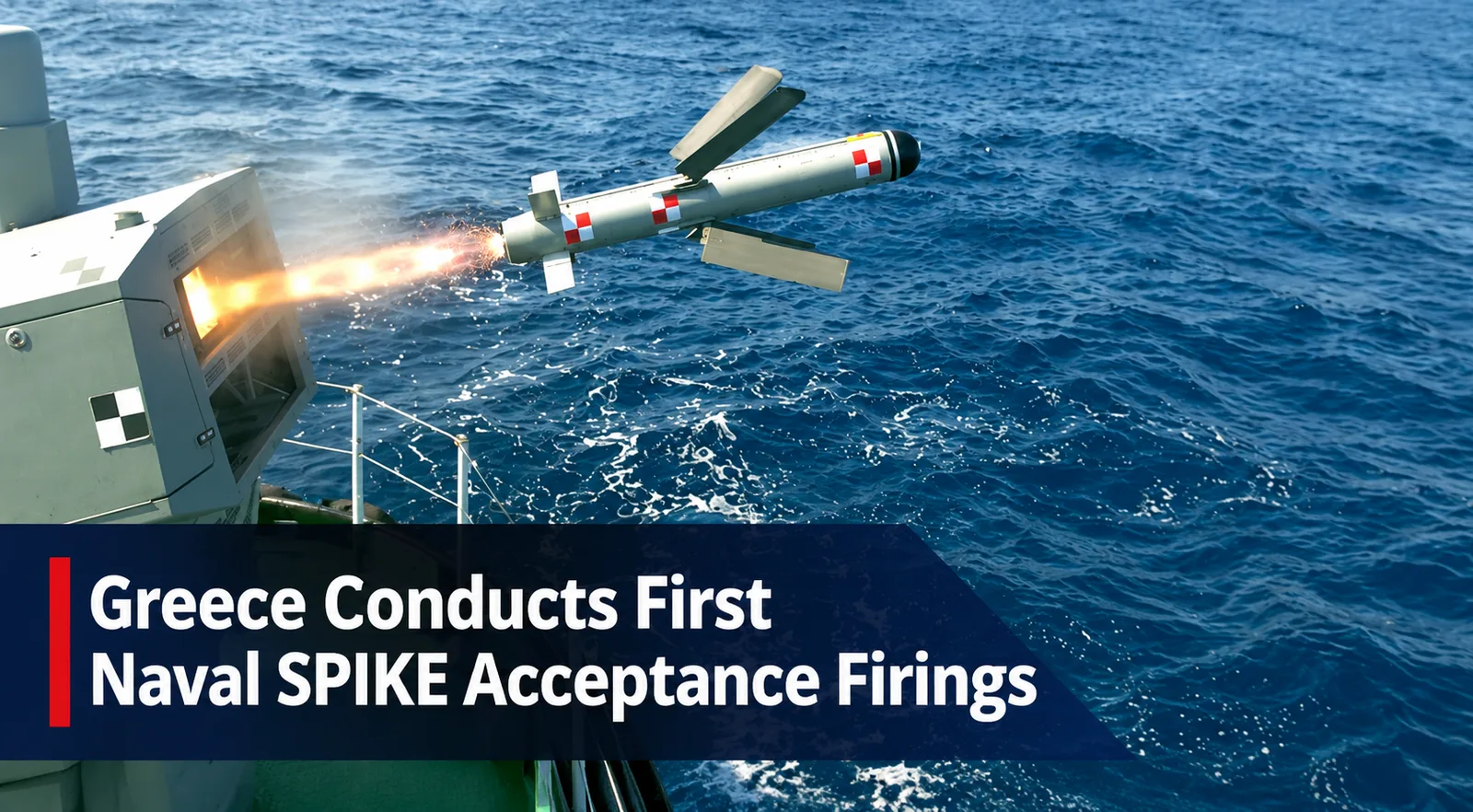
The Hellenic Navy conducted acceptance firings of SPIKE NLOS and SPIKE ER guided missiles in the northern Cretan Sea on 21 October 2026, using a Machitis-class gunboat and a Mark V special-operations craft during joint activity with the Israeli Navy. The event provides direct evidence of naval launcher integration and live use of the new weapons.
Official account establishes the acceptance milestone
The Hellenic Navy stated on 23 October that the missiles were successfully launched during joint operational training attended by senior Greek and Israeli naval commanders. The participating force included frigates, submarines, patrol craft, naval aviation and two Israeli guided-missile craft. Greek officials described the activities as acceptance firings of SPIKE NLOS and ER guided missiles.
Naval News identified the longer-range fit as SPIKE NLOS on the Machitis-class patrol vessel and SPIKE ER2 on the Mark V craft. The official Hellenic release uses the broader ER designation, so reporting should preserve the source difference rather than silently expand the navy’s formal nomenclature. The reported launch outcome does not disclose all qualification criteria.
Small-vessel precision firepower is the main change
Installing modern guided missiles on patrol and special-operations vessels can allow them to engage designated coastal or surface targets without relying entirely on their guns. This can make smaller ships more relevant to distributed maritime operations, where larger combatants may be tasked elsewhere and targeting may depend on networked sensors.
The capability remains bounded by the vessel’s sensor picture, launcher integration, engagement rules and available missile stocks. A marketed maximum range is not proof that a particular shot used that distance, and the public exercise reporting does not establish an operational engagement envelope in contested electronic or maritime conditions.
Bouboulina sinking involved another weapon
The exercise used the decommissioned frigate Bouboulina as a surface target. Following the missile activity, the hull was sunk by an SUT heavyweight torpedo fired from a Hellenic Navy submarine. This sequence matters because the sinking should not be attributed solely to the SPIKE missile engagements.
The broader exercise tested coordination among several force elements rather than only the weapon’s terminal effects. Israeli naval participation added a bilateral interoperability component, although the exact missile systems fired by Israeli craft were not specified in the official summary and should not be guessed.
Integration and readiness questions remain
A successful acceptance firing indicates that a defined live-test step was performed, but separate decisions can govern final technical acceptance, maintenance procedures, crew certification and routine operational deployment. The number of launchers, support packages and ammunition replenishment available to each unit is essential to understanding the sustained military value.
The Hellenic Navy and Rafael will also need to maintain secure mission-planning and targeting processes appropriate for the vessels’ size and roles. Future exercise evidence can show whether the missile installations are being integrated into broader Greek naval command networks rather than remaining stand-alone weapons.
For smaller combatants, weapon availability is inseparable from the targeting chain. Even a successful guided-missile launch may rely on a target detected by the firing vessel, another ship, a helicopter or a shore-based sensor. Commanders need procedures for avoiding duplicated engagements and for distinguishing hostile, neutral and friendly contacts in congested waters. The acceptance firings provide evidence about the launcher, crew and missile interface under the exercise conditions, but they do not disclose how the targeting process performed under jamming or degraded navigation. Sustained operational value also depends on how quickly a small craft can reload, obtain technical support and return to patrol after expending weapons. Future Hellenic Navy reporting that covers these logistical and network questions would help establish the effect of the upgrade far more clearly than maximum-range figures taken from a sales brochure.
Implications / Next
Next verified milestones should include formal acceptance documentation, additional ship and crew certifications, resupply arrangements and operational exercises demonstrating maritime targeting with multiple sensors. These October firings should be described as acceptance trials, not a declaration of fleet-wide initial operational capability.