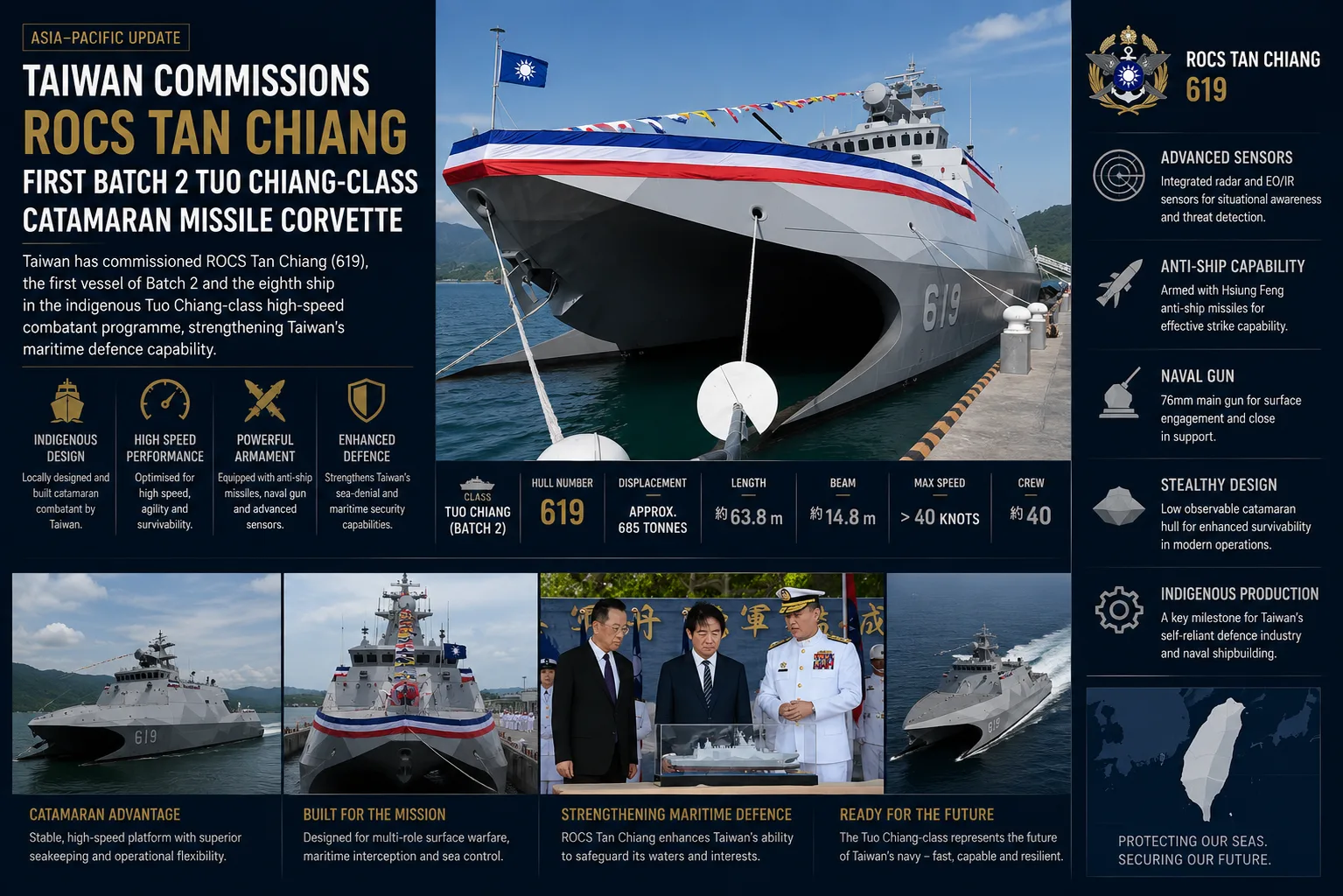
Tan Chiang Tuo Chiang corvette commissioning marks the entry into service of Taiwan’s first Batch 2 high-speed catamaran missile ship and advances the Republic of China Navy’s plan to operate 12 vessels of the class.
ROCS Tan Chiang, identified by pennant number PGG-627, was formally commissioned at Tsoying Naval Base in Kaohsiung on 24 July 2026. Taiwanese President Lai Ching-te presided over the ceremony alongside senior defence, national-security and naval officials.
The vessel’s name is written as 丹江 in Chinese. Naval News and Janes use the English rendering “Tan Chiang”, while the Taipei Times report uses “Dan Chiang”. Both names refer to the same PGG-627 warship.
The official Taiwan Ministry of National Defense announcement describes the commissioning as another milestone in the country’s indigenous-warship programme. Taiwan expects all 12 planned Tuo Chiang-class corvettes to be delivered by the end of 2026.
Key Facts
- Ship: ROCS Tan Chiang, also rendered Dan Chiang.
- Pennant number: PGG-627.
- Commissioning date: 24 July 2026.
- Location: Tsoying or Zuoying Naval Base, Kaohsiung.
- Fleet position: Eighth Tuo Chiang-class corvette overall.
- Production status: First vessel in the second production batch.
- Planned class strength: 12 ships, including the prototype.
- Completion target: All 12 vessels delivered by the end of 2026.
- Shipbuilder: Lungteh Shipbuilding.
- Reported displacement: Approximately 685 tonnes.
- Reported maximum speed: Approximately 44–45 knots.
- Reported operating range: Approximately 1,800–2,000 nautical miles.
- Batch 2 radar: Leonardo NA-30S Mk2 fire-control radar.
- Principal roles: Anti-surface warfare, air defence, patrol, escort and littoral sea-control operations.
What Is ROCS Tan Chiang?
ROCS Tan Chiang is a high-speed, low-observable, catamaran-hulled missile corvette developed for the Republic of China Navy.
The ship is the first vessel in the second production batch of the Tuo Chiang programme. It follows the original prototype, ROCS Tuo Chiang, and six vessels belonging to the first production batch.
The second batch consists of five additional ships. Together with the prototype and six Batch 1 vessels, these ships are intended to bring the total Tuo Chiang-class force to 12.
The design combines a wave-piercing catamaran hull, waterjet propulsion, reduced-radar-signature features and a concentrated missile armament. Taiwan developed the class to give its navy a fast and comparatively small combatant capable of threatening larger surface ships.
Why Is Tan Chiang’s Commissioning Important?
The commissioning demonstrates that Taiwan’s programme has progressed from an experimental prototype to repeatable domestic production across multiple configurations.
Taiwanese officials have presented the programme as evidence that local organisations can design, build, integrate, maintain and upgrade advanced combat ships without relying entirely on foreign shipyards.
The programme also supports Taiwan’s asymmetric-defence strategy. Instead of relying only on large destroyers and frigates, the navy can distribute anti-ship missiles across multiple fast and manoeuvrable platforms.
A larger number of smaller missile ships can complicate an opponent’s surveillance, targeting and engagement planning, particularly in coastal and littoral waters.
How Does Batch 2 Differ From Earlier Tuo Chiang Corvettes?
The most clearly identified Batch 2 change is the installation of the Leonardo NA-30S Mk2 fire-control radar.
The six vessels in the first production batch use the STIR 1.2 EO Mk2 fire-control radar. Naval News reports that the Batch 2 radar change followed the inability to continue sourcing the Thales-manufactured STIR system for the later ships.
The NA-30S Mk2 is intended to support gun and missile fire-control functions and provide tracking data against air and surface targets. The complete Taiwan-specific configuration has not been publicly detailed.
Batch 2 also places greater emphasis on Hsiung Feng III supersonic anti-ship missiles. Public reporting indicates that these ships are expected to carry more Hsiung Feng III missiles and fewer Hsiung Feng II missiles than the first production batch.
Tuo Chiang Prototype, Batch 1 and Batch 2 Comparison
The programme has developed through three identifiable configurations. The table separates confirmed differences from areas where complete technical data has not been released.
| Capability Area | Prototype | Production Batch 1 | Production Batch 2 |
|---|---|---|---|
| Lead vessel | ROCS Tuo Chiang, PGG-618 | ROCS Ta Chiang, PGG-619 | ROCS Tan Chiang, PGG-627 |
| Number planned or completed | One prototype | Six vessels | Five vessels |
| Approximate displacement | Approximately 600 tonnes | Approximately 685 tonnes | Approximately 685 tonnes |
| Approximate length | Approximately 60 metres | Approximately 65 metres | Approximately 65 metres |
| Hull configuration | Wave-piercing catamaran | Improved wave-piercing catamaran | Improved wave-piercing catamaran |
| Fire-control radar | Prototype configuration | STIR 1.2 EO Mk2 | Leonardo NA-30S Mk2 |
| Organic surface-to-air missiles | Not fitted in the original configuration | TC-2N Sea Sword II | TC-2N Sea Sword II |
| Anti-ship emphasis | Hsiung Feng II and Hsiung Feng III missiles | Larger proportion of Hsiung Feng II missiles | Larger proportion of Hsiung Feng III missiles |
| Air-defence capability | Primarily close-in defence | TC-2N and Phalanx layered protection | TC-2N, Phalanx and updated fire-control radar |
| Programme role | Design validation and initial operational concept | First serially produced operational group | Final production group completing the 12-ship force |
What Weapons Does Tan Chiang Carry?
The Tuo Chiang family combines anti-ship, surface-to-air, naval-gun and close-in defensive weapons on a comparatively small hull.
Public reporting on the second production batch identifies the following principal weapons:
- Hsiung Feng II subsonic anti-ship missiles
- Hsiung Feng III supersonic anti-ship missiles
- TC-2N Sea Sword II surface-to-air missiles
- 76 mm OTO Melara naval gun
- Phalanx Close-In Weapon System
- Heavy machine guns for short-range defence
Reporting before Tan Chiang’s commissioning indicated a Batch 2 anti-ship load of four Hsiung Feng II and eight Hsiung Feng III missiles. The precise operational load can vary according to mission requirements and official confirmation of the commissioned ship’s complete loadout remains limited.
The increased number of Hsiung Feng III missiles strengthens the ship’s ability to threaten larger and faster surface combatants with supersonic weapons.
What Air-Defence Capability Does the Ship Have?
The improved production vessels carry TC-2N Sea Sword II surface-to-air missiles, giving the ships an organic air-defence capability that was absent from the original prototype configuration.
The TC-2N layer is intended to engage aircraft and incoming aerial threats before they reach the ship’s close-in defensive system.
Phalanx provides the final gun-based defensive layer against missiles and other close-range threats. The 76 mm gun can also support engagements against surface and selected aerial targets.
The Leonardo NA-30S Mk2 fire-control radar is a key Batch 2 component because it supports precise tracking and engagement functions. Its effectiveness will also depend on integration with the ship’s search radar, combat-management system and missile-control architecture.
How Fast Is the Tuo Chiang Class?
Published estimates generally place the class’s maximum speed at approximately 44–45 knots.
The ships use diesel engines connected to waterjet propulsion. Waterjets support high speed and manoeuvrability while avoiding exposed conventional propellers.
The combination of speed and a reduced radar cross-section supports hit-and-run tactics. A corvette can move quickly into a firing position, launch anti-ship missiles and attempt to relocate before an opposing force can respond.
High speed does not make the ship invulnerable. Survivability also depends on emissions control, electronic warfare, deception, air cover, shore-based support and coordination with other naval units.
What Missions Will Tan Chiang Perform?
Taiwan’s Ministry of National Defense describes the class as a flexible force for both peacetime security missions and wartime combat operations.
Peacetime tasks can include:
- Maritime patrol
- Routine readiness exercises
- Escort of transport vessels serving offshore islands
- Monitoring activity in Taiwan’s surrounding waters
- Supporting larger naval task groups
Potential wartime missions include:
- Anti-surface warfare
- Sea-control operations
- Counter-blockade missions
- Coordinated missile attacks
- Command and control of smaller missile craft
- Rapid defence of offshore islands
- Patrol and port defence
- Reconnaissance and support to special operations
- Support for offensive and defensive minelaying
- Transport of limited supplies to offshore positions
The complete mission set will depend on task-group composition, threat conditions and support from shore-based surveillance and command networks.
Why Does Taiwan Use Catamaran Missile Corvettes?
The catamaran configuration provides a broad deck area and high-speed potential on a relatively short hull.
For Taiwan, the design supports the deployment of significant missile firepower on a platform smaller and less expensive than a conventional frigate or destroyer.
The ships can operate in coastal waters, around offshore islands and within dispersed naval formations. Their speed allows them to respond rapidly to maritime developments and reposition between operating areas.
The design also involves trade-offs. Smaller combatants normally have less endurance, limited damage tolerance and reduced space for future equipment compared with larger warships.
Is the Tuo Chiang Really a Carrier Killer?
“Carrier killer” is a media nickname rather than an official ship classification.
The description reflects the vessel’s ability to carry multiple Hsiung Feng anti-ship missiles, including the supersonic Hsiung Feng III.
A single small corvette would not normally operate alone against an aircraft-carrier strike group. Any successful attack would require intelligence, surveillance, targeting information, coordination with other launch platforms and the ability to penetrate layered air and missile defences.
The more relevant operational concept is distributed missile firepower. Multiple corvettes, shore batteries, aircraft and other platforms could launch coordinated attacks from different positions.
Who Built Tan Chiang?
Tan Chiang was constructed by Taiwan’s Lungteh Shipbuilding.
The wider programme also involves the Republic of China Navy, Taiwan’s Ministry of National Defense, the National Chung-Shan Institute of Science and Technology and a broader domestic defence-industry supply chain.
Local participation covers shipbuilding, weapon integration, command systems, sensors, missiles, testing and through-life support.
Taiwanese officials argue that domestic production gives the navy greater control over repairs, modifications and wartime sustainment.
When Will the Remaining Tuo Chiang Corvettes Enter Service?
Construction of the five Batch 2 ships began in 2024. Naval News reports that deliveries are scheduled between March and December 2026.
Taiwan’s official target is to complete delivery of all 12 Tuo Chiang-class ships by the end of 2026.
Tan Chiang was delivered by the shipbuilder in March 2026 before completing navy preparations and entering commissioned service in July.
The remaining Batch 2 vessels must complete construction, equipment installation, harbour trials, sea trials, acceptance and crew preparation before commissioning.
How Does the Programme Support Taiwan’s Naval Strategy?
The programme expands Taiwan’s ability to distribute anti-ship weapons across a larger number of naval platforms.
This supports an asymmetric approach in which smaller, mobile and heavily armed units attempt to impose operational risk on a larger opposing fleet.
The vessels can supplement Taiwan’s destroyers and frigates rather than replace them. Larger warships retain advantages in endurance, sensors, command facilities, air defence and sustained operations.
Tuo Chiang-class ships provide an additional missile-launching layer optimised for speed, coastal operations and dispersed deployment.
What Are the Main Operational Limitations?
The Tuo Chiang concept offers concentrated firepower, but its operational value depends on several supporting capabilities.
- Reliable targeting data beyond the ship’s own sensor horizon
- Secure communications during electronic warfare
- Protection against aircraft, submarines and long-range missiles
- Access to dispersed ports and replenishment facilities
- Coordination with shore-based missile and surveillance units
- Maintenance of waterjet propulsion and advanced combat systems
- Damage control on a relatively small hull
- Survivability against persistent airborne and satellite surveillance
- Availability of missiles and replacement components during sustained conflict
The ships are therefore best understood as one component of a wider joint defence network rather than independent strategic systems.
Conclusion
The commissioning of ROCS Tan Chiang marks the beginning of the second and final production batch of Taiwan’s 12-ship Tuo Chiang-class programme.
The vessel is the eighth ship of the class and introduces the Leonardo NA-30S Mk2 fire-control radar to Taiwan’s serially produced catamaran missile corvettes.
Its combination of Hsiung Feng anti-ship missiles, TC-2N air-defence missiles, a 76 mm gun and close-in protection gives a 685-tonne platform significant offensive and defensive firepower.
Tan Chiang also demonstrates the industrial progress of Taiwan’s indigenous-warship programme. Completion of the remaining Batch 2 ships by the end of 2026 would give the navy a full force of 12 Tuo Chiang-class vessels.
The next indicators will be commissioning of the remaining Batch 2 ships, operational integration of the new fire-control radar and the class’s participation in increasingly complex naval exercises.
For related coverage, visit Defence Agenda’s naval warfare, missiles and defence industry sections. Related reports include South Korea’s KSAM-II naval air-defence missile, Türkiye’s TCG KARADENİZ frigate launch and defence supply-chain security and critical minerals.
Further Reading
- Janes: Taiwan commissions lead Batch 2 Tuo Chiang-class corvette
- Naval News: Taiwan Navy commissions first Batch 2 Tuo Chiang-class corvette
- Taipei Times: New warship Dan Chiang commissioned
- Taiwan Ministry of National Defense: Tan Chiang commissioning announcement
- Office of the President: Tan Chiang commissioning ceremony
- Naval News: Tan Chiang delivered to the Taiwan Navy
- Republic of China Navy: Tuo Chiang programme overview