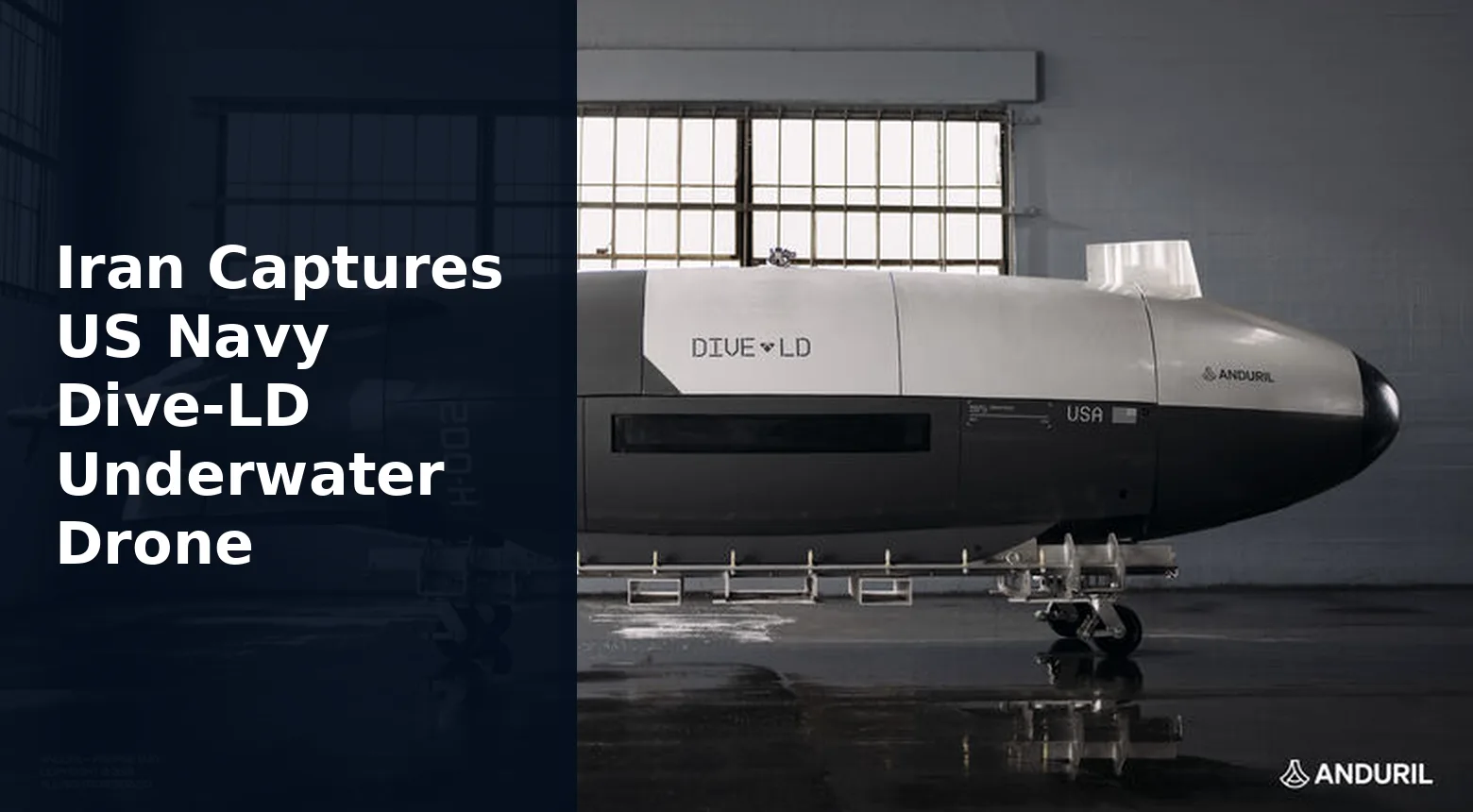
Iran’s Islamic Revolutionary Guard Corps captured a U.S. Navy Dive-LD autonomous underwater vehicle near the Strait of Hormuz after the craft reportedly malfunctioned. U.S. officials said the older vehicle carried no classified sensors or sensitive data, while Anduril confirmed the loss as a risk associated with deploying autonomous systems in hazardous environments. The incident exposes the operational and counter-intelligence costs of distributing uncrewed systems in contested waters. Even without classified payloads, physical access can reveal materials, manufacturing methods and design choices to an adversary.
The basic loss is acknowledged but narratives differ
Iran presented the capture as an intelligence and propaganda success. U.S. officials characterised the vehicle as an older system that malfunctioned and lacked sensitive sensors or data. Both statements can be true in part: a non-classified vehicle can still offer exploitable physical information.
Dive-LD is designed for long autonomous missions
Anduril describes the approximately 5.8-metre vehicle as capable of missions such as seabed mapping, mine countermeasures and infrastructure inspection. Public specifications cite operation for up to ten days and depth to 6,000 metres. Those are platform-level figures and do not identify the captured craft’s payload or mission.
Recoverability changes autonomy risk calculations
An uncrewed system can accept hazards that would be unacceptable for a crewed vessel. That advantage must be balanced against capture, reverse engineering and propaganda. Mission planning needs scuttling, data protection, fault recovery and retrieval concepts proportionate to the technology exposed.
Hardware exploitation has limits and value
An adversary may inspect hull materials, propulsion, connectors, manufacturing and component sourcing. Protected software, encrypted data and absent mission payloads can limit the intelligence gain. It is premature to claim that Iran can reproduce the complete system or access classified algorithms from the captured vehicle.
Programme and procurement context
This development must be read at its exact maturity level. Iran’s Islamic Revolutionary Guard Corps captured a U.S. Navy Dive-LD autonomous underwater vehicle near the Strait of Hormuz after the craft reportedly malfunctioned. U.S. officials said the older vehicle carried no classified sensors or sensitive data, while Anduril confirmed the loss as a risk associated with deploying autonomous systems in hazardous environments. Defence programmes pass through distinct stages: policy announcement, requirement definition, competition, contract, testing, production, delivery, acceptance and operational fielding. Collapsing those stages into a single claim can overstate both near-term military utility and industrial certainty.
For acquisition teams, the decisive evidence is funded scope, customer acceptance, integration responsibility and a supportable schedule. The incident exposes the operational and counter-intelligence costs of distributing uncrewed systems in contested waters. Even without classified payloads, physical access can reveal materials, manufacturing methods and design choices to an adversary. Public announcements rarely resolve every dependency. Training, secure data, range access, infrastructure, export approval and supplier capacity can delay useful capability even after a technically successful milestone.
Source discipline is equally important. Company releases naturally emphasise momentum; government notices may describe only funded scope; exercise reports show activity without proving full readiness. Values should be labelled as contract ceilings or estimates when appropriate, performance figures as manufacturer claims until independently demonstrated, and dates as targets unless a customer confirms completion. Later primary records should replace early reporting as the programme matures.
The operational question is not whether the technology can be shown once, but whether users can employ it repeatedly under representative conditions. That requires realistic testing, configuration control, trained personnel, spares and an accountable command chain. Industrial significance also depends on repeatable production and quality assurance rather than prototype output alone.
Implications / Next
Track a detailed U.S. incident review, recovery or disposition of the vehicle, software and data-security findings and any operational changes. Keep cost, payload and intelligence-gain claims attributed unless official evidence is released.
This item remains a draft pending final image-rights review, CMS media assignment and canonical publication data. A later report should be treated as a separate update only if it materially changes the programme status described here.
Further Reading
HAVELSAN Unveils AVISTA Underwater R&D Platform