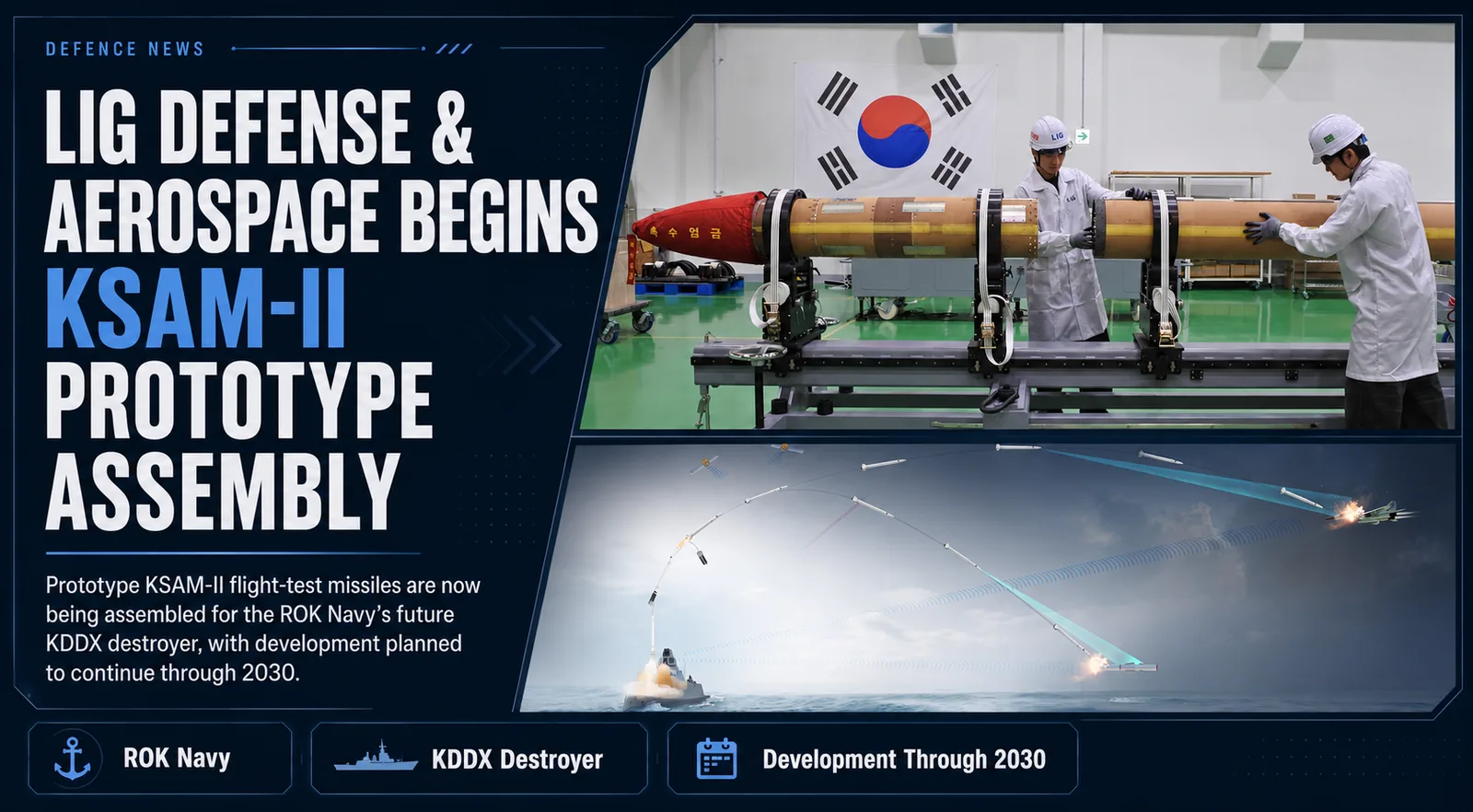
KSAM-II prototype assembly has started at LIG Defense & Aerospace’s dedicated missile facility as South Korea moves its indigenous long-range naval air-defence programme into the flight-test hardware stage.
According to Naval News’s report on the programme, LIG Defense & Aerospace has begun producing the first prototype missiles intended for flight testing under the Republic of Korea Navy’s Ship-to-Air Missile-II programme.
The weapon, commonly referred to as KSAM-II in English-language reporting, is being developed as a domestically produced replacement for the US-made SM-2 family aboard South Korea’s future surface combatants. Its first confirmed platform is the planned Korea Destroyer Next Generation, or KDDX.
The official LIG Defense & Aerospace programme announcement states that the missile is intended to counter hostile aircraft and cruise missiles and improve the survivability of ROK Navy vessels. South Korea’s Defense Acquisition Program Administration identifies the programme as a domestic development and production effort extending from 2023 to 2036, with system development scheduled through 2030.
Key Facts
- Programme: Ship-to-Air Missile-II, widely referred to as KSAM-II.
- Prime contractor: LIG Defense & Aerospace, formerly known as LIG Nex1.
- Customer: Republic of Korea Navy.
- Primary platform: Future KDDX destroyer.
- Role: Long-range naval air defence against aircraft and incoming cruise missiles.
- Replacement objective: Reduce reliance on imported SM-2 missiles.
- Launch system: Korean Vertical Launching System, with one KSAM-II carried per cell.
- Development period: System development scheduled through 2030.
- System-development contract: Approximately KRW 330.6 billion, according to Naval News.
- Total programme value: Approximately KRW 690 billion including production, according to DAPA.
- Localisation target: More than 90 percent.
- Reported missile length: Approximately six metres.
- Reported performance target: Around Mach 5 and manoeuvring loads of up to 17G.
- Test programme: More than ten launches are reportedly planned before service entry.
What Is the KSAM-II Missile?
KSAM-II is South Korea’s next-generation ship-launched long-range surface-to-air missile programme.
Its official Korean programme name translates as Ship-to-Air Guided Missile-II or Surface-to-Air Missile-II, depending on the English rendering used by the source. The KSAM-II abbreviation is commonly used in international naval-defence reporting.
The programme should not be confused with the existing K-SAAM, also known as Haegung or Sea Bow. K-SAAM is a shorter-range ship self-defence system already in production and service, while KSAM-II is intended to provide a broader fleet-area air-defence capability.
KSAM-II is being developed to engage enemy aircraft and cruise missiles before they reach the close-in defensive layer surrounding a warship or naval formation.
What Has LIG D&A Started Producing?
LIG Defense & Aerospace has moved from facility preparation and component development into the assembly of prototype flight-test missiles.
These missiles are not operational production weapons. They will be used to verify aerodynamics, propulsion, guidance, structural performance, vertical-launch compatibility and engagement functions during the development campaign.
Naval News reports that production of the first flight-test rounds began in July 2026 following a visit by Asia Business Daily to LIG D&A’s dedicated assembly and inspection facility in Gumi.
Starting prototype assembly is an important transition because it indicates that individual design elements are sufficiently mature to be combined into complete test articles.
How Is a KSAM-II Prototype Assembled?
According to the details reported by Naval News, the missile is approximately six metres long and is divided into three principal areas.
- Forward section: Guidance, navigation and control components.
- Main body: Warhead, propulsion and associated subsystems.
- Rear section: Booster used during the initial launch phase.
Each missile reportedly passes through approximately 20 assembly stages. The complete process is expected to take around three months per test missile.
The assembly sequence is likely to include mechanical integration, electrical connection, subsystem verification, software loading, safety inspections and end-to-end functional testing. The detailed industrial process has not been publicly released.
The six-metre length, number of assembly stages and three-month production period originate from media reporting following access to the Gumi facility. They should not be treated as a complete official production specification.
Where Is KSAM-II Being Assembled?
Prototype missiles are being assembled at LIG Defense & Aerospace’s Gumi House in South Korea.
The company completed a dedicated KSAM-II assembly and inspection facility at the site in March 2026. The facility was designed to support development, prototype manufacture, testing and future production activities.
More than 100 representatives from LIG D&A, DAPA, the Republic of Korea Joint Chiefs of Staff, the ROK Navy, the Agency for Defense Development and other defence organisations attended the facility-completion ceremony.
The dedicated infrastructure is intended to reduce development risk by bringing assembly, inspection and missile-system expertise together at one location.
What Performance Is KSAM-II Expected to Deliver?
Naval News reports that KSAM-II is being designed to reach approximately Mach 5 and withstand manoeuvring loads of up to 17G.
High speed would reduce the reaction time available to an incoming aircraft or cruise missile, while high manoeuvring tolerance would allow the interceptor to follow rapidly changing target trajectories.
Neither LIG D&A nor DAPA has published a complete official technical data sheet confirming the missile’s maximum engagement range, interception altitude, seeker type, warhead configuration or terminal-guidance method.
The reported Mach and manoeuvring figures should therefore be treated as development targets disclosed through industry reporting rather than fully qualified operational performance.
KSAM-II, K-SAAM and SM-2 Comparison
KSAM-II occupies a different defensive layer from the existing K-SAAM and is intended to reduce South Korea’s dependence on imported SM-2 missiles. Publicly available information does not yet permit a complete range-for-range or seeker-for-seeker comparison.
| Capability Area | KSAM-II | K-SAAM / Haegung | SM-2 in ROK Navy Service | Operational Meaning |
|---|---|---|---|---|
| Primary role | Long-range naval area air defence | Short-range ship self-defence and anti-missile protection | Imported fleet-area air-defence missile | The systems support different layers of a naval air-defence network |
| Development origin | South Korean domestic development | South Korean domestic development | United States | KSAM-II would increase domestic control over long-range missile supply |
| Main target set | Aircraft and cruise missiles | Incoming anti-ship missiles and aircraft at shorter ranges | Aircraft and cruise-missile threats, depending on variant and combat-system integration | KSAM-II is intended to engage threats before the point-defence layer is required |
| Programme status | Prototype assembly and system development | Development completed and in production and service | Operational imported system | KSAM-II must complete flight and interception testing before operational deployment |
| Primary South Korean platform | Future KDDX destroyer | Multiple ROK Navy frigates and destroyers | Existing ROK Navy destroyers | KDDX is intended to combine indigenous sensors, combat systems and missiles |
| Launch architecture | Korean Vertical Launching System, one missile per cell | Korean Vertical Launching System | US-origin vertical-launch architecture on compatible ships | Domestic launch compatibility supports greater integration control |
| Published dimensions | Approximately six metres long, according to media reporting | Not compared in the cited KSAM-II sources | Variant-specific and not detailed in the cited programme sources | No complete direct technical comparison is currently available |
| Published speed | Approximately Mach 5 development target, according to Naval News | Not stated in the cited sources | Variant-specific and not stated in the cited sources | The reported KSAM-II figure remains subject to testing and qualification |
| Industrial model | More than 90 percent localisation targeted | Domestic missile programme | Foreign procurement and external supply chain | KSAM-II aims to improve supply security, maintenance control and export potential |
How Is KSAM-II Related to the L-SAM Programme?
Naval News reports that KSAM-II is based on the anti-aircraft interceptor variant of South Korea’s land-based L-SAM programme.
Using an existing technology base can reduce development risk by carrying forward knowledge associated with propulsion, guidance, control and high-speed interception.
A naval missile must still be adapted to shipboard storage, vertical launch, maritime environmental conditions, vessel movement and integration with the ship’s combat-management system and radar.
The L-SAM lineage has led to speculation that a future KSAM-II derivative could provide naval ballistic-missile defence. No official programme for a KSAM-II anti-ballistic missile variant has been announced.
Will KSAM-II Be Launched From KVLS?
KSAM-II is being designed for South Korea’s Korean Vertical Launching System.
Naval News reports that one missile will be carried in each launch cell. This indicates that the current design is not publicly presented as a quad-packed or multi-round-per-cell interceptor.
South Korea has developed larger and more capable KVLS-II cells to accommodate new generations of indigenous anti-air, anti-surface and land-attack missiles.
The final KDDX launch configuration, allocation of cells between missile types and total KSAM-II load have not been officially disclosed.
Why Is KSAM-II Important for the KDDX Destroyer?
KDDX is intended to become a principal surface combatant within the ROK Navy’s future task fleet.
The programme combines a domestically developed combat-management system, integrated mast, multifunction radar, vertical-launch architecture and a high proportion of indigenous weapons.
KSAM-II will provide the ship’s long-range aircraft and cruise-missile interception layer. K-SAAM and CIWS-II are expected to support progressively shorter-range defensive layers.
This layered structure is intended to give the ship multiple opportunities to detect, classify and engage an incoming threat before it reaches the vessel.
The detailed design and lead-ship construction phase of KDDX is being procured separately. Changes to the ship programme could therefore affect missile-integration and fleet-entry schedules.
Why Does South Korea Want to Replace the SM-2?
South Korea currently relies on imported SM-2 missiles for part of its naval area-air-defence capability.
An indigenous replacement could give the ROK Navy greater control over procurement quantities, production timing, maintenance, software integration and stockpile replenishment.
Domestic production could also reduce exposure to foreign export approvals, international production backlogs and disruptions affecting overseas suppliers.
Replacing an established missile such as SM-2 requires more than matching individual speed or range figures. KSAM-II must demonstrate reliability, target-detection compatibility, engagement accuracy and safe integration with the KDDX combat system.
How Much Does the KSAM-II Programme Cost?
Naval News places the system-development contract awarded to LIG D&A at approximately KRW 330.6 billion.
DAPA has identified the total programme value, including development and production, at approximately KRW 690 billion.
The larger programme figure should not be interpreted as the price of a specific number of missiles. It may include prototype rounds, flight testing, launch-system integration, engineering, production preparation, support equipment and eventual series manufacture.
Neither DAPA nor LIG D&A has publicly disclosed the planned total production quantity or individual missile price.
What Does the 90 Percent Localisation Target Mean?
LIG Defense & Aerospace states that the programme is targeting a localisation rate of more than 90 percent.
This means that most of the missile’s value, components or manufacturing activities are intended to be sourced from South Korean industry.
A high localisation level can support supply-chain security, domestic maintenance, faster replenishment and future upgrades. It can also make the missile more attractive for export if South Korea controls the majority of the intellectual property and production chain.
The company has not published a component-level breakdown showing which propulsion, seeker, electronics or material elements may remain dependent on foreign suppliers.
How Many KSAM-II Test Launches Are Planned?
More than ten test launches are expected before the missile enters service, according to the information reported by Naval News.
The test campaign could include basic launch verification, propulsion trials, guidance testing, manoeuvring demonstrations, representative target engagements and integrated firings involving the ship’s radar and combat-management system.
The exact number, sequence and location of the launches have not been officially disclosed.
Development schedules may change if testing identifies problems with propulsion, control, seeker performance, software or vertical-launch integration.
When Will KSAM-II Enter Service?
System development is scheduled to continue through 2030.
Completion of development does not necessarily mean immediate fleet-wide service. The programme must also complete qualification, production approval, integration with KDDX and operational acceptance by the ROK Navy.
DAPA’s wider acquisition plan extends through 2036, reflecting the expected transition from development to production and deployment.
The exact initial operating capability date has not been announced. It will depend partly on the progress of the KDDX destroyer programme.
Could KSAM-II Become an Export Product?
A domestically controlled long-range naval air-defence missile could eventually support South Korea’s warship-export strategy.
South Korean shipbuilders already market frigates, destroyers, submarines and combat systems internationally. A locally controlled missile package could reduce dependence on separate US approval for a principal air-defence weapon.
The planned localisation rate and compatibility with Korean vertical-launch architecture could support future offers involving Korean-designed combatants.
No export customer, international contract or export configuration for KSAM-II has been announced.
What Are the Main Programme Risks?
KSAM-II remains a development programme, and several technical and schedule risks must be resolved before operational deployment.
- Completion of prototype missile assembly
- Safe vertical-launch testing
- Validation of the reported Mach 5 performance target
- Verification of high-G manoeuvring capability
- Guidance and seeker performance against low-altitude cruise missiles
- Integration with the KDDX multifunction radar
- Integration with the domestic combat-management system
- Resilience against electronic warfare and countermeasures
- Completion of more than ten planned test launches
- Achievement of the 90 percent localisation target
- Coordination with the KDDX construction schedule
- Transition from prototype assembly to repeatable series production
The reported performance figures will remain development targets until demonstrated through flight and interception testing and confirmed through official qualification.
Conclusion
The beginning of KSAM-II prototype assembly marks a major transition in South Korea’s effort to develop an indigenous long-range naval air-defence missile.
LIG Defense & Aerospace is now producing the first flight-test missiles at its dedicated Gumi assembly and inspection facility.
The weapon is intended to protect the future KDDX destroyer against aircraft and cruise missiles, operate from the Korean Vertical Launching System and eventually reduce the ROK Navy’s reliance on imported SM-2 missiles.
Media reporting places the missile’s length at approximately six metres and its target performance at around Mach 5 with manoeuvring loads of up to 17G. These figures remain subject to development testing and official confirmation.
The next indicators will be completion of the first test rounds, the beginning of the flight-test programme and progress toward system-development completion in 2030.
For related coverage, visit Defence Agenda’s naval warfare, missiles and defence industry sections. Related reports include TCG KARADENİZ and Türkiye’s İstif-class frigate programme, critical minerals and defence supply-chain security and Airbus MARS networked UAV missions.
Further Reading
- Naval News: LIG D&A begins prototype KSAM-II assembly
- LIG Defense & Aerospace: KSAM-II assembly and inspection facility
- DAPA: Ship-to-Air Guided Missile-II programme approval
- DAPA: KSAM-II system-development plan
- Naval News: KDDX destroyer programme overview
- Naval News: K-SAAM Haegung production
- LIG Defense & Aerospace: Corporate rebranding announcement