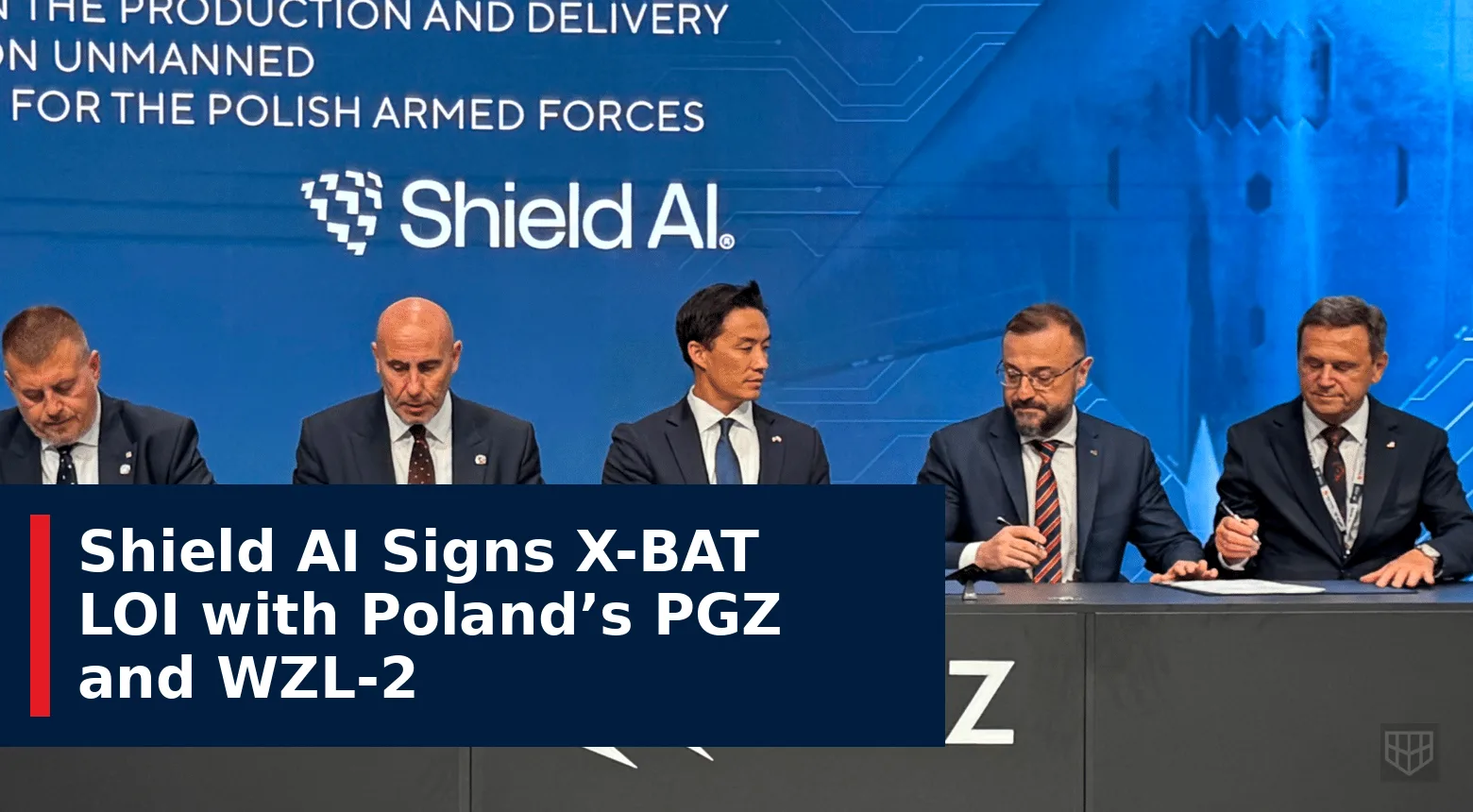
Shield AI, PGZ and WZL-2 have signed a five-year letter of intent covering potential X-BAT production and sustainment in Poland.
A five-year cooperation framework
Shield AI, Poland’s PGZ and its Wojskowe Zakłady Lotnicze No. 2 subsidiary have signed a five-year Letter of Intent covering cooperation on uncrewed aircraft. The document was signed at the MSPO defence exhibition on 8 September 2026 and announced the following day. X-BAT is the central proposed platform, while the scope also mentions V-BAT, Hivemind autonomy, maintenance, repair and overhaul, training, supply chains and technology transfer.
A Letter of Intent is not a Polish order for X-BAT. It records areas that the companies plan to develop and creates a basis for negotiation. The announcement gives no aircraft quantity, contract value, binding workshare or delivery schedule. Shield AI said definitive agreements would follow, making those future documents the point at which obligations and programme economics can be evaluated.
Potential Polish design and production work
The parties envisage design, production, delivery and sustainment activity in Poland. PGZ provides access to the state defence-industrial group, while WZL-2 brings military-aircraft maintenance and manufacturing experience. Shield AI identified WZL-2’s support for the F110 engine as a relevant foundation because X-BAT is also planned around an F110-class powerplant.
Engine familiarity does not automatically qualify a factory to build the complete aircraft. Low-observable structures, flight controls, mission systems, software assurance and weapons integration impose separate requirements. Workshare will depend on technical-data access, export approval, investment and customer demand. The LOI can organise that qualification path, but it does not prove that a Polish production line is already authorised or funded.
The X-BAT proposition
Shield AI describes X-BAT as an uncrewed vertical-take-off-and-landing combat aircraft able to operate without a runway. Company figures include a 1,000-nautical-mile combat radius, a 2,000-pound internal weapons payload and an 80-kilowatt power capacity. These are advertised design objectives and should not be treated as independently demonstrated operational performance before the flight-test campaign produces public evidence.
Flight testing is planned during 2026. The aircraft is intended to use Shield AI’s Hivemind autonomy stack, allowing operation in environments where communications are degraded or denied. Autonomy does not eliminate command responsibility: armed employment still requires approved rules, human authority, identification standards, cyber security and predictable behaviour. Those issues will be central to any Polish or allied evaluation.
Strategic logic and decision points
Poland has been expanding defence spending and domestic industrial participation as it acquires new aircraft, missiles and land systems. Local production and sustainment can improve availability and build sovereign skills, while a US developer can gain manufacturing scale and proximity to European customers. The proposed five-year horizon gives the parties time to align qualification, supply-chain and training work with X-BAT’s technical maturity.
The broader package matters because an aircraft programme is sustained by more than final assembly. MRO rights, spares, mission-data support, software updates and operator training determine how much control the customer retains during service. Technology transfer can range from limited manufacturing instructions to deeper engineering access, and the LOI does not define where this agreement will sit on that spectrum.
The next evidence should be a binding agreement with investment, workshare and certification milestones, followed by flight-test results and a government procurement decision. Until then, the signing is best understood as an industrial framework and market-positioning step. It advances the possibility of Polish X-BAT participation, but neither confirms that Poland has selected the aircraft nor that series production will occur at WZL-2. Export approval for the F110, mission systems and controlled manufacturing data could shape the final industrial package. Poland will also need to decide how any X-BAT force would connect with its crewed fighters, air-defence network and national command arrangements before production planning becomes operationally meaningful.