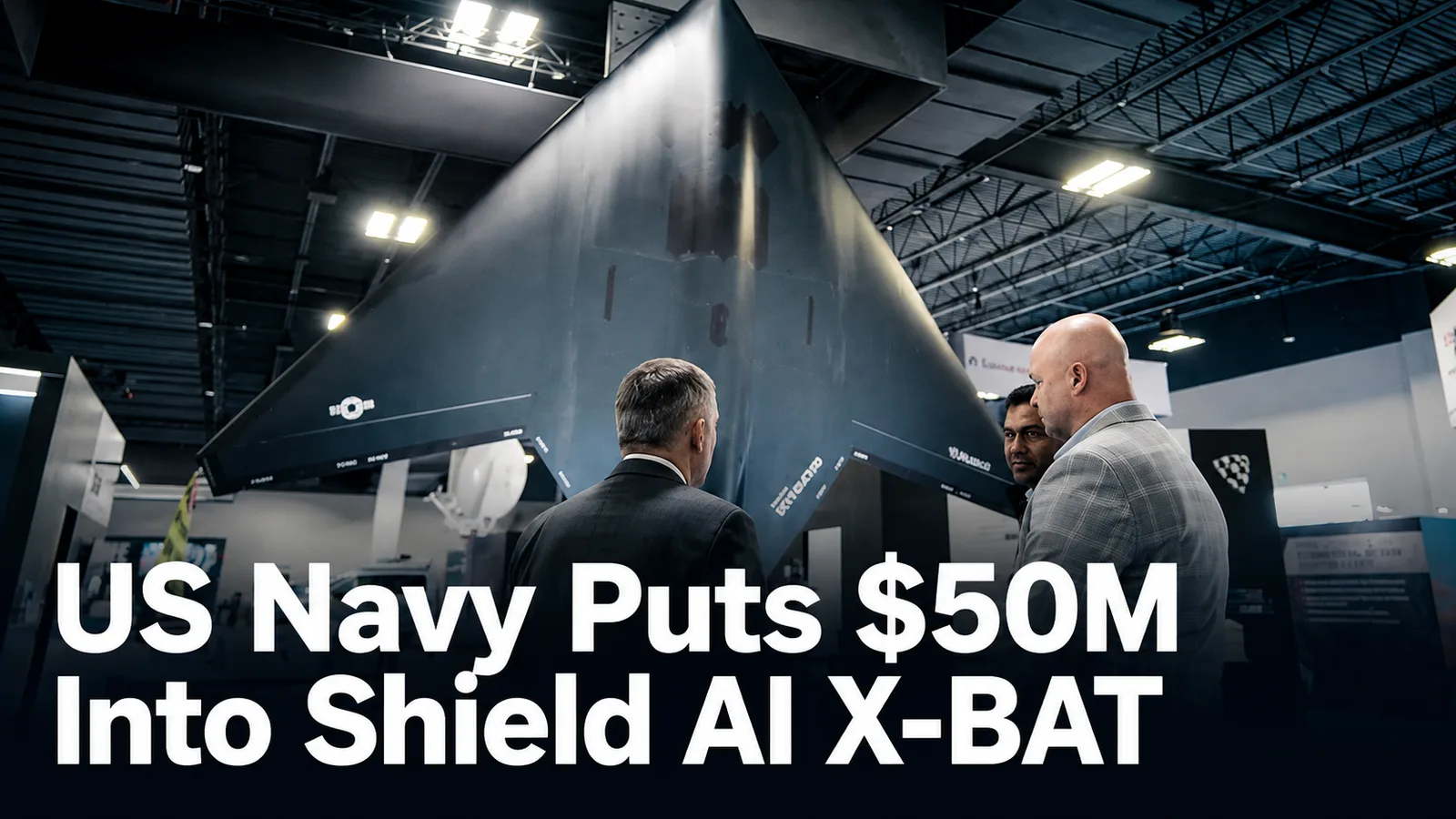
Navy X-BAT investment has moved Shield AI’s runway-independent autonomous fighter closer to a formal U.S. military development pathway, with the Department of the Navy committing $50 million to advance the aircraft under the Runway Independent Maritime Expeditionary Strike programme.
Air & Space Forces Magazine reported the development as a potentially important signal for both naval aviation and the wider U.S. autonomous combat-air market. The funding comes from the Department of the Navy Rapid Capability Office and Portfolio Acquisition Executive Aviation in partnership with the Defense Innovation Unit.
The significance goes beyond a single Navy experiment. X-BAT is being developed as an AI-piloted, long-range, vertical-take-off-and-landing combat aircraft able to operate without conventional runways. At the same time, Shield AI’s Hivemind software is already under U.S. Air Force contract as one of the leading mission-autonomy candidates for Collaborative Combat Aircraft. The Navy is therefore helping mature an aircraft that could eventually intersect with a much broader joint-service autonomous-airpower architecture.
Key Facts
- Investment: $50 million from the Department of the Navy Rapid Capability Office, PAE Aviation and Defense Innovation Unit.
- Programme: Runway Independent Maritime Expeditionary Strike, or RIMES.
- Aircraft: Shield AI X-BAT, an AI-piloted VTOL autonomous combat aircraft.
- Primary RIMES objective: Long-range strike from expeditionary sites or surface ships without large flight decks.
- X-BAT status: Ground, aerodynamic and propulsion testing is underway; first VTOL flight is scheduled for 2026.
- Propulsion: GE Aerospace F110-GE-129E with an adapted AVEN thrust-vectoring nozzle.
- Air Force link: Shield AI’s Hivemind has a production option for USAF CCA mission autonomy, but X-BAT itself is not an Increment 1 CCA airframe.
US Navy Puts $50M Behind X-BAT
The Navy investment was formally announced on 13 August 2026.
Portfolio Acquisition Executive Aviation said the Department of the Navy Rapid Capability Office, PAE Aviation and DIU were committing $50 million to rapidly scale the Navy’s unmanned aviation portfolio.
The announcement specifically says the funding expands existing risk-reduction work with Shield AI to advance Runway Independent Maritime Expeditionary Strike capabilities.
This is materially different from a conventional procurement contract for a defined fleet quantity.
The Navy has not announced an operational X-BAT squadron, production quantity or frontline deployment date. The investment is better interpreted as accelerated development and risk reduction around a mission architecture the Navy considers strategically relevant.
What Is RIMES?
RIMES addresses a specific weakness in naval long-range strike.
Surface combatants can carry long-range missiles, but those weapons are normally single-use and constrained by finite vertical-launch-system magazine capacity.
Replenishing large missiles at sea remains difficult, while persistent tactical aviation generally requires either land runways or ships equipped with large aviation decks.
DIU’s description of RIMES calls for an uncrewed aircraft able to support naval surface combatants with long-range strikes using standard munition payloads while operating from expeditionary sites with minimal infrastructure or from ships without large flight decks.
That mission directly favours unconventional take-off-and-landing architectures.
A reusable aircraft that can launch from a destroyer, small expeditionary site or remote island potentially allows commanders to move some long-range strike capacity outside conventional airfields and aircraft carriers.
RIMES Wants More Than Another Cruise Missile
The distinction between RIMES and a traditional missile programme is important.
A cruise missile provides one strike before the weapon is consumed.
A recoverable uncrewed combat aircraft can theoretically fly repeated sorties, return for maintenance, accept new payloads and conduct missions other than strike.
That changes the cost calculation from cost per missile fired toward cost per reusable combat sortie.
It also broadens the mission set. An autonomous aircraft can potentially provide sensing, electronic warfare or counter-air capability before or after a strike mission.
This is why RIMES should be viewed as a distributed aviation programme rather than simply an alternative missile launcher.
X-BAT Fits the Runway-Independent Requirement
X-BAT was designed around precisely this infrastructure problem.
Shield AI describes X-BAT as an autonomous VTOL fighter intended to launch and recover from ships, remote islands and austere forward locations.
The company publishes a maximum range of more than 2,000 nautical miles and a service ceiling above 50,000 feet.
The aircraft has a 39-foot wingspan and approximately 26-foot fuselage length.
Shield AI also claims that three X-BAT aircraft can occupy approximately the deck footprint of one legacy fighter.
These are company specifications for an aircraft still under development, not operational test results.
X-BAT Has Not Flown Yet
The programme’s maturity needs to remain clear.
As of 20 August 2026, X-BAT has not completed its first publicly confirmed flight.
Shield AI says the programme has completed wind-tunnel, pole and engine testing and that a structural pathfinder is in fabrication.
The company currently targets first VTOL flights during 2026, mission capability in 2028 and production from 2029.
The Navy’s $50 million commitment should therefore be understood as investment in a pre-flight development programme.
This creates technical risk but also explains why the Navy is using rapid-capability and DIU mechanisms rather than waiting for a mature programme of record.
F110 and AVEN Are Central to the VTOL Architecture
The aircraft’s propulsion system is one of its most unconventional elements.
X-BAT uses the GE Aerospace F110-GE-129E, a fighter-class engine derived from the same family powering variants of the F-16 and F-15.
The engine is paired with an Axisymmetric Vectoring Exhaust Nozzle, or AVEN, to provide the thrust-vectoring authority required for vertical launch and recovery.
GE Aerospace and Shield AI announced on 20 July 2026 that they had completed AVEN integration, actuation and engine light-off testing.
The hardware originated in a 1990s F-16 thrust-vectoring programme and accumulated 135 flight hours across 95 flights during its earlier development history.
For X-BAT, however, the nozzle is being used for a much more demanding function: controlling a fighter-class aircraft during vertical launch and recovery.
Vertical Recovery Is the Harder Problem
Launching vertically is only half of the technical challenge.
The aircraft must also transition safely from horizontal flight into a tail-down recovery profile and maintain precise control close to the ground or ship deck.
At sea, vessel movement introduces another layer of complexity.
Pitch, roll, wind and deck motion can change continuously during the final seconds of recovery.
Autonomy and propulsion control therefore have to operate together at high speed and with very low tolerance for error.
The first VTOL flight campaign will consequently be one of the programme’s most important technical risk-reduction milestones.
X-BAT Is Designed Around Fighter-Class Weapons
Shield AI is deliberately placing X-BAT above the small-drone class.
GE Aerospace states that the aircraft is designed with internal weapon bays capable of carrying weapons up to the 2,000-pound class in each bay.
The aircraft is also designed for external stores.
Shield AI lists air-to-air, air-to-surface and electronic-warfare missions and says the platform will include active and passive sensing modes.
This aligns with the RIMES objective of carrying standard aviation munitions rather than requiring the Navy to develop a new family of weapons specifically for one autonomous aircraft.
RIMES Is Not a Single-Vendor X-BAT Programme
The Navy investment should also not be interpreted as evidence that Shield AI has won an exclusive RIMES competition.
DIU confirmed in June that Shield AI, Mach Industries and AeroVironment had received RIMES-related awards.
Breaking Defense reported that the original solicitation sought cost-effective systems prepared for substantial physical prototyping within approximately 12 months of agreement award.
Mach Industries is pursuing its Atlas aircraft with Whisper Aero under the same broader requirement.
Competition therefore remains an important part of the Navy acquisition strategy.
Why the Air Force Is Watching
The Air Force connection is more complicated than the headline suggests.
X-BAT is often described as a Collaborative Combat Aircraft-class system because it combines autonomous mission execution, weapons, sensors and teaming with crewed fighters.
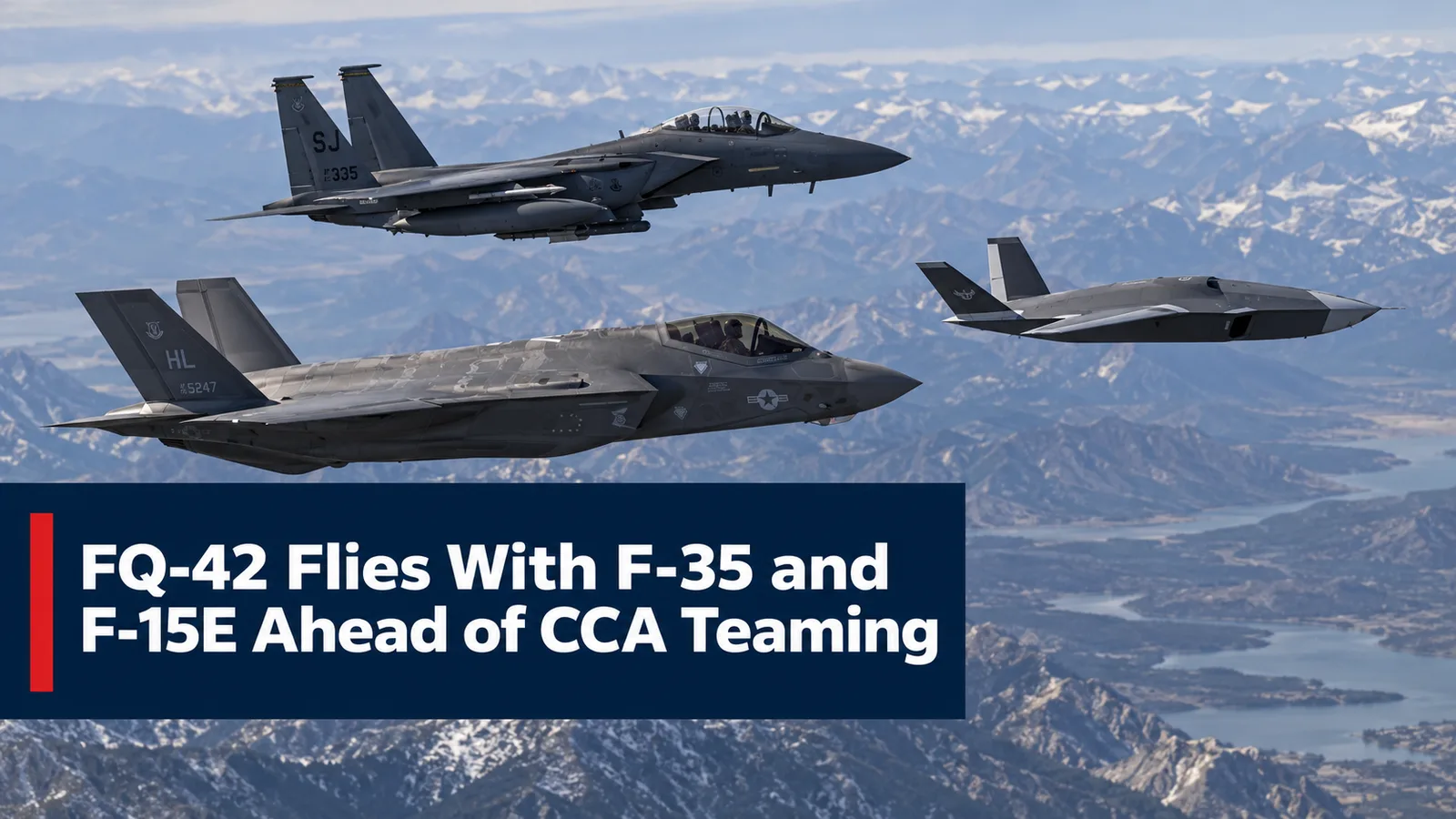
However, the Air Force has already selected General Atomics and Anduril as the Increment 1 CCA airframe suppliers.
The Air Force announced on 17 June 2026 that the FQ-42 and FQ-44 had received engineering, manufacturing development and production contracts.
The service plans to procure more than 150 combat-capable CCA by the end of the decade and maintains a longer-term objective of approximately 1,000 aircraft.
X-BAT is not one of those two Increment 1 airframes.
Shield AI Is Already Inside the Air Force CCA Programme
Shield AI nevertheless has a direct Air Force CCA role through software.
The Air Force awarded mission-autonomy baseline contracts to six vendors in June 2026.
Shield AI, Anduril and RTX Collins Aerospace also received production options for the first competitive phase of operational mission-autonomy software.
The Air Force plans two six-month competitive phases before selecting a primary Increment 1 autonomy provider by summer 2027.
Shield AI’s Hivemind is therefore already competing to become the AI pilot for Air Force CCAs even though Shield AI is not building an Increment 1 CCA airframe.
Air Force Separates the AI Pilot From the Aircraft
This separation is fundamental to understanding why Navy investment in X-BAT may still matter to the Air Force.
The Air Force is deliberately separating mission-autonomy software from aircraft hardware.
The service calls the concept “software sold separately”.
Air & Space Forces Magazine reported in July 2026 that the architecture is intended to allow the service to select and replace autonomy providers without redesigning the physical aircraft.
The government-owned Autonomy Government Reference Architecture, or A-GRA, provides the common interface.
That means Hivemind can potentially mature across several aircraft at once.
Navy Funding Could Indirectly De-Risk Air Force Options
The cross-service benefit is therefore primarily technical rather than contractual.
The Navy is paying to mature X-BAT’s propulsion, VTOL, shipboard and long-range strike architecture.
The Air Force is separately paying to mature Shield AI’s mission-autonomy software.
If both efforts succeed, the U.S. military would have a more mature autonomous software stack and a more mature runway-independent fighter-class aircraft without either service carrying the complete development burden alone.
This does not mean the Air Force will buy X-BAT.
It does mean the aircraft could become a more credible option for later autonomous combat-air requirements because another military service has helped retire some of its technical risk.
Increment 2 Could Create a Future Opening
The Air Force CCA programme is designed to evolve through multiple increments rather than freeze one aircraft architecture for decades.
Later increments can alter mission, cost, range, survivability and payload requirements as operational experience accumulates.
This creates a possible future market for aircraft that were not selected for Increment 1.
Defence Agenda has tracked the current U.S. CCA field in YFQ-44 Collaborative Combat Aircraft Flies and USAF CCA Flight Testing Begins.
For Shield AI, the strategic question is whether X-BAT’s greater range, fighter-class performance and runway independence justify a higher price and logistical footprint than simpler CCA designs.
X-BAT Is Deliberately Different From FQ-42 and FQ-44
Shield AI has not designed X-BAT simply to copy existing Increment 1 aircraft.
The FQ-42 and FQ-44 use conventional runway operations and are optimised around the Air Force’s current CCA mission architecture.
X-BAT instead accepts the engineering complexity of VTOL in exchange for eliminating runway dependence.
It also uses a full fighter-class afterburning engine rather than the smaller propulsion architectures associated with several CCA competitors.
The result is a concept aimed at higher-end autonomous airpower rather than the lowest-cost possible uncrewed aircraft.
Runway Independence Matters Most in the Indo-Pacific
The operational argument is particularly relevant to a potential Indo-Pacific conflict.
Fixed runways can be targeted by ballistic missiles, cruise missiles and long-range air-launched weapons.
Air forces can mitigate that vulnerability through hardened shelters, rapid runway repair, dispersion and Agile Combat Employment.
X-BAT attempts to remove the runway from the equation entirely.
A mobile launch-and-recovery system could theoretically reposition aircraft between islands, roads, expeditionary sites and ships as the threat changes.
This creates uncertainty for adversary targeting and reduces dependence on a relatively small number of prepared airfields.
The Navy Wants Airpower From Ships Without Carrier Decks
For the Navy, the same VTOL architecture solves a different problem.
Arleigh Burke-class destroyers and many other surface combatants have helicopter flight decks but cannot operate conventional fixed-wing tactical aircraft.
RIMES explicitly seeks systems that can overcome that restriction.
An X-BAT-class platform could potentially give a destroyer access to reusable long-range tactical aviation without requiring catapults, arresting gear or a carrier-sized deck.
This is a highly attractive concept but remains technically unproven at full scale.
Deck Footprint Will Be a Major Naval Metric
Space aboard surface combatants is limited.
Every aircraft competes with helicopters, maintenance equipment, weapons, fuel and other mission systems.
Shield AI therefore emphasises compact storage and multiple aircraft per conventional fighter footprint.
The company publishes a storage envelope of approximately 40 by 14 by 6 feet for X-BAT.
Whether a useful detachment can be accommodated aboard a destroyer will depend on much more than deck geometry, including fuel, weapons handling, maintenance access, launch equipment and flight-deck safety.
Shipboard Sustainment Could Be Harder Than Launch
The ability to take off vertically does not automatically create sustainable naval aviation.
A fighter-class turbofan requires inspection, spare parts and maintenance support.
Weapons must be stored and loaded safely.
Hot exhaust during vertical operation creates deck-heating and personnel-safety considerations.
Saltwater corrosion adds another sustainment burden.
The Navy will therefore need to determine whether the additional operational reach compensates for the logistics footprint imposed on ships that were never designed to support fighter-class aircraft.
Hivemind Is X-BAT’s Other Major Strategic Asset
The aircraft’s value also depends on autonomy.
Shield AI says Hivemind allows X-BAT to conduct mission-level operations in GPS- and communications-denied environments.
The software is intended to allow teams of aircraft to execute objectives with limited continuous human control.
For the Navy, this is particularly relevant if aircraft operate hundreds or thousands of miles from the launch ship.
A long-range uncrewed fighter cannot depend on a perfect high-bandwidth link throughout every mission.
It must retain enough autonomy to navigate, respond to contingencies and execute authorised mission behaviours when connectivity deteriorates.
But Autonomous Strike Raises Command Questions
Long-range autonomous strike also creates policy and command challenges.
Technical autonomy does not necessarily imply autonomous authority to employ lethal weapons.
Military commanders still require positive control, appropriate targeting confidence and compliance with rules of engagement.
The more communications are degraded, the more important pre-planned authorities and software constraints become.
These issues are common across the wider CCA ecosystem and will be part of the operational maturation process regardless of which airframe ultimately enters service.
The Navy Investment Creates a Joint-Service Technology Path
One of the most consequential features of the $50 million award is therefore institutional rather than aerodynamic.
The Navy is financing a maritime application of an autonomous aircraft architecture whose software already participates directly in the Air Force CCA enterprise.
This reduces the traditional separation between naval aviation development and Air Force combat-air experimentation.
If common autonomy standards remain open, future aircraft could potentially migrate between service-specific mission architectures more easily than legacy systems.
That would support a genuinely joint autonomous-aircraft industrial base.
The Air Force Is Building an Autonomy Marketplace
The Air Force’s acquisition model makes this cross-pollination more realistic.
A-GRA allows the service to treat mission autonomy as a competitive software market rather than permanently binding one AI provider to one aircraft manufacturer.
Shield AI can therefore improve Hivemind through work on X-BAT, V-BAT and other aircraft while still competing to supply the software aboard General Atomics or Anduril CCAs.
Defence Agenda previously examined the broader X-BAT architecture in Shield AI X-BAT: AI-Piloted VTOL Stealth Jet.
The latest Navy funding substantially strengthens the programme’s government-backed development base compared with its position at unveiling in October 2025.
Cost Will Decide Whether X-BAT Finds a Wider Role
The main strategic counterargument is cost.
A fighter-class engine, low-observable structure, advanced sensors, large weapon bays and a complex VTOL propulsion system are unlikely to produce the cheapest autonomous combat aircraft.
The Air Force has repeatedly emphasised affordability as it scales CCA numbers.
The operational case for X-BAT therefore depends on whether runway independence creates enough additional combat value to justify a potentially higher unit and sustainment cost.
The Navy may answer that question differently from the Air Force because access to fixed-wing airpower from non-carrier ships carries unique value.
X-BAT Also Faces an Attritability Question
Another unresolved issue is how commanders classify the aircraft economically.
Some CCA concepts are designed around relatively low costs and an expectation that commanders can accept aircraft losses in high-risk missions.
X-BAT’s fighter-class performance and propulsion architecture may push it toward a more valuable reusable asset.
That does not make it equivalent to a crewed fifth-generation fighter, but it can change how aggressively commanders are willing to expose the platform.
Procurement quantity and final unit cost will determine where X-BAT falls on the spectrum between expendable mass and high-value autonomous combat aircraft.
European Customers Could Become Another Development Driver
Shield AI is also actively marketing X-BAT outside the United States.
Poland has publicly discussed potential industrial participation in the programme, including possible manufacturing activity.
The aircraft has also been promoted to European operators seeking autonomous partners for fourth-generation fighters.
Defence Agenda examined that market in Wingman Aircraft Take Centre Stage in Europe’s Rearmament.
Successful Navy testing would strengthen Shield AI’s export case because it would provide a U.S. military-backed development reference for the airframe rather than only company-funded demonstrations.
The Main Programme Risk Is Still Flight
Despite the funding and strong technical narrative, the immediate risk remains straightforward: X-BAT still has to fly.
Ground testing has de-risked important propulsion components, but successful vertical launch, transition to forward flight, high-speed operation and vertical recovery have not yet been demonstrated publicly by the full-scale aircraft.
Those events will determine whether the core architecture works as intended.
Until then, the $50 million Navy investment is a significant confidence signal but not proof of operational capability.
Implications / Next
The first milestone is X-BAT’s initial VTOL flight, scheduled for 2026. A successful launch, transition and recovery cycle would retire the programme’s most distinctive technical risk.
The second is RIMES prototyping. The Navy and DIU will need to demonstrate that the aircraft can operate from the constrained environments for which the requirement was created, particularly ships without conventional carrier infrastructure.
The third is weapons integration. RIMES requires standard military payloads and persistent strike utility, making realistic stores integration central to the programme’s value.
The fourth is Air Force mission autonomy. Shield AI remains in the competition for the primary CCA Increment 1 autonomy provider, with a selection planned by summer 2027.
The fifth is future CCA requirements. Navy-funded X-BAT maturity could position the aircraft for later Air Force, Marine Corps or allied autonomous-combat-air opportunities even if it never joins CCA Increment 1.
Finally, cost data will become decisive. X-BAT must demonstrate that the operational flexibility created by VTOL, fighter-class range and reusable strike capability justifies its added propulsion and sustainment complexity.
Conclusion
The U.S. Navy’s $50 million X-BAT investment materially changes the programme’s position.
Shield AI unveiled X-BAT in October 2025 as a privately developed vision for runway-independent autonomous airpower. Less than a year later, the aircraft is receiving significant Navy and DIU backing under a defined long-range maritime-strike requirement.
The investment does not mean the Navy has ordered an operational X-BAT fleet, and it does not place X-BAT inside the Air Force’s current FQ-42/FQ-44 Increment 1 airframe programme.
But the Air Force connection is still substantial.
Shield AI’s Hivemind software is already being funded as a CCA mission-autonomy candidate while Navy money now helps mature the X-BAT hardware carrying that same autonomy architecture.
The result is a potentially important joint-service pathway: the Navy explores runway-free maritime strike, the Air Force develops modular autonomous wingmen, and Shield AI builds technology positioned to operate across both environments.
The decisive test will come when X-BAT leaves the ground. If the programme can prove reliable full-scale VTOL flight and shipboard operations while controlling cost, the Navy’s $50 million investment could turn what began as an unconventional CCA concept into a serious new category of distributed combat aviation.
Further Reading
- Air & Space Forces Magazine: Navy X-BAT Investment and Air Force Implications
- U.S. Navy PAE Aviation: $50M Investment in Unmanned Maritime Strike
- Shield AI: X-BAT Autonomous VTOL Fighter
- GE Aerospace: X-BAT F110 and AVEN Engine Test
- U.S. Air Force: CCA Hardware and Mission Autonomy Contracts
- Defence Agenda: Shield AI X-BAT — AI-Piloted VTOL Stealth Jet
- Defence Agenda: YFQ-44 Collaborative Combat Aircraft Flies
- Defence Agenda: Wingman Aircraft Take Centre Stage in Europe’s Rearmament