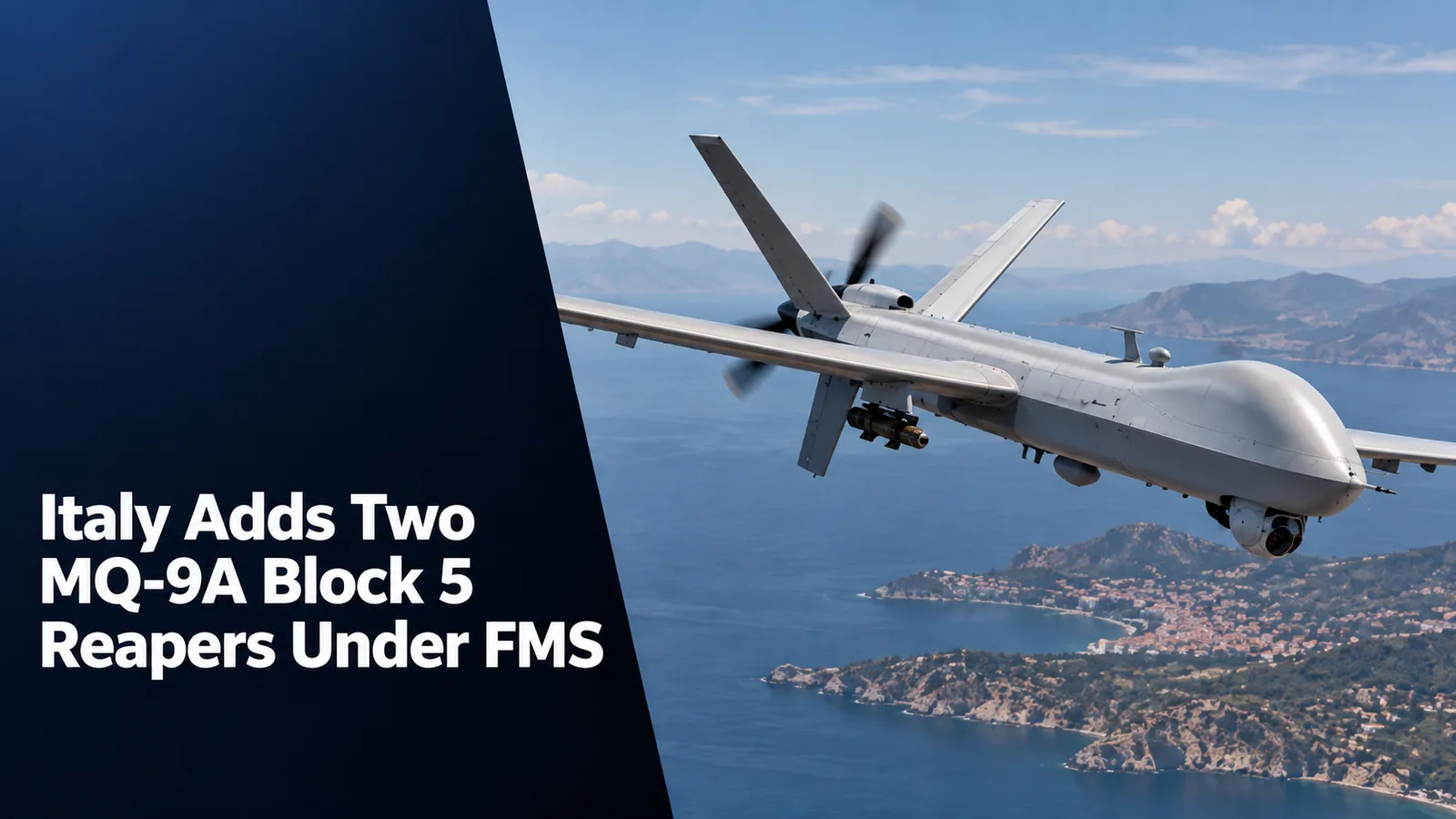
General Atomics Aeronautical Systems announced on 8 September 2026 that the Italian Air Force has ordered two additional MQ-9A Block 5 Reaper remotely piloted aircraft. The acquisition is being executed through a U.S. Foreign Military Sale with the U.S. Air Force and also includes Ground Control Stations. GA-ASI says the two aircraft are scheduled for delivery by the end of 2027, but it did not disclose the value of the order.
Italy Expands Its Reaper Fleet Through the FMS Channel
The order extends a relationship that has made Italy one of the longest-standing European operators of the Predator/Reaper family. Italy has used MQ-9A aircraft for intelligence, surveillance and reconnaissance missions over national territory, the Mediterranean and in support of NATO operations. The new purchase should therefore be read as a fleet-growth and continuity decision rather than the launch of an entirely new remotely piloted aircraft programme.
Block 5 Adds Capability but the Purchase Is Not a New Operational Declaration
GA-ASI lists the Block 5 configuration with endurance of up to 26 hours, an operating ceiling up to 45,000 feet and a payload capacity of 4,600 pounds, including 3,750 pounds of external stores. The company also highlights full-motion video, synthetic-aperture radar and moving-target-indicator functions, maritime radar capability, and automatic take-off and landing. Those figures are manufacturer specifications and should not be treated as mission performance guarantees under every operational configuration.
Italy has already introduced Block 5 aircraft and modernised ground-control infrastructure, so the latest order builds on an existing training, sustainment and command architecture. That lowers integration risk compared with adopting a different unmanned aircraft family, but it does not eliminate the normal certification, mission-system and support requirements associated with additional airframes. Delivery at the end of 2027 will be a logistics milestone; operational availability will depend on subsequent acceptance and fleet integration.
The Procurement Reinforces Persistent ISR Capacity
Long-endurance remotely piloted aircraft remain valuable because they can maintain surveillance over maritime approaches, deployed forces and areas of interest for periods that would impose a heavier crew and cost burden on many manned platforms. For Italy, geography makes persistent coverage of the central Mediterranean particularly relevant. MQ-9A can also support NATO situational awareness when national tasking and alliance requirements overlap.
The additional aircraft should increase scheduling flexibility and reduce the pressure created when airframes are committed to training, maintenance and deployed operations at the same time. Two aircraft do not by themselves transform the force structure, but they can improve the resilience of a comparatively small fleet. The Ground Control Stations included in the FMS package are equally important because unmanned-aircraft availability is constrained by control, communications and mission-processing infrastructure as well as by the air vehicles themselves.
Industrial and Programme Questions Now Shift to Delivery
The announcement does not identify the contract value, detailed production slots or the exact number and type of Ground Control Stations. Those omissions matter because they prevent a reliable calculation of unit cost and make it inappropriate to compare the purchase directly with larger MQ-9A or MQ-9B packages announced for other operators. The confirmed milestone is the order and the planned end-2027 delivery window.
The next useful evidence will be factory completion, formal delivery, Italian acceptance and entry of the additional aircraft into operational tasking. Any future weapons integration, mission-system change or shift toward MQ-9B would be a separate programme decision and should not be inferred from this order. For now, Italy is deepening an established MQ-9A fleet through the existing U.S. FMS framework.
Implications / Next
The next publication-grade milestone will be the first independently verifiable event that changes the programme status described above, such as a delivery, acceptance event, production start, exercised option, operational test or formal fielding decision. Defence Agenda will continue to separate these maturity stages and will not treat an announcement, contract or first test as proof that the full capability has already entered operational service.