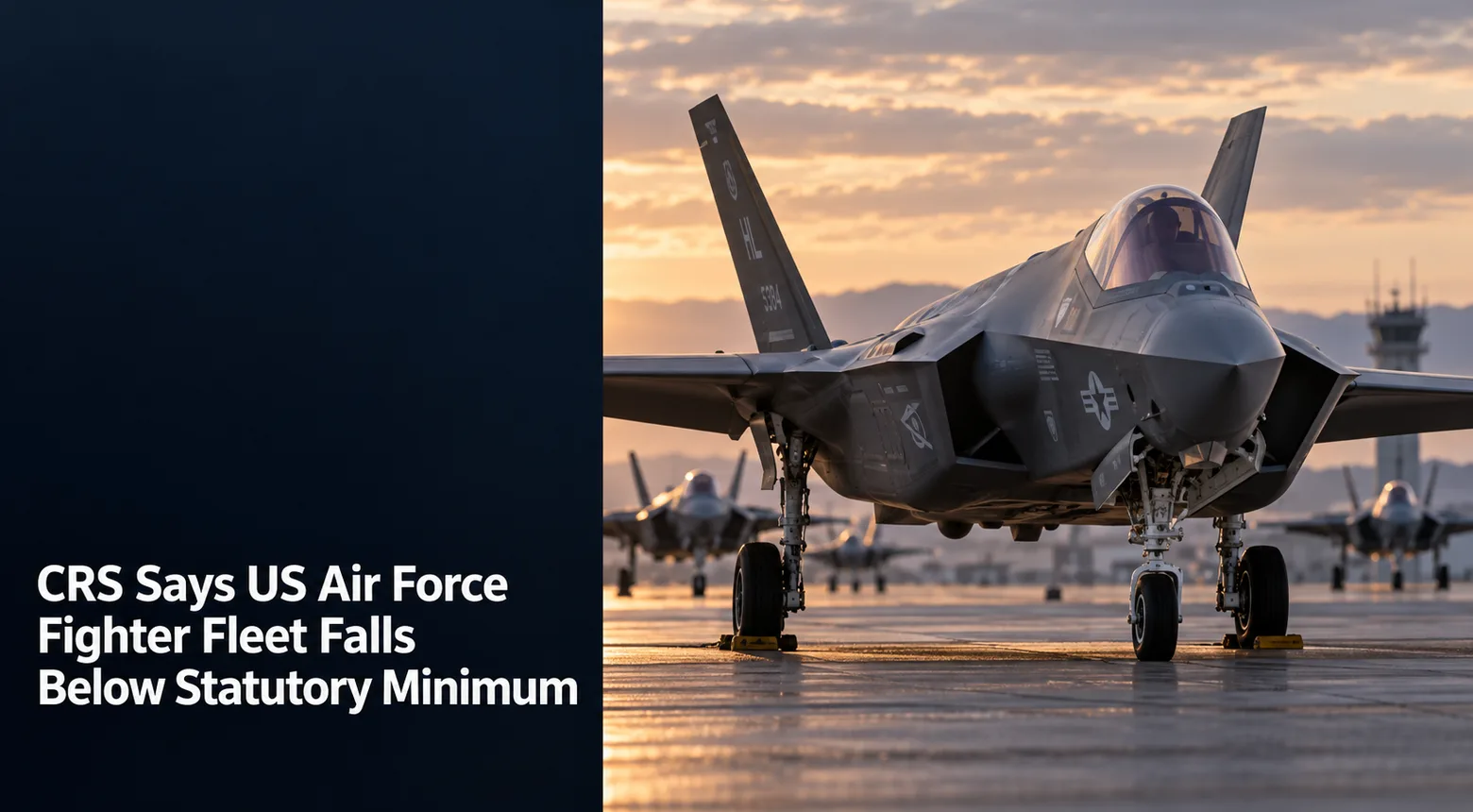
A Congressional Research Service report published on 4 September 2026 says the U.S. Air Force fighter force has moved below a statutory minimum that Congress established for combat-coded primary-mission aircraft. Title 10 requires the service to maintain at least 1,145 fighter aircraft in that category through 1 October 2026, while CRS notes that the Department of the Air Force had already projected an FY2026 decline below the threshold.
The significance is broader than a single inventory count. CRS treats the shortfall as the product of fleet age, retirement decisions, procurement rates, readiness, pilot availability and industrial constraints, all of which affect how quickly the Air Force can replace legacy F-15, F-16 and A-10 capacity with F-35A, F-15EX and future systems. The report therefore gives Congress a framework for judging whether planned modernisation can arrest the decline without creating a readiness gap.
Key Facts
- CRS report date: 4 September 2026; report number R49338.
- Title 10 requires at least 1,145 combat-coded primary-mission fighter aircraft through 1 October 2026.
- The Department of the Air Force had previously projected that FY2026 inventory would fall below that floor.
- CRS cites a service objective of 1,558 combat-coded fighters by 2035 for a low-risk posture.
- Congress is considering proposed statutory changes that could extend and reshape fighter-inventory requirements.
- F-15EX and F-35 procurement, legacy retirements, readiness, pilot supply and industrial capacity are all identified as linked force-structure variables.
CRS frames the fighter shortfall as a force-structure problem
The development is best assessed as a programme milestone rather than a complete operational endpoint. The verified evidence establishes the event described above, while subsequent procurement, integration, readiness or fielding claims require their own confirmation as the programme advances. That distinction is important for comparing announcements across defence programmes, where testing, production, delivery and operational acceptance are separate maturity stages with different evidentiary thresholds.
The 1,558-fighter objective changes the scale of the debate
The Department of the Air Force’s 2025 long-term force-structure work set an objective of 1,558 combat-coded tactical fighters by 2035 for what it characterised as a low-risk posture. That is not simply a replacement target: reaching it would require the service to stabilise near-term retirements and sustain acquisition, modification, training and maintenance capacity over many years. CRS notes that lawmakers are considering proposals that could codify future inventory targets and extend statutory constraints beyond the current 1 October 2026 deadline.
The counting method also matters. The existing statute is written around primary-mission aircraft inventory, while the Air Force has discussed combat-coded total aircraft inventory as a planning metric. Different definitions can move aircraft in or out of the headline number without changing the physical fleet, so Congress must decide not only how many fighters it wants but which readiness status should qualify them for compliance and planning.
Procurement, retirements and industrial capacity are inseparable
Near-term fleet management is constrained by the production and sustainment capacity of replacement types. F-35A deliveries remain central to the Air Force’s recapitalisation plan, while F-15EX offers a faster path to replacing some legacy Eagle capacity and carrying large weapons loads. At the same time, Congress has placed restrictions on certain F-22 and F-15E retirements because premature drawdown could deepen the inventory trough before new aircraft are available in sufficient numbers.
The report does not imply that a simple numerical increase automatically produces combat power. Mission-capable rates, munitions, trained pilots, maintenance personnel, basing and tanker support can limit the usable force even when inventory targets are met. The next policy test is therefore whether FY2027 legislation aligns authorised fighter numbers with executable procurement, sustainment and workforce plans rather than treating the statutory minimum as an isolated accounting requirement.
Implications / Next
The next publication-grade milestone will be the first independently verifiable step that moves the programme beyond the status described here—such as a follow-on test, formal contract action, delivery, operational deployment or completed transaction, depending on the story. Defence Agenda will treat each maturity stage separately and will not infer production, operational capability or procurement completion from an earlier demonstration or announcement. The most useful follow-up evidence will therefore be dated official documentation, customer acceptance, serial-production data or operational activity that can be cross-checked against the current record.