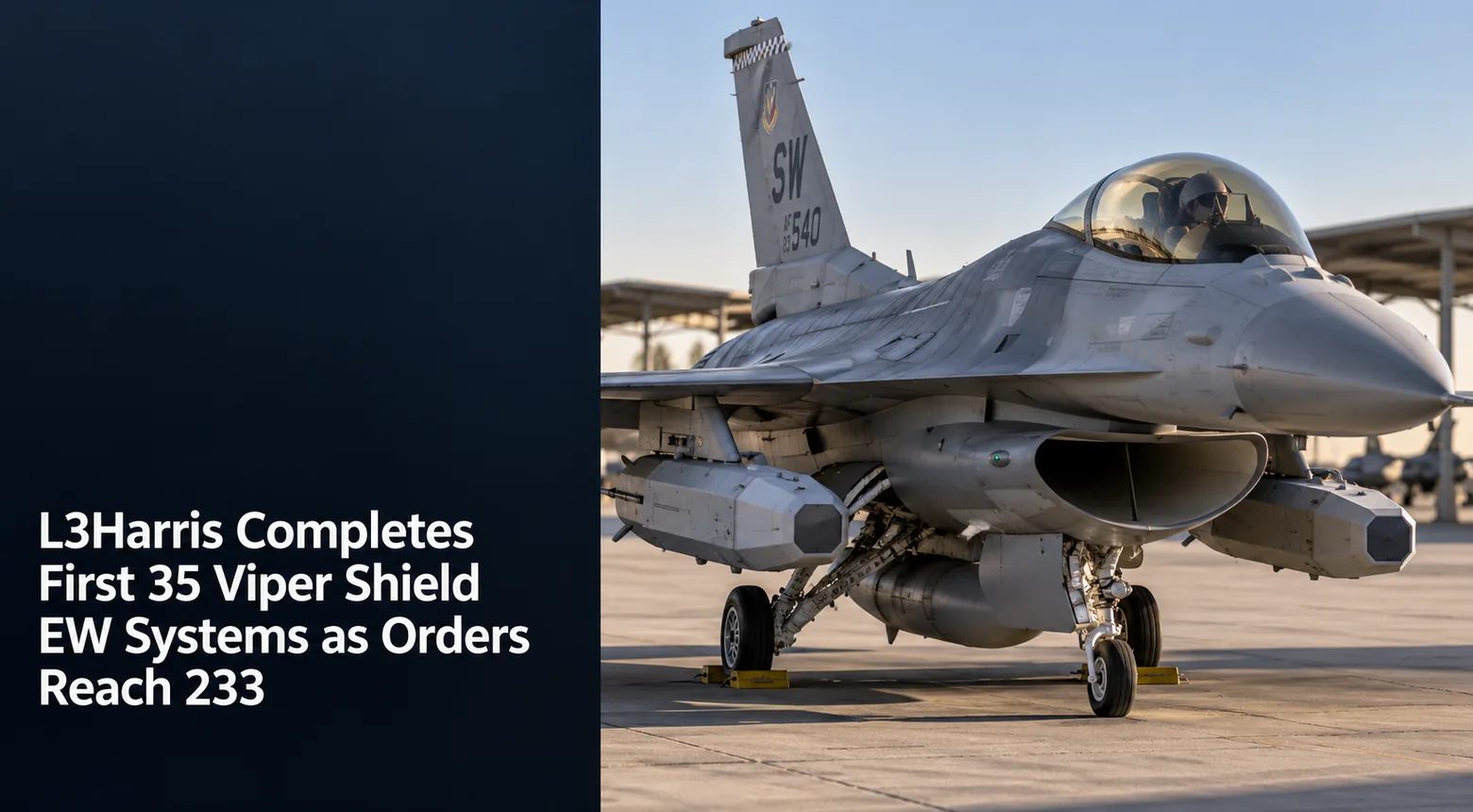
L3Harris Technologies has completed production of the first 35 Viper Shield electronic-warfare and countermeasure systems for the global F-16 fleet, moving the AN/ALQ-254(V)1 programme deeper into manufacturing after years of development and flight-test activity. The company announced the milestone on 3 September 2026 and said it is ramping toward full-rate production for 233 systems currently on order from eight allied nations.
The figure is important because it separates an early production milestone from the programme’s total contracted demand. Thirty-five completed systems demonstrate that the production line is active, but they do not represent completion or delivery of all 233 ordered units. L3Harris also says it has assembled the first external pod using production-standard hardware, widening the possible installation path beyond aircraft configured for the internally integrated suite.
Key Facts
- L3Harris announced completion of the first 35 production systems on 3 September 2026.
- Viper Shield is officially designated AN/ALQ-254(V)1.
- Orders total 233 systems from eight allied nations, according to L3Harris.
- The system can be installed internally or configured as an external pod.
- L3Harris says it has assembled the first pod using production-standard systems.
- The company is ramping toward full-rate production; completion of 35 units is not the same as delivery of all 233 ordered systems.
First production lot establishes a manufacturing baseline
The development is best assessed as a programme milestone rather than a complete operational endpoint. The verified evidence establishes the event described above, while subsequent procurement, integration, readiness or fielding claims require their own confirmation as the programme advances. That distinction is important for comparing announcements across defence programmes, where testing, production, delivery and operational acceptance are separate maturity stages with different evidentiary thresholds.
Viper Shield targets modern radar-guided threats on F-16 fleets
Viper Shield is an all-digital, software-defined electronic-warfare suite designed to detect, identify and counter radar-frequency threats. L3Harris markets the system as a digital defensive layer for F-16 operators, combining threat awareness and countermeasures in an architecture intended to evolve through software and mission-data updates. The internal configuration is closely associated with new-build F-16 Block 70/72 aircraft, while the external pod creates another route for fleets whose aircraft cannot accept the same internal installation.
For allied operators, the attraction is partly commonality. A shared production line and a larger installed base can spread software, test and sustainment costs across multiple customers and make upgrades easier to coordinate, particularly when threat emitters change faster than airframe replacement cycles. The operational value will still depend on mission-data quality, integration with each nation’s radar and weapons configuration, and the ability to validate countermeasures against current threat systems.
Orders are strong, but full-rate production is the next industrial test
L3Harris says Viper Shield is the only F-16 electronic-warfare system currently in production with orders from eight allied nations. That is a manufacturer statement, but the disclosed 233-system backlog gives the programme a measurable industrial base and creates pressure on suppliers to sustain electronics, receivers, processors and pod hardware at higher rates. The company has previously said partner operators collectively invested heavily in development, laboratory work, flight testing and production readiness.
The next programme indicators are monthly or annual delivery rate, customer-specific acceptance, integration on new and existing F-16 configurations, and the timing of full-rate production. Those milestones will show whether the current order book converts into predictable fielded capability across multiple allied fleets. Until then, the completed first 35 should be treated as a major production threshold rather than the end of the acquisition cycle.
Implications / Next
The next publication-grade milestone will be the first independently verifiable step that moves the programme beyond the status described here—such as a follow-on test, formal contract action, delivery, operational deployment or completed transaction, depending on the story. Defence Agenda will treat each maturity stage separately and will not infer production, operational capability or procurement completion from an earlier demonstration or announcement. The most useful follow-up evidence will therefore be dated official documentation, customer acceptance, serial-production data or operational activity that can be cross-checked against the current record.