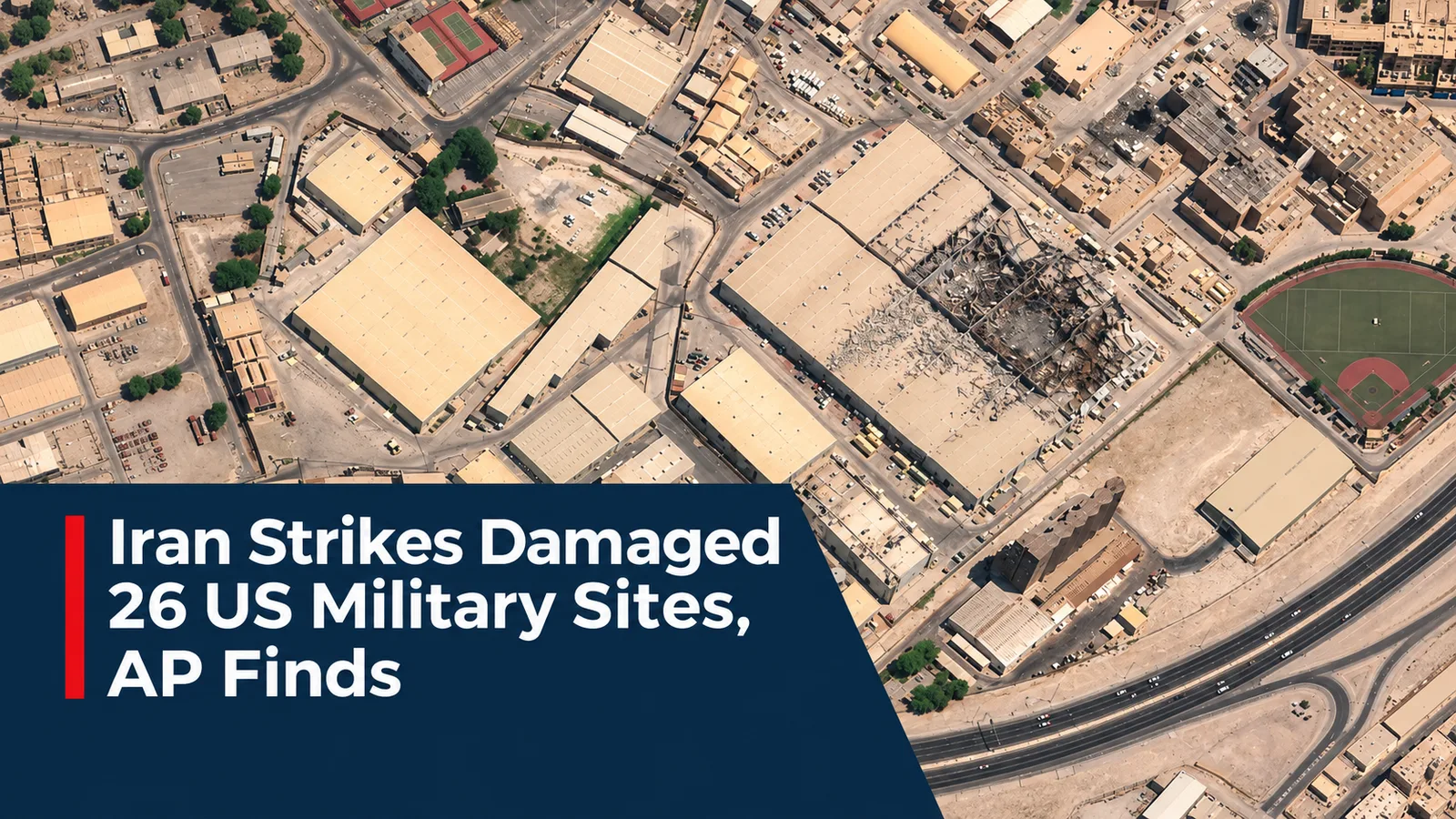
An Associated Press investigation published on 31 October 2026 found evidence of damage at 26 Middle Eastern military bases and other sites containing US equipment, following more than 115 drone or missile strikes claimed by Iran or Iran-backed groups through August. The assessment indicates that attacks affected early-warning radars as well as aircraft, hangars and support infrastructure. For defence planners, the findings underline the exposure of fixed regional bases to repeated attacks; they do not establish that every Iranian claim was independently verified or that all sites remain unusable.
Why the Investigation Matters
The scale of the reported damage challenges a familiar assumption: maintaining forces at established regional bases can provide sustained access and logistics without repeated disruptions. Hardened aircraft shelters, radars, communications sites and utilities remain essential even when combat aircraft operate from more dispersed locations. The physical loss of a building and the temporary loss of a mission function are not the same metric, but both can complicate sortie generation, resupply and recovery.
AP reviewed satellite imagery from several providers and spoke with four regional officials familiar with the consequences of the strikes. Its findings should be read alongside the 14 September 2026 Lead Inspector General report, which documented hundreds of damaged or destroyed structures over the April–June reporting period. The inspector general and AP assessments overlap, but their counts are not interchangeable because they use different dates, methods and reporting units.
What AP Established — and What It Did Not
The AP investigation identified structural damage at 26 sites and counted more than 115 Iranian or Iran-backed attack claims associated with damage through August. The number of claims is not a verified inventory of every missile or drone impact, and a site can be struck repeatedly. The reported 26 locations also include other military sites hosting American equipment, rather than 26 exclusively American-owned bases.
An independent Wall Street Journal methodology report described 274 damaged structures at 24 installations with a US presence during the war’s first six months. That is useful corroborating context, not a second total to add to AP’s figures. The Journal used lower-resolution imagery, fire data and manual checks, while AP drew on other imagery and official interviews. Neither public study supplies an exhaustive, installation-by-installation accounting of operational readiness.
Why Radar and Early-Warning Losses Are Significant
According to AP, several of the earliest strikes affected radar shelters and detection assets, including facilities in Kuwait and Bahrain. The report also describes damage to radar equipment associated with installations in Jordan and Saudi Arabia. An early-warning or missile-defence radar represents a capital-intensive sensor whose replacement, repair and recalibration can take time; this makes such equipment relevant to both operational readiness and reconstruction costs.
A radar strike does not by itself prove that an entire regional air-defence network failed. Coverage depends on multiple platforms, command links, available interceptors and allied sensors, some of which are not publicly disclosed. AP cited substantial losses involving a radar in Jordan and damage to one in Qatar, but publicly available evidence does not resolve the precise status of every system. A meaningful effectiveness assessment would require dates, configurations, damage assessments and post-repair performance data that have not been released.
Kuwait and Other Regional Installations
Kuwait was prominent in AP’s findings. Its analysis said Ali Al Salem Air Base suffered at least 30 strikes and that at least 15 aircraft hangars, storage facilities and buildings near a residential area were damaged or destroyed. AP also described widespread damage at Camp Buehring, including non-flight infrastructure used by personnel. These examples illustrate why measuring only destroyed aircraft would understate the disruption faced by a deployed force.
AP identified other affected locations in Bahrain, Iraq, Jordan, Oman, Qatar, Saudi Arabia and the United Arab Emirates. At Al Dhafra Air Base in the UAE, satellite images dated 11 March showed several heavily damaged hangars. In Bahrain, imagery showed damage to communications and radar-related facilities. These cases are evidence of separate incidents across the region, not proof that each installation experienced identical attack methods, losses or levels of operational disruption.
The human consequences should not be reduced to a financial figure. The 1 March 2026 strike at Port Shuaiba in Kuwait killed six American service members, AP reported. Fatalities, injuries, shelter availability and the continuity of essential services are relevant to basing decisions alongside hardware replacement.
Aircraft Losses, Financial Exposure and Reporting Limits
Aircraft and specialist military equipment can be much more expensive to replace than visible building damage. AP described attacks affecting tankers, surveillance aircraft, hangars, communications facilities and fuel-related infrastructure. An October update to a Congressional Research Service aircraft-loss study places those events within a larger record of aircraft damaged or lost during Operation Epic Fury. Aircraft losses across the operation must not be equated with aircraft damaged specifically while parked at bases.
The costs should also remain separate. AP reported equipment damage running into billions of dollars, but neither a complete independent repair bill for the 26 sites nor a definitive per-site loss estimate has been published. The wider estimated cost of US military operations includes expenditure on munitions, logistics and other activities; it is not an accounting of airbase reconstruction. Treating operational spending and destroyed-property estimates as the same category would exaggerate the available evidence.
US Central Command declined to disclose specific site damage to AP, citing operational security, while a Pentagon spokesperson maintained that American forces and bases remained well protected. Those are materially different kinds of evidence: the Pentagon statement communicates an institutional assessment; the imagery documents observable physical changes. Neither alone provides a complete picture of current mission availability.
The Airbase Resilience Question
The strategic issue is how a distributed but still infrastructure-dependent force restores capacity after repeated attack. A base might retain a functioning runway yet lose specialised storage, communications equipment, housing or maintenance spaces. Conversely, repaired shelters and relocated assets may allow an installation to resume selected missions long before a full reconstruction programme is complete. The public evidence does not permit a reliable ranking of which facilities remain operational.
Resilience therefore spans physical protection, continuity of communications, distributed logistics, rapid engineering assessment and the capacity to regenerate sorties. Defence Agenda’s earlier report on USAF research into drone-enabled airfield damage assessment is directly relevant: determining what remains serviceable is an essential part of recovery. Our analysis of the challenges posed by drones to air defence provides separate context on the detection and defensive burden, without implying that a single system explains the reported attacks.
Regional Posture and Strategic Alternatives
AP cited two regional officials who said the United States had moved some aircraft, air-defence systems, communications equipment and other assets out of the Persian Gulf. Such reports are consistent with a broader reassessment of the cost and exposure of concentrated infrastructure. They are not an official announcement that Washington has abandoned any particular base, nor evidence of an agreed long-term basing plan.
Basing changes involve trade-offs. A wider network may improve redundancy but increase logistics costs, reduce maintenance efficiency and create dependence on host-nation access. Concentrating equipment can simplify supply and protection while making particular facilities harder to replace after attack. These constraints matter even if a future ceasefire holds. In separate coverage, Defence Agenda discussed reported US options for renewed strikes on Iran; that reporting concerns possible policy choices, not evidence that a new operation has been ordered.
Implications / Next
The next meaningful indicators will be official base-repair assessments, the extent of any renewed dispersal or relocation, statements on damaged radar replacement and the time needed to restore affected installations. An updated inspector-general or congressional report could also clarify which losses were temporary, which required new procurement and how much reconstruction has actually been funded.
The AP investigation establishes a consequential pattern of physical damage across the regional US footprint. It does not show that every claimed strike succeeded, provide a comprehensive current-readiness measure or settle the debate over future American basing. For procurement and programme offices, the lesson is that expensive sensors, low-visibility support facilities and recovery capacity all influence the real cost of operating forward.
Further Reading
- Associated Press satellite investigation, 31 October 2026
- US Department of Defense Lead IG, Operation Epic Fury, 14 September 2026
- Congressional Research Service, Aircraft Losses in Operation Epic Fury, updated 5 October 2026
- Wall Street Journal, methodology for U.S. base damage investigation, 31 October 2026
- USAF Tests Drones for Rapid Airfield Damage Assessment
- U.S. Weighs MOAB Strikes on Iran, but Deep-Bunker Effectiveness Remains in Doubt
- Why Air Defences Face Challenges Against Drones