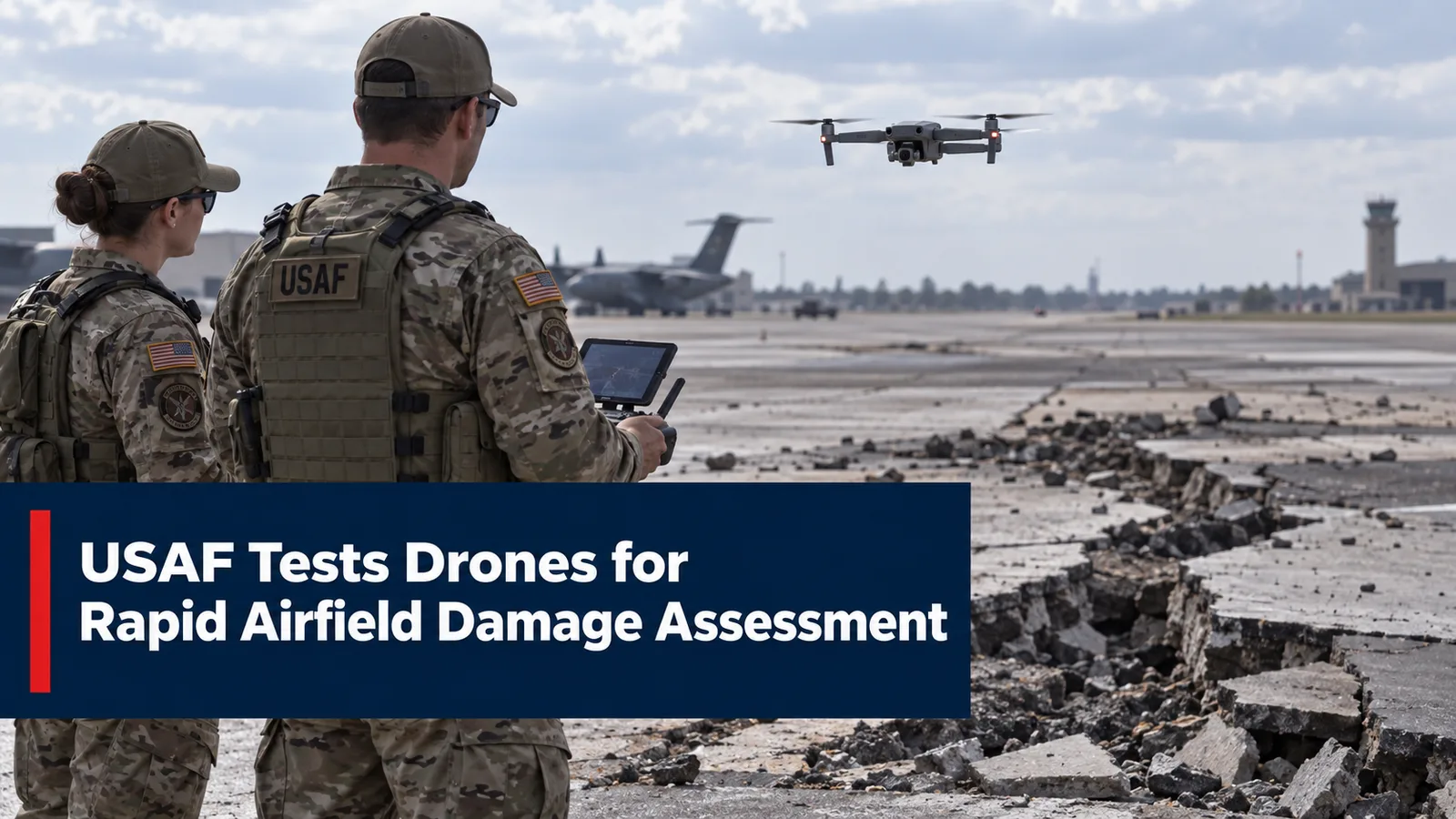
The U.S. Air Force Institute of Technology is testing whether small unmanned aircraft can give civil engineers a faster and safer picture of damaged airfields after attack. The research, detailed by the Air Force on 17 September 2026, combines multirotor and fixed-wing systems and compares the drone-enabled process against conventional ground assessment using speed, accuracy and safety as core measures.
AFIT is testing the full assessment workflow
Post-attack airfield recovery can expose engineering teams to unexploded ordnance, chemical or biological contamination, cratered pavement and debris. Current situational awareness still relies heavily on personnel entering damaged areas, observing hazards and relaying information by radio. AFIT’s research asks whether unmanned aircraft can move the sensor forward first and give commanders a more complete picture before people and equipment enter the risk area.
The work does not focus only on flight performance. Capt. Ross Jurek’s graduate research evaluates mission planning, flight execution, camera coverage, imagery collection and the time required for analysts to turn imagery into an actionable hazard picture. The project therefore treats reconnaissance as a system-of-systems problem involving aircraft, sensors, communications, software, operators and decision-making.
Fixed-wing and multirotor aircraft cover different parts of the problem
The multirotor element is intended for confined and unpredictable areas where hovering, close inspection and flexible launch points are useful. A parallel fixed-wing project trades that manoeuvrability for endurance and broader coverage, allowing runways, taxiways and parking areas to be surveyed more quickly. AFIT’s concept is that the two types could operate as complementary layers rather than competing solutions.
That approach is operationally sensible because airfield damage is heterogeneous. A broad-area sweep may identify craters, debris and inaccessible sectors, while a multirotor can examine a specific object or route from several angles. The research still needs to prove that this combination provides usable information faster and more reliably than established ground methods.
The test standard is whether it improves recovery, not whether the drone flies
AFIT is explicitly comparing drone-supported reconnaissance with conventional Damage Assessment and Response Team routes. Speed alone is not sufficient if imagery is incomplete or inaccurate, and safety benefits are limited if communications or data-processing delays prevent commanders from acting. This is why the project measures the end-to-end process rather than presenting flight activity as a fielded capability.
The work supports broader Air Force priorities around Agile Combat Employment and resilient basing. Dispersed operations depend on the ability to recover damaged operating locations and regenerate sorties under pressure. Small UAS could become a relatively low-cost reconnaissance layer in that process, but the Air Force has not disclosed a fielding decision, production quantity or service-wide deployment plan from this research.
Implications / Next
The next meaningful evidence will be comparative test results showing whether the unmanned approach materially improves speed, accuracy and safety. The service will also need to address communications resilience, data handling, operator training, airspace deconfliction and performance in degraded weather or electronic-warfare conditions before a deployable concept can be standardised.
For procurement observers, the current maturity level is research and evaluation. The programme is building evidence for a future fielding decision; it should not yet be described as a new operational drone fleet for runway inspection.
The research also illustrates why small-drone adoption is frequently an integration problem rather than an airframe problem. A commercially familiar aircraft can still fail an operational requirement if imagery cannot be geolocated, transferred or interpreted quickly enough, or if operators cannot safely launch it amid damaged infrastructure and competing airspace users. AFIT’s emphasis on the full workflow is therefore a useful maturity signal. If the research produces a standardised process, the eventual procurement decision may focus as much on sensors, software and data architecture as on the physical drone selected to fly the mission.