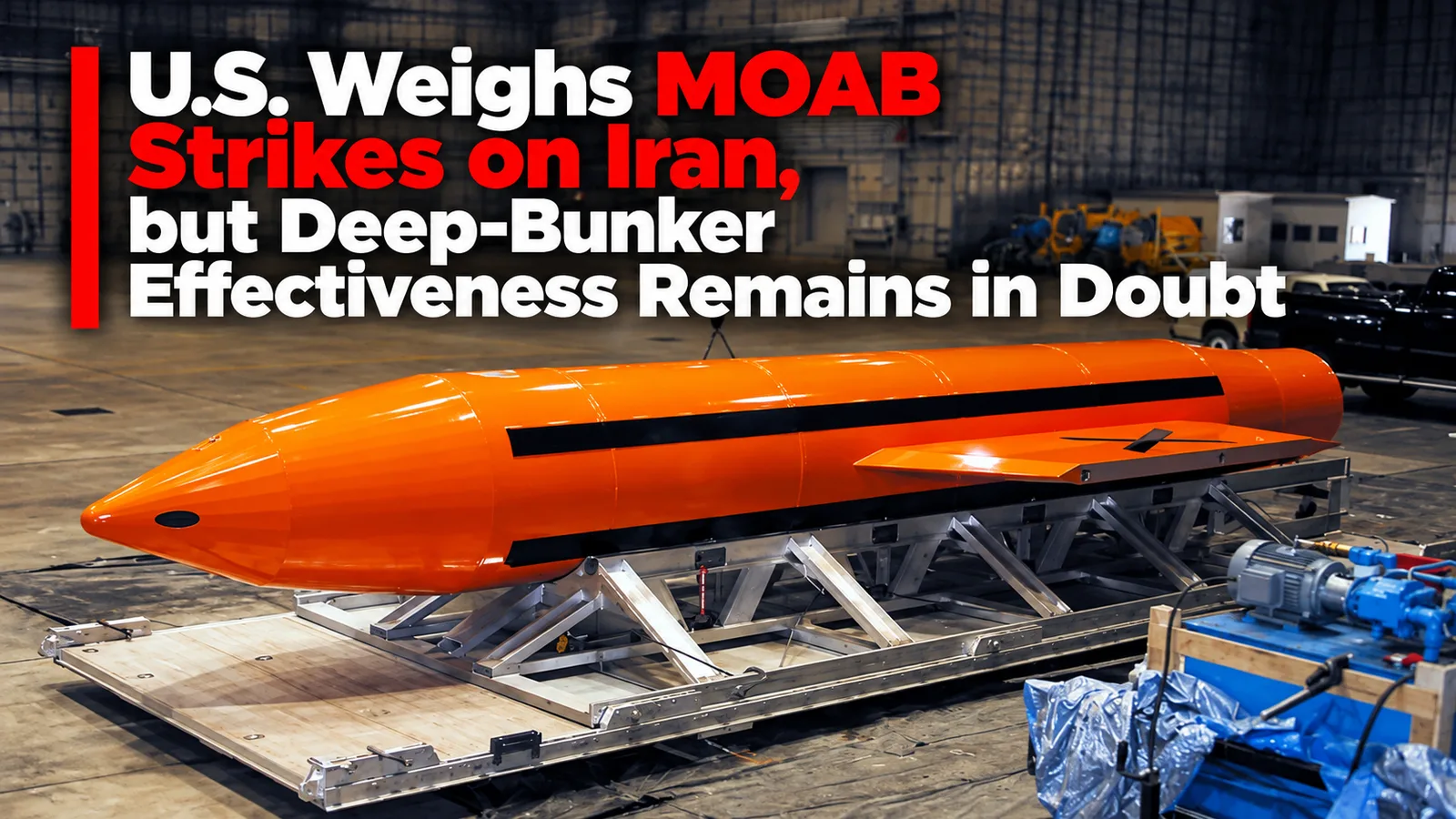
The U.S. military is reportedly considering the GBU-43/B Massive Ordnance Air Blast (MOAB) bomb in potential future attacks on Iran, according to a CNN investigation published on 14 October and reported by Reuters on 15 October. The options could cover Iranian energy infrastructure and nuclear facilities if President Donald Trump authorises renewed operations. No decision to carry out such strikes has been confirmed.
The reported proposals raise an immediate technical question: the MOAB is a very large air-blast bomb, but it is not a purpose-built deep-penetration weapon. CNN’s sources questioned whether it could destroy heavily protected underground sites. Reuters explicitly stated that it could not independently verify the planning report.
CNN Reports Contingency Plans, Not a Strike Order
CNN cited several U.S. officials and people familiar with internal deliberations who said the military had prepared new options involving the MOAB. The report includes proposed strikes on energy targets and separately discusses possible attacks on nuclear infrastructure, including a suspected underground complex known as Pickaxe Mountain.
Military planners routinely develop contingencies for different policy choices. The existence of an option does not mean that the president has selected it, that the bomb has been deployed, or that an operation has a launch date. Public accounts have not established any of those outcomes.
The White House and Pentagon Did Not Confirm the Specific Plans
Asked by CNN, a White House official declined to comment on sensitive military plans that might or might not exist, while saying the president retained policy options concerning Iran’s nuclear programme. A Pentagon official described planning for a broad range of scenarios without confirming the specific MOAB proposal.
That distinction is central to the sourcing. Reuters independently reported CNN’s findings but said it had not verified them. Other outlets that repeat the CNN account do not turn the underlying claim into multiple independent confirmations.
The GBU-43/B Is Designed for Massive Air-Blast Effects
The U.S. Air Force describes the GBU-43/B as a 21,600-pound GPS-guided munition. Its defining characteristic is a large blast effect over a broad surface area. Those characteristics make it a different category of weapon from a dense penetrator built to travel through rock, earth and reinforced structural layers before detonating.
CNN’s reporting quotes officials who question whether such a blast could reach suspected nuclear facilities protected by thick rock. A powerful surface detonation can cause major destruction, but its size alone cannot establish an ability to disable a deeply buried facility.
MOAB Must Not Be Confused With the GBU-57 Bunker Buster
The GBU-57 Massive Ordnance Penetrator (MOP) is a separate, approximately 30,000-pound U.S. weapon developed for hardened and deeply buried targets, according to official Air Force material. The GBU-43/B MOAB instead prioritises wide-area explosive effects. Referring to the MOAB as the largest U.S. non-nuclear bomb by weight without qualification is misleading because the GBU-57 is heavier.
This is more than a naming distinction. The weapons embody different intended effects. That does not establish the performance of either against a particular Iranian facility; access, geology, structural design and reliable damage assessment would still matter.
The 2017 Afghanistan Strike Is the Verified Combat Precedent
On 13 April 2017, the U.S. used a GBU-43/B against an Islamic State–Khorasan cave-and-tunnel complex in Afghanistan’s Nangarhar province, the Air Force confirms. The operation is the clearest public combat precedent for the munition.
The Afghanistan mission does not prove that the same weapon can defeat a much deeper or more heavily fortified nuclear facility. The target environment and the munition’s intended effect need to be evaluated separately rather than treating one historical strike as proof of universal effectiveness.
Energy Infrastructure Raises a Separate Civilian-Risk Question
CNN reported that energy facilities were among the targets discussed. Strikes involving a wide-area blast near populated areas could create serious risks to civilians, essential services and nearby non-military facilities. Such effects would require careful assessment under applicable international humanitarian law, including distinction, proportionality and feasible precautions.
The available reporting does not identify an authorised target, a final weapons selection or a planned damage footprint. It is therefore not possible to judge the legality of a hypothetical specific strike on the basis of the reported planning discussions alone.
Strategic Effectiveness Remains Contested Even in the Reported Deliberations
CNN’s sources also questioned whether employing the MOAB would achieve U.S. strategic objectives. Some reportedly viewed its psychological or signalling impact as potentially relevant, while doubting it would destroy deep nuclear infrastructure or compel a political settlement.
These are attributed assessments by people described as familiar with military planning, not established effects or official U.S. policy. The operational issue is whether a chosen weapon can produce an identifiable military outcome, while the political question concerns what any new strikes would accomplish or risk escalating.
What Remains Unconfirmed
No publicly confirmed presidential order, MOAB deployment, delivery aircraft assignment, number of weapons, target approval, strike timing or post-strike objective was provided in Reuters’ 15 October dispatch. CNN’s more detailed account identifies possible target sets and internal views but remains based on confidential sourcing.
The next meaningful developments would be an on-the-record administration statement, publicly documented force movements relevant to the claimed plan, an announced decision to resume attacks, or verified evidence of an operation. Until then, the development is best characterised as reported contingency planning, not an impending or executed MOAB strike.