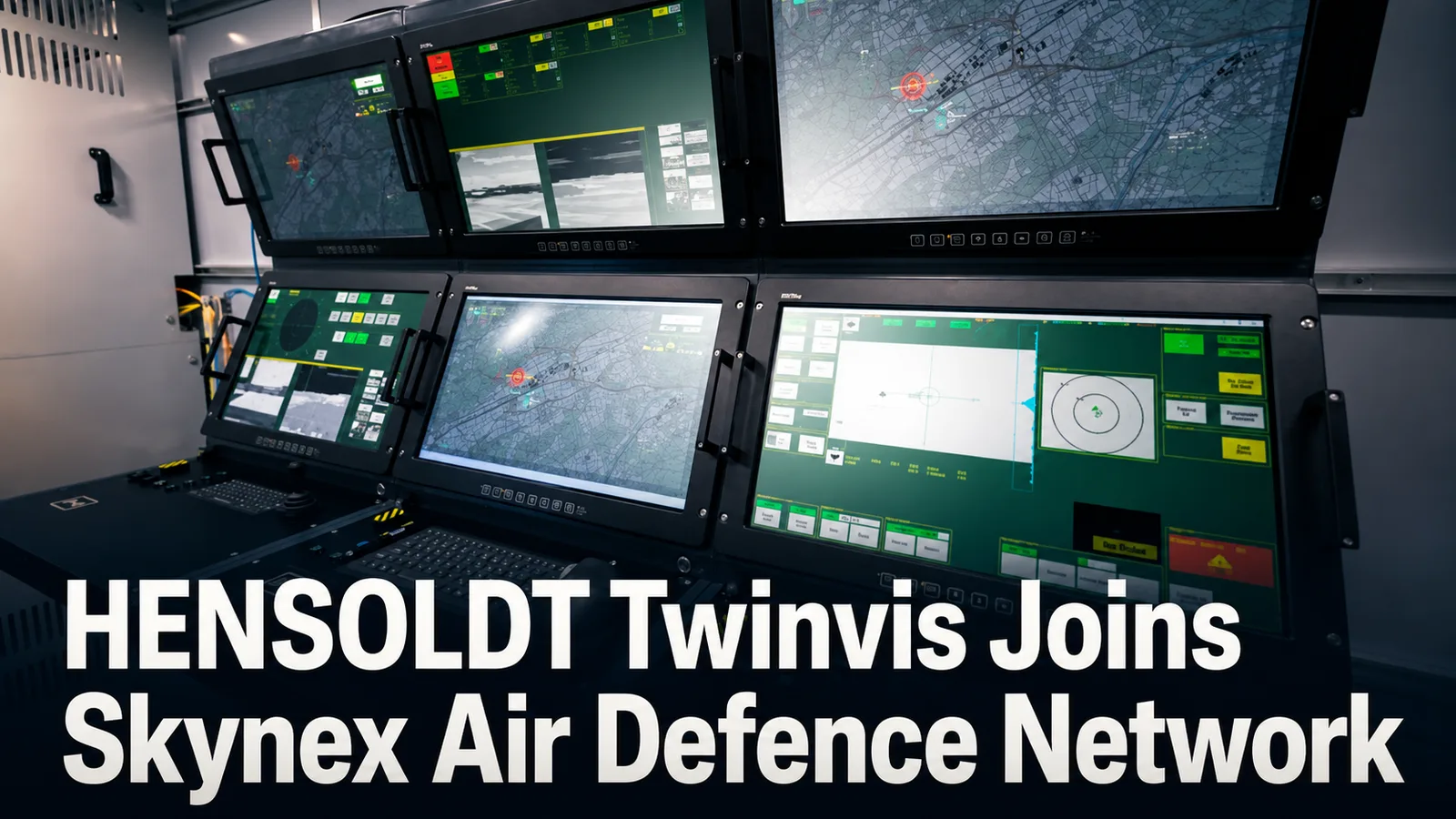
HENSOLDT Twinvis passive radar has been integrated into Rheinmetall’s Skymaster command-and-weapon-engagement architecture during the German Air Force’s Timber Express 2026 exercise, demonstrating how a non-emitting sensor can contribute directly to a networked ground-based air-defence picture.
Janes reported the integration following the German exercise, while Rheinmetall and HENSOLDT said the air picture generated by Twinvis was successfully fed into the Skymaster system controlling the Skynex air-defence battery used in the scenario.
The operational significance lies in the sensor architecture rather than a new interceptor. Twinvis does not transmit radar energy of its own. By adding its passive tracks to active radar, electro-optical and other network information, an air-defence unit can potentially maintain situational awareness while reducing its electromagnetic signature and complicating an adversary’s efforts to locate or suppress the surveillance network.
Key Facts
- Exercise: German Air Force Timber Express 2026.
- Location: Manching, Germany.
- Passive sensor: HENSOLDT Twinvis.
- C2 system: Rheinmetall Oerlikon Skymaster.
- Air-defence system: Skymaster directed the Skynex battery used in the exercise scenario.
- Network: Sensor tracks were fused and correlated within a NATO Link 16 environment to produce a common air picture.
- Follow-on potential: Rheinmetall and HENSOLDT identify Skynex, Skyranger and counter-UAS architectures such as Skyspotter as potential beneficiaries of the integration work.
Twinvis Enters the Air-Defence Kill Chain
The important development at Timber Express was not that Twinvis detected aircraft.
HENSOLDT has demonstrated passive air surveillance for years. The more consequential step was moving the resulting tracks into the same command environment being used to manage an operationally relevant air-defence battery.
During Timber Express 2026, the air picture generated by Twinvis was connected to Rheinmetall’s Skymaster command-and-weapon-engagement system.
Skymaster was directing a Skynex air-defence battery within the exercise scenario.
This places passive sensing inside the wider detect–track–classify–assign architecture rather than treating Twinvis as an independent surveillance display.
The distinction matters because modern integrated air defence depends increasingly on fusing several imperfect sensors rather than asking one radar to provide every piece of target information.
How Twinvis Detects Without Transmitting
Conventional active radar transmits electromagnetic energy and analyses the signal reflected from an object.
Twinvis takes a different approach.
The passive radar uses electromagnetic signals already present in the environment, including commercial broadcast transmissions, and compares the direct signal from the transmitter with echoes reflected from aircraft and other objects.
Because the Twinvis receiver does not need to generate the illuminating signal itself, the sensor can conduct surveillance without producing the characteristic emissions associated with a conventional radar transmitter.
HENSOLDT’s published Twinvis technical material identifies FM, DAB and DVB-T transmissions among the signals the system can exploit.
Passive Radar Changes the Electromagnetic Signature
The absence of a radar transmitter creates the principal military advantage.
Active air-defence radars can reveal their approximate position when an adversary detects and geolocates their emissions.
That can expose them to electronic attack, stand-off weapons and anti-radiation missiles.
A passive receiver is substantially more difficult to identify through the same emissions-based methods because it does not broadcast its own surveillance signal.
This does not make the sensor invisible in every sense or immune to attack. Its physical position can still be compromised by other intelligence methods, and the external transmitters it relies upon form part of the wider sensing environment.
But passive surveillance creates an additional layer that complicates suppression of enemy air defences and supports more disciplined emissions-control, or EMCON, tactics.
Link 16 Created the Common Air Picture
Timber Express tested the architecture under NATO networking conditions rather than through a closed company-only connection.
Rheinmetall said Twinvis data was fused and correlated with other sensor information inside the NATO Link 16 network to generate a common air picture.
This is operationally important because the value of a passive sensor increases considerably when its tracks can be compared with information from active radar, airborne sensors or other network participants.
One sensor may detect a contact earlier. Another may provide greater positional accuracy. A third may support identification.
Sensor fusion allows the command system to combine these inputs rather than force the operator to manage several separate air pictures.
Timber Express Is Built Around Tactical Data Links
The exercise is particularly suited to this type of experiment.
Timber Express has developed into a recurring German Air Force test environment for tactical data links and multi-domain digital connectivity.
The 2026 iteration ran from 22 June to 10 July, with Manching supporting exercise activity.
Earlier iterations have connected fixed-wing aircraft, helicopters, command centres and ground forces using Link 16, VMF, JREAP-C, CESMO and other tactical-data-link standards.
The Twinvis integration therefore fits the exercise’s broader objective: moving information between heterogeneous platforms and turning separate systems into one operational network.
Skymaster Is the Integration Layer
Rheinmetall’s Skymaster provides the command layer between sensors and effectors.
Rheinmetall describes Skymaster as a command-and-control system intended for tactical and operational air-defence networks using multi-spectrum sensor networking.
The architecture compiles a common air picture, conducts threat evaluation and supports weapon assignment across heterogeneous air-defence systems.
That open integration philosophy is central to the Timber Express demonstration.
Twinvis is a HENSOLDT sensor. Skymaster and Skynex are Rheinmetall systems. Link 16 provides a NATO-standard networking environment.
The successful combination is therefore a practical example of multi-vendor air defence rather than a vertically integrated single-company architecture.
Skynex Separates Sensors From Effectors
Skynex is particularly suited to distributed sensing because its design separates airspace surveillance from the weapon effectors.
Rheinmetall’s Skynex architecture allows several radar and sensor units to contribute to the air picture while Skymaster assigns targets to connected effectors.
Those effectors can include 35 mm gun systems, surface-to-air missiles, electronic-warfare capabilities and future directed-energy systems.
The modular approach means that integrating Twinvis does not require the passive radar to become physically tied to one specific gun or launcher.
Instead, its information can contribute to a shared command picture from which the most appropriate effector is selected.
Twinvis Is a Surveillance Sensor, Not a Fire-Control Radar
This distinction should remain clear.
The Timber Express result does not mean Twinvis itself became the terminal fire-control radar for a Skynex gun engagement.
The exercise demonstrated integration of its air picture into the command-and-weapon-engagement network.
Terminal weapon engagement may still require dedicated tracking information and appropriate fire-control sensors depending on the effector and engagement geometry.
Rheinmetall explicitly states that Skynex can integrate sensors from different manufacturers, provided appropriate tracking capability is available for the weapon engagement chain.
The correct interpretation is therefore that Twinvis strengthens detection and situational awareness inside the network rather than replacing every active tracking sensor.
Manufacturer Data Indicates Wide-Area Coverage
HENSOLDT publishes substantial surveillance performance for Twinvis.
The company states that one system can generate a three-dimensional picture of up to 200 aircraft within a radius of up to 250 km under applicable operating conditions.
Its earlier technical data identifies FM-based detection of larger aircraft at ranges up to 250 km and DAB/DVB-T-based tracking at shorter ranges with higher stated positional accuracy.
Those are manufacturer specifications and depend on transmitter geometry, target characteristics and local electromagnetic conditions.
No public Timber Express 2026 source reviewed for this article provides the actual detection ranges achieved during the exercise.
Defence Agenda therefore does not treat the 250 km figure as a demonstrated Timber Express performance result.
Passive Radar Depends on the Electromagnetic Environment
Passive radar also involves trade-offs.
Unlike an active radar, the sensor does not control the illuminators it uses.
Performance depends partly on the location, power, frequency and geometry of external transmitters relative to the radar and target.
A dense European broadcast environment can provide a favourable set of illuminators. Other theatres may offer different signal conditions.
This is why passive radar is generally most powerful as a complementary sensor rather than a universal replacement for active AESA surveillance radars.
The Timber Express architecture reflects exactly that logic: passive information contributes to a fused network rather than becoming the only source of air surveillance.
Sensor Diversity Improves Air-Defence Survivability
The military advantage of mixing active and passive sensing is resilience.
An adversary attempting to suppress an integrated air-defence network has to identify its sensors, disrupt their communications and neutralise the nodes that contribute to the recognised air picture.
If every sensor uses the same operating principle and electromagnetic signature, that task becomes more predictable.
A network containing active radar, passive radar, electro-optics and potentially electronic-support sensors presents a more complicated problem.
Loss or shutdown of one sensor type does not necessarily eliminate the entire surveillance picture.
This is increasingly important in air defence against adversaries capable of electronic attack and precision strike.
EMCON Is Returning to Ground-Based Air Defence
The integration also strengthens emissions-control options.
A ground-based air-defence unit does not necessarily want every radar transmitting continuously.
Under some tactical conditions, active radars can remain silent or operate intermittently while passive sensors and offboard network tracks maintain part of the situational picture.
Active sensors can then be brought online when higher-quality tracking or weapon-support data is required.
This creates a more dynamic relationship between surveillance and signature management.
Rheinmetall specifically links the Twinvis demonstration to resilient low-emission air surveillance and modern EMCON strategy.
Counter-UAS Is a Logical Follow-On Application
Rheinmetall and HENSOLDT also identify counter-UAS as a potential application for the integration work.
Small drones create a difficult sensor problem because they can operate at low altitude, have comparatively small radar signatures and appear against complex ground clutter.
No single sensor modality performs optimally in every condition.
Defence Agenda’s UAV Swarms vs SHORAD analysis identified multi-phenomenology sensing — radar, EO/IR and passive detection — as a key requirement for resilient short-range air defence.
Twinvis cannot be assumed to detect every small drone at the ranges associated with larger aircraft, but integrating additional passive information into the wider network can improve the overall sensor picture.
Skyspotter Could Use the Same Integration Logic
Rheinmetall specifically identifies Skyspotter among the systems that could benefit from the Timber Express findings.
Skyspotter was introduced at Eurosatory 2026 as a counter-UAS detection architecture for airports and other critical infrastructure.
The system is intended to detect, identify and track airborne threats while minimising disruption to normal aviation activity.
Adding passive surveillance to such networks could be particularly useful around infrastructure where constant high-power military radar emissions may be undesirable or where additional sensor diversity improves classification confidence.
Skyranger Is Another Potential Destination
The companies also point toward Rheinmetall’s mobile Skyranger family.
Skyranger provides short-range mobile air defence for manoeuvre forces using guns, missiles and integrated sensors.
Germany and Austria are already integrating HENSOLDT Spexer 2000 3D MkIII radars into their Skyranger 30 configurations under a 2026 agreement.
A passive track source would not necessarily replace those organic sensors.
Instead, it could provide additional cueing through the wider air-defence network, allowing mobile units to benefit from tracks generated beyond their own radar horizon or while managing their electromagnetic signature.
Germany Is Rapidly Expanding Its Air-Defence Sensor Base
The Timber Express demonstration takes place during a much wider German and European air-defence expansion.
HENSOLDT is supplying TRML-4D radars for IRIS-T SLM and other air-defence applications, while Germany is replacing legacy long-range surveillance infrastructure through the HADR follow-on programme.
Rheinmetall is simultaneously expanding Skynex and Skyranger production.
In July 2026, Rheinmetall disclosed another order for four complete Skynex systems worth several hundred million euros.
Defence Agenda’s Rheinmetall H1 2026 analysis found that air-defence sales increased 62% to €478 million, making the segment the company’s fastest-growing reported business area in the first half.
European Air Defence Is Moving Toward Sensor Networks
The wider European trajectory increasingly favours networked rather than stand-alone air-defence batteries.
A missile launcher, gun system or radar contributes more operational value when it can exchange tracks and engagement information with neighbouring units.
This is particularly important against cruise missiles and drones that can approach from low altitude and exploit terrain or gaps between radar sectors.
Defence Agenda examined this architecture in Inside the Emergency Push for a European Drone Wall, where distributed radar, passive sensing, electronic warfare and shared command software form the detection layer behind future European counter-UAS defence.
Twinvis integration provides a concrete German example of how one additional sensing modality can be inserted into that wider network.
Passive Detection Does Not Make Stealth Obsolete
Passive radar is sometimes presented as a simple answer to low-observable aircraft.
The operational reality is more complicated.
Different radar geometries and frequencies can detect aspects of a target that are difficult for conventional monostatic fire-control radar to observe, and HENSOLDT promotes Twinvis for detection of low-observable and non-emitting targets.
But detection does not automatically equal a weapons-quality track.
A network may still require active radars, electro-optical tracking or other sensors to refine the contact sufficiently for engagement.
The military relevance of passive radar therefore lies partly in cueing, track correlation and forcing stealth aircraft to confront a more diverse surveillance environment.
Network Architecture Becomes the Force Multiplier
The Timber Express result illustrates a broader shift in air-defence procurement.
Individual sensor specifications remain important, but the ability to ingest and fuse third-party data is becoming a major competitive metric.
An open command architecture can allow an operator to improve capability by adding a new sensor without replacing the existing effector fleet.
That can shorten upgrade cycles and prevent a force from becoming dependent on one radar family or manufacturer.
The same principle is visible in other modern integrated-defence programmes covered by Defence Agenda, including ASELSAN’s Steel Dome architecture, where radars, electronic warfare and multiple effectors are treated as one system of systems.
The Main Risk Is Track Quality and Latency
Successful networking introduces its own technical requirements.
Sensor data from different sources must be time-synchronised, correlated and deconflicted quickly enough to support operational decisions.
If two sensors report the same aircraft as separate targets, the command system needs to recognise the duplication.
If the passive track is less precise than an active-radar track, the system must preserve the uncertainty rather than create false confidence.
Latency also matters. Air-defence timelines against drones, cruise missiles and high-speed aircraft can be measured in seconds.
Timber Express demonstrated that the integration could generate a shared picture under NATO networking conditions, but detailed public figures for track latency and correlation accuracy were not released.
The Demonstration Was Integration, Not a Procurement Decision
The exercise result should also be separated from a procurement announcement.
Neither the publicly available company material nor the Janes report reviewed for this article establishes that the German Air Force has ordered Twinvis specifically for operational Skynex batteries as a consequence of Timber Express 2026.
The trial validates interoperability and creates a technical basis for future applications.
A formal integration programme, production order or fielding decision would represent the next material step.
Implications / Next
The first milestone to watch is whether Rheinmetall and HENSOLDT move the Twinvis–Skymaster integration from exercise configuration into a formal customer baseline for Skynex.
The second is mobile integration. Applying passive tracks to Skyranger units would demonstrate whether the concept can support manoeuvre air defence rather than primarily fixed or semi-fixed networks.
The third is counter-UAS. Skyspotter and other drone-defence architectures provide an opportunity to evaluate how passive radar contributes against smaller and lower-flying targets in cluttered environments.
The fourth is multinational interoperability. Timber Express demonstrated Link 16 integration under NATO conditions; future Alliance exercises can test whether passive tracks remain useful across larger multinational sensor and C2 networks.
The fifth is EMCON doctrine. Technical integration becomes operationally valuable only if air-defence units develop procedures governing when active radars transmit, when passive surveillance carries more of the workload and how the network transitions into the terminal engagement phase.
Finally, procurement authorities will need to compare passive-radar investment against alternative ways of increasing sensor diversity, including additional AESA radars, electro-optics and electronic-support systems.
Conclusion
The Timber Express 2026 trial is significant because it moves HENSOLDT Twinvis from passive surveillance toward a more operationally relevant position inside an integrated air-defence network.
Twinvis generated the passive air picture. NATO Link 16 provided the networking environment. Rheinmetall Skymaster fused and correlated the information while controlling the Skynex battery used in the scenario.
The architecture demonstrates why future air defence is increasingly a sensor-fusion problem rather than a contest between individual radars.
Active radar remains essential for many surveillance and weapon-support functions, but passive sensing can complicate enemy electronic intelligence, support emissions control and create additional tracks when conventional radars are silent or threatened.
The next step is operationalisation. If the integration moves into Skynex, Skyranger and counter-UAS deployments, Twinvis could become part of a broader European model in which air-defence effectors are surrounded by distributed active, passive and electro-optical sensor networks rather than tied to one emitting radar.
Further Reading
- Janes: HENSOLDT Passive Radar Integrated for Air Defence During Timber Express 2026
- HENSOLDT: Twinvis Passive Radar Technical Overview
- Rheinmetall: Oerlikon Skynex Networked Air Defence
- German Air Force: Timber Express Digital Networking of Weapon Systems
- Defence Agenda: UAV Swarms vs SHORAD
- Defence Agenda: Inside the Emergency Push for a European Drone Wall
- Defence Agenda: Rheinmetall H1 Sales Rise 39% to €5.2B
- Defence Agenda: ASELSAN Steel Dome Adds New C-UAS Layer