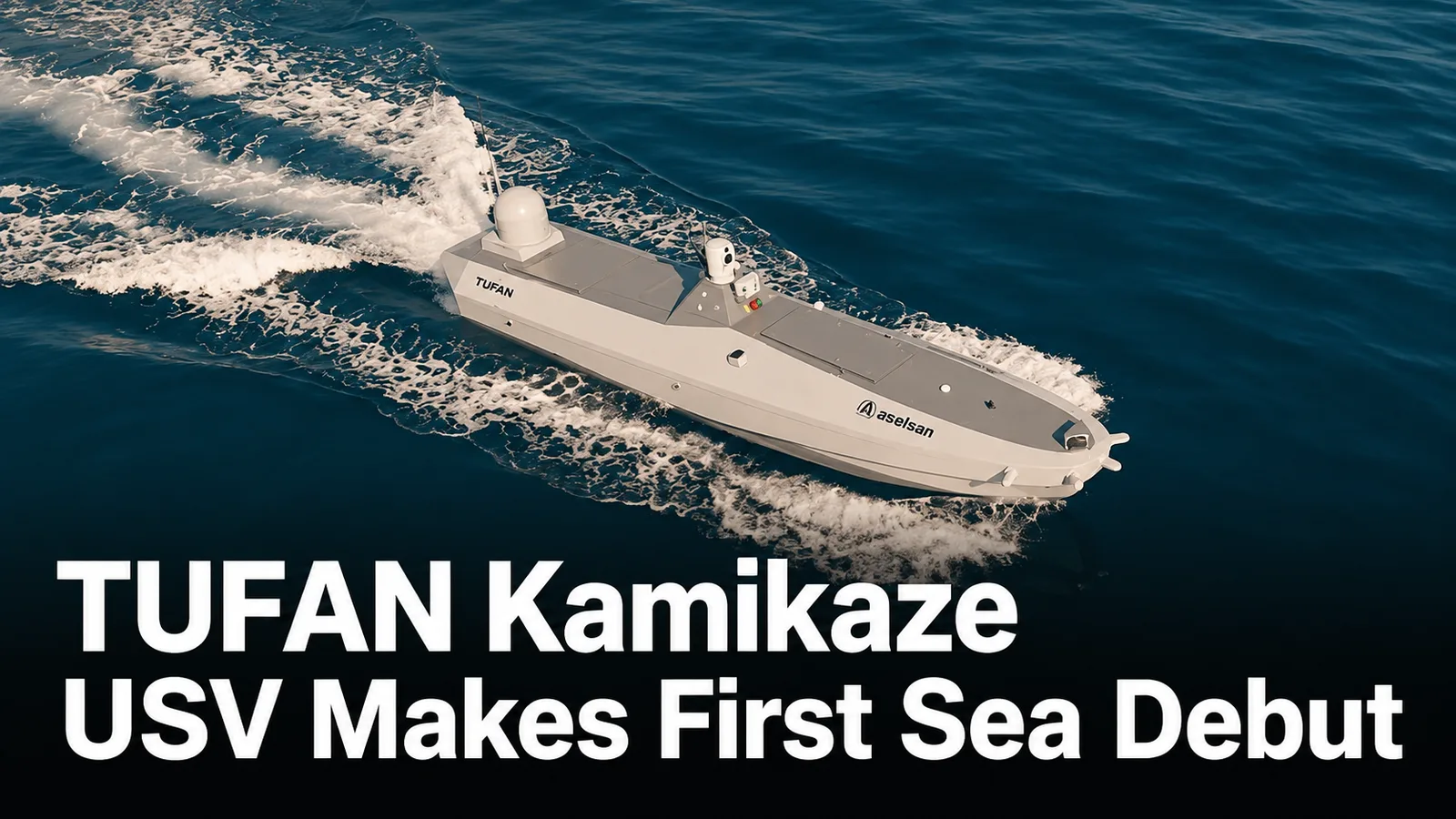
ASELSAN’s TUFAN Kamikaze USV has entered the water for the first time during TEKNOFEST Mavi Vatan 2026 at Gölcük Naval Shipyard Command, moving Türkiye’s new autonomous maritime strike platform from exhibition debut toward at-sea development.
The milestone took place on 20 August 2026, just over three months after TUFAN was publicly unveiled alongside the KILIÇ family of one-way attack autonomous underwater vehicles. ASELSAN is positioning the system as a high-speed, low-signature unmanned surface vehicle capable of autonomous and swarm operations for reconnaissance and offensive maritime missions.
The first launch is important because TUFAN is intended to become more than a static technology demonstrator. ASELSAN has publicly targeted 2027 for inventory entry, meaning the next development phase will need to validate propulsion, navigation, communications, autonomous behaviour, sensor integration and operational reliability at sea.
Key Facts
- Milestone: TUFAN entered the water for the first time on 20 August 2026.
- Location: TEKNOFEST Mavi Vatan at Gölcük Naval Shipyard Command, Türkiye.
- Developer: ASELSAN.
- Platform type: Kamikaze / one-way attack unmanned surface vehicle.
- Manufacturer-stated range: 200 nautical miles.
- Manufacturer-stated speed: At least 50 knots.
- Dimensions: 8 m long and 1.8 m wide.
- Planned status: ASELSAN has previously stated a 2027 inventory-entry target.
TUFAN Kamikaze USV Enters the Water for the First Time
SavunmaSanayiST reported on 20 August 2026 that the ASELSAN-developed TUFAN Kamikaze USV had been launched for the first time during TEKNOFEST Mavi Vatan.
Anadolu Agency independently confirmed the first launch, citing ASELSAN’s statement that TUFAN was “in our waters for the first time.”
The wording matters. This was the platform’s first publicly reported launch, not an operational acceptance or inventory ceremony.
TUFAN therefore remains in development and testing as ASELSAN moves toward its previously stated 2027 service-entry objective.
TUFAN Was First Unveiled at SAHA 2026
ASELSAN publicly revealed TUFAN on 5 May 2026 alongside the KILIÇ family of expendable autonomous underwater vehicles.
The original introduction at SAHA 2026 presented the two systems as complementary components of Türkiye’s emerging autonomous maritime strike architecture.
KILIÇ operates below the surface, while TUFAN is designed to conduct missions on the surface.
Both programmes place heavy emphasis on autonomy, low observability, expendability and the ability to operate in coordinated groups rather than as isolated platforms.
Official TUFAN Specifications
ASELSAN’s official TUFAN product brochure provides the clearest current technical baseline for the platform.
- Length: 8 metres.
- Width: 1.8 metres.
- Maximum speed: At least 50 knots.
- Operational range: 200 nautical miles.
- Propulsion: Gasoline engine and water-jet propulsion.
- Communications: RF line-of-sight, mesh networking, satellite BLOS and 4G/LTE.
- Navigation: Designed to continue missions in GNSS- and communication-denied environments.
- Signature management: Low radar cross-section and reduced thermal signature.
These figures are manufacturer-stated specifications. Operational testing will determine how the platform performs across different sea states, communications conditions and mission profiles.
TUFAN Is Designed for Autonomous and Swarm Missions
TUFAN’s defining characteristic is not simply that it is unmanned.
ASELSAN describes an autonomy architecture capable of mission planning, task distribution, sensor fusion, dynamic route planning and solo or swarm operation.
The system can detect fixed and moving obstacles and adjust its route autonomously, while day-and-night sensing supports operations outside favourable visual conditions.
ASELSAN also states that multiple TUFAN vehicles can form mission-specific subgroups and asymmetric attack formations.
The ability to divide a larger swarm into smaller task groups is potentially significant because it allows a commander to assign different roles within a distributed maritime mission rather than treating every vehicle identically.
The Platform Combines Strike and ISR Roles
TUFAN is primarily being marketed as a kamikaze or one-way attack USV, but ASELSAN also identifies intelligence, surveillance and reconnaissance missions as part of its operational role.
This dual-use mission architecture can give the platform more utility during periods when an immediate strike is not required.
A USV operating forward of a naval formation can contribute visual information and maritime surveillance while remaining available for other assigned missions if required.
The wider significance is that expendable or attritable platforms no longer need to perform only one narrowly defined task before being committed.
TUFAN Is Designed for Contested Communications
One of the most consequential features in ASELSAN’s published specification is operation under GNSS- and communications-denied conditions.
This is critical for autonomous naval warfare because maritime strike platforms cannot assume continuous satellite navigation or uninterrupted communications during combat.
Electronic warfare can disrupt navigation and command links, while coastal geography and the curvature of the Earth can restrict conventional line-of-sight communications.
TUFAN therefore combines multiple communications options with onboard autonomy intended to allow mission continuation when external connectivity is degraded.
The precise behaviour of the system under such conditions has not been publicly described in operational detail, and its resilience will need to be demonstrated through testing.
C2 Integration Is Central to the Concept
ASELSAN also states that TUFAN can conduct joint operations with crewed and uncrewed platforms and can integrate with command-and-control systems.
This is strategically more important than treating TUFAN as an independent remote-controlled boat.
Modern maritime combat increasingly depends on distributed sensing and targeting, where one platform may detect a contact while another provides identification, command approval or the final effect.
A TUFAN formation integrated into a wider naval C2 network could therefore receive information from ships, UAVs, coastal sensors or other autonomous systems rather than relying entirely on its own onboard sensors.
The challenge will be demonstrating interoperability under realistic communications constraints.
TUFAN Extends Türkiye’s Existing USV Portfolio
Türkiye already operates and develops several classes of unmanned surface vehicles, but TUFAN occupies a different mission category from larger reusable platforms.
ASELSAN and Sefine Shipyard’s MARLIN platform, for example, has been developed for reusable electronic warfare, reconnaissance and other modular missions.
Defence Agenda previously examined that architecture in Türkiye’s Electronic Warfare USV, where MARLIN’s role as an off-board electronic support and attack node demonstrated the value of moving high-risk missions away from crewed warships.
TUFAN applies a different economic and operational logic: lower emphasis on platform recovery and greater emphasis on high-speed, attritable or one-way employment.
The Hybrid Fleet Is Moving Toward Specialised Uncrewed Nodes
The emergence of TUFAN also reflects a global shift from large multipurpose unmanned vessels toward families of specialised autonomous systems.
Some USVs are designed for electronic warfare, others for mine countermeasures, anti-submarine sensing, logistics or reconnaissance.
One-way attack USVs represent another specialised layer in this architecture.
Defence Agenda’s USV Technology Drives the Navy’s Hybrid Fleet analysis outlines how navies are increasingly distributing sensors and mission payloads across uncrewed platforms while retaining crewed ships as command, networking and high-end combat nodes.
TUFAN fits that model by adding a dedicated autonomous surface-strike option to Türkiye’s growing naval unmanned-systems portfolio.
KILIÇ and TUFAN Create Surface and Subsurface Layers
TUFAN’s development alongside the KILIÇ family is particularly relevant.
KILIÇ 10 and KILIÇ 200 are designed as expendable autonomous underwater systems, while TUFAN operates on the surface.
This creates the basis for a multi-axis autonomous maritime concept in which threats or surveillance systems must account for activity both above and below the surface.
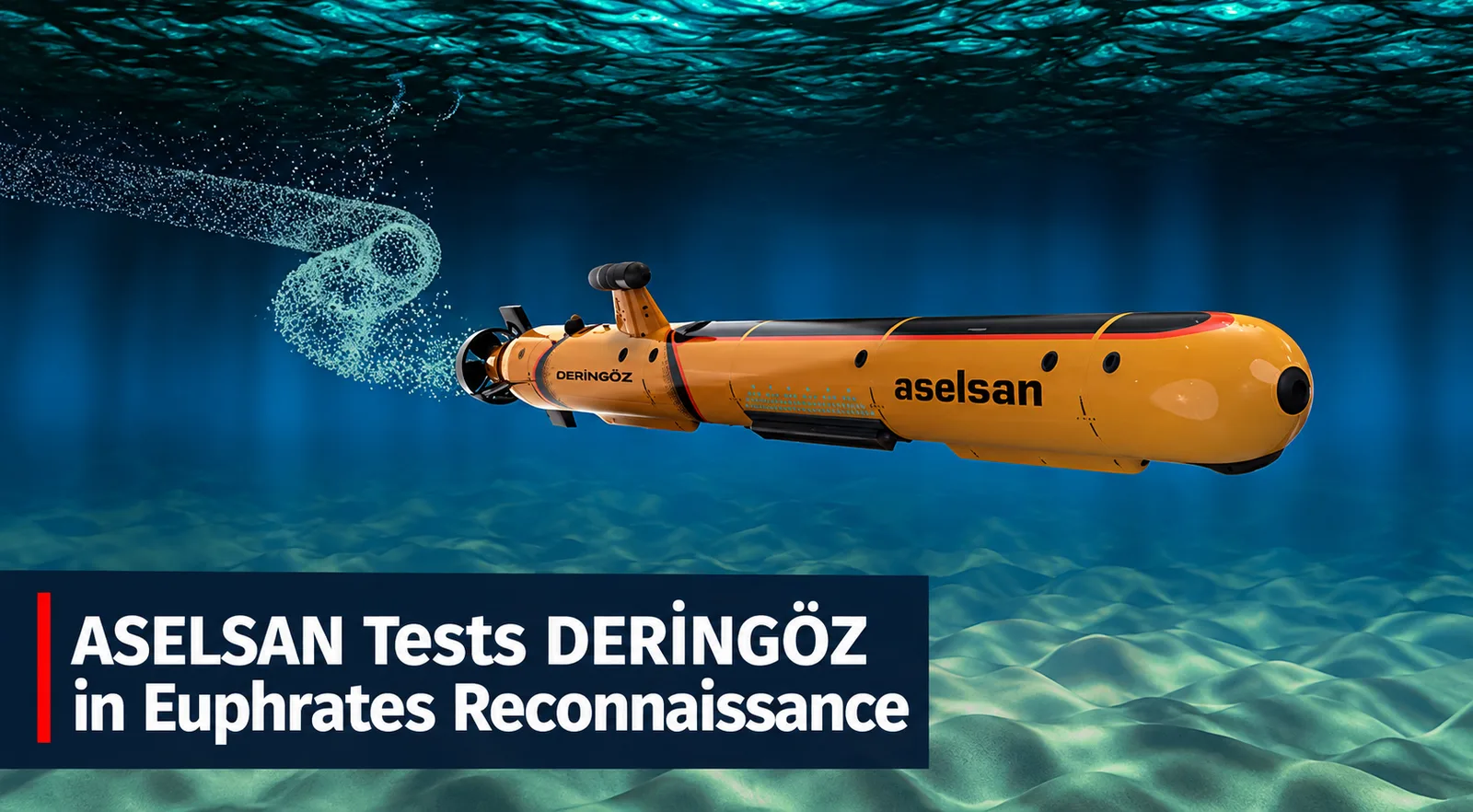
Defence Agenda recently examined this wider trend in its coverage of DERİNGÖZ and KILIÇ 10 at TEKNOFEST Mavi Vatan, where Türkiye’s reusable underwater sensing and expendable strike systems were demonstrated together.
The long-term operational value will depend on whether those surface, subsurface and airborne systems can share data and operate within common mission-command structures.
A 200 NM Range Changes Deployment Options
ASELSAN lists TUFAN’s operational range as 200 nautical miles.
That figure gives the platform potential utility beyond immediate harbour defence or very short-range coastal missions.
It could allow deployment from shore facilities or suitable launch platforms without requiring the controlling force to operate directly alongside the mission area.
The actual tactical radius will depend on mission profile, sea state, speed, communications requirements and whether recovery is part of the mission.
For that reason, manufacturer-stated operational range should not automatically be interpreted as equivalent to an engagement radius under every combat condition.
High Speed Supports a Shorter Exposure Window
TUFAN’s published maximum speed of at least 50 knots places it firmly in the high-speed USV category.
Speed matters because an autonomous surface platform remains exposed to detection and interception once identified.
Higher transit speed can reduce the period during which an opposing force has to track and respond to the platform, although survivability also depends on signature, manoeuvrability, environmental conditions and the quality of defensive surveillance.
ASELSAN specifically highlights both low radar cross-section and reduced thermal signature as elements of the TUFAN design.
Low Signature Does Not Mean Undetectable
The low-observable language surrounding TUFAN should also be interpreted carefully.
A reduced radar or thermal signature can make detection more difficult or shorten detection range under some conditions, but it does not make a surface craft invisible.
Modern naval forces can combine radar, electro-optical sensors, airborne surveillance and other systems to detect small maritime contacts.
The effectiveness of the TUFAN concept will therefore depend on the combined effect of speed, signature management, autonomy, route selection and coordinated operation rather than any single low-observable characteristic.
TEKNOFEST Mavi Vatan Provides a Maritime Test Environment
TEKNOFEST Mavi Vatan 2026 is being held from 20–23 August at Gölcük Naval Shipyard Command under the coordination of Türkiye’s Ministry of National Defence, Ministry of Industry and Technology and the Turkish Technology Team Foundation.
The event focuses on naval, underwater and uncrewed technologies and includes competitions for unmanned surface and underwater systems.
For TUFAN, the significance of the event lies less in the exhibition environment than in the transition from a static May 2026 unveiling to actual operation in the water.
2027 Inventory Entry Is the Next Major Target
ASELSAN CEO Ahmet Akyol previously stated that TUFAN was planned to enter inventory in 2027.
The company has also indicated that development and preparations for production are being pursued in parallel.
This approach can compress the interval between successful qualification and deliveries, but it also places additional importance on resolving design changes before serial manufacture expands.
The 20 August launch therefore represents an early maritime milestone on a comparatively aggressive programme timeline.
Counterargument: First Launch Is Not Operational Validation
TUFAN’s first entry into the water is noteworthy, but it should not be confused with combat readiness.
An operational USV must prove more than basic propulsion and navigation.
Reliability over longer missions, performance in different sea states, communications resilience, autonomous obstacle avoidance, navigation under degraded GNSS conditions and integration with military C2 all require continued evaluation.
Swarm operation introduces an additional layer of software, communications and deconfliction complexity.
The most meaningful next milestones will therefore come from progressively more representative sea trials rather than exhibition demonstrations alone.
Industrial Scalability Will Determine Operational Relevance
The strategic case for one-way attack USVs also depends heavily on manufacturing economics.
An attritable system is valuable only if it can be produced and sustained at a cost and rate that justify accepting platform losses.
This gives ASELSAN’s simultaneous development-and-production approach a broader significance.
If TUFAN reaches serial production, the relevant measure will not only be vehicle performance but how quickly the company can manufacture platforms, maintain communications and sensor components and replenish the fleet after use.
Implications / Next
The first milestone to watch is extended sea trials. Longer-duration operation will provide a clearer indication of propulsion reliability, navigation performance and endurance.
The second is GNSS-denied testing. ASELSAN explicitly markets operation under degraded navigation and communications conditions, making this one of the platform’s more strategically important advertised capabilities.
The third is swarm demonstration. Coordinated operation by multiple TUFAN vehicles would represent a substantially higher maturity level than a single-platform sea launch.
The fourth is C2 integration. Demonstrating operations with Turkish naval combat-management systems or other crewed and uncrewed platforms would show whether TUFAN is developing as part of a genuine system-of-systems architecture.
The fifth is inventory acceptance in 2027. Confirmation of customer, quantity and production status will determine whether the programme has moved from advanced development into operational force structure.
Conclusion
TUFAN’s first launch marks the transition of ASELSAN’s new kamikaze USV from a publicly displayed concept into at-sea development.
The platform combines a manufacturer-stated 200-nautical-mile range and speed of at least 50 knots with low-signature design, multiple communications links, autonomous navigation and swarm-capable mission software.
Its strategic relevance, however, will be determined by more than headline performance figures.
Reliable operation in difficult sea and communications environments, integration into Türkiye’s naval command architecture and the ability to produce the system at meaningful scale will decide whether TUFAN becomes an operationally significant part of Türkiye’s uncrewed maritime force.
The 20 August 2026 sea debut is therefore best understood as the beginning of that validation process rather than its conclusion.
Further Reading
- SavunmaSanayiST: TUFAN Enters the Water for the First Time
- ASELSAN: TUFAN Kamikaze USV Official Product Data
- Anadolu Agency: TUFAN Kamikaze USV Launches for the First Time
- Anadolu Agency: ASELSAN Introduces KILIÇ and TUFAN
- TEKNOFEST: Mavi Vatan 2026 Programme
- Defence Agenda: Türkiye’s Electronic Warfare USV
- Defence Agenda: USV Technology Drives the Navy’s Hybrid Fleet
- Defence Agenda: DERİNGÖZ and KILIÇ 10 at TEKNOFEST Mavi Vatan