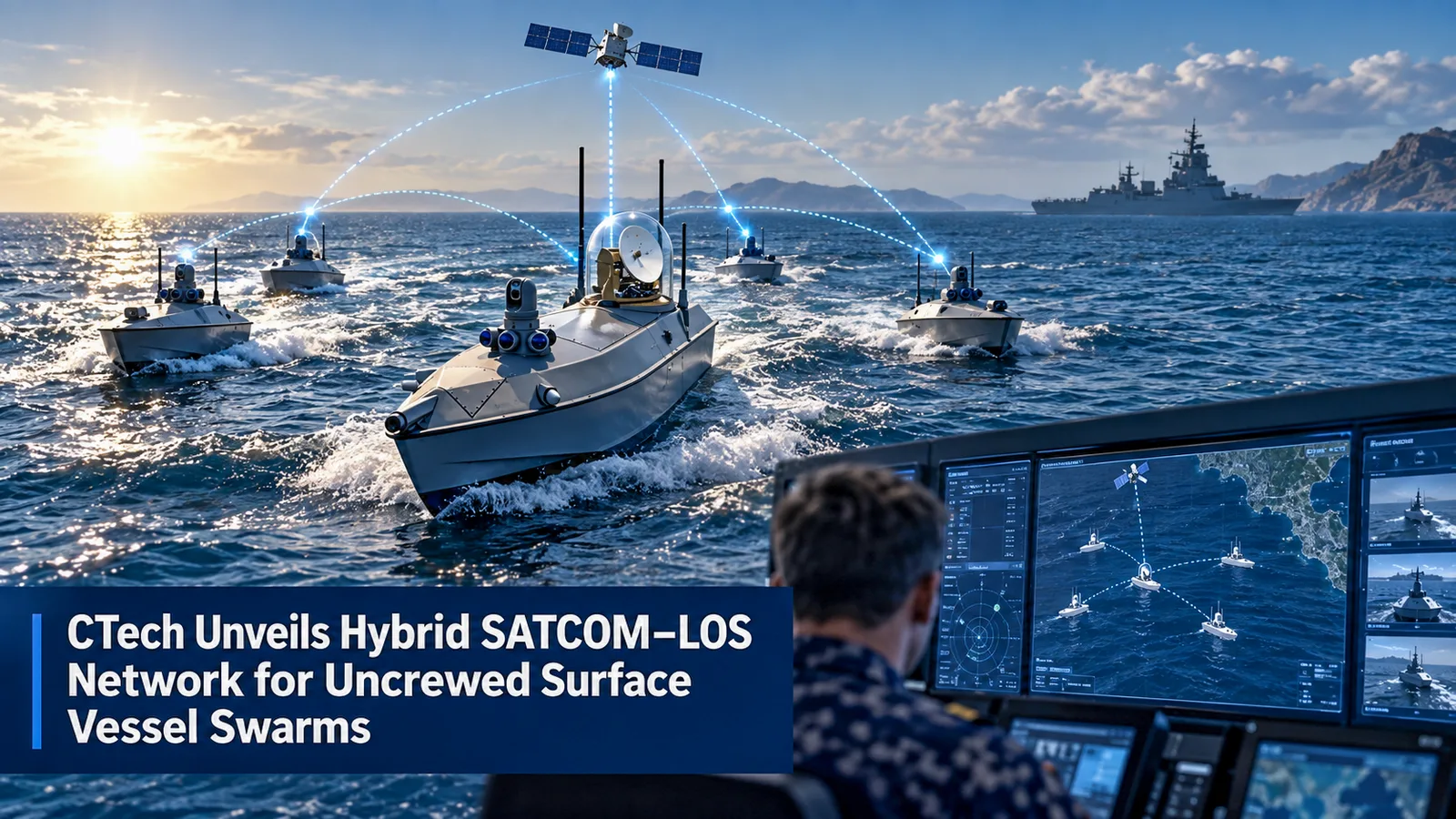
Türkiye-based communications specialist CTech has presented a hybrid communications concept that combines satellite communications and line-of-sight networking to connect groups of uncrewed surface vessels with a distant command centre. The architecture pairs the company’s AquaARX maritime SATCOM terminal with UfukLink Mini Pro line-of-sight communications equipment, allowing one gateway vessel to relay command, control and live imagery between a satellite link and other vessels in the group.
In the concept shown by CTech, only the gateway craft carries both AquaARX and UfukLink Mini Pro. Other vessels — including strike or kamikaze USVs shown in the source material — can remain connected through UfukLink Mini Pro, meaning the concept does not require a separate satellite terminal on every craft in the formation.
Gateway Vessel Bridges Satellite Communications and the Local Swarm Network
The central element of CTech’s architecture is a gateway USV fitted with both AquaARX and UfukLink Mini Pro. AquaARX provides the beyond-line-of-sight satellite connection to the remote command centre, while UfukLink Mini Pro distributes that connectivity to nearby vessels over a local line-of-sight network.
Command instructions therefore follow a two-stage path: from the command centre through the satellite link to the AquaARX-equipped vessel, then from that vessel to the rest of the formation through UfukLink Mini Pro. The same architecture is shown carrying information in the opposite direction, including live imagery and mission data from the distributed vessels back to operators at the command centre.
UfukLink Mini Pro Provides the Intra-Swarm Communications Layer
CTech’s published technical material positions UfukLink Mini Pro as a compact line-of-sight communications system with mesh-network capability. The manufacturer lists data rates of up to 100 Mbps and communications distances of up to 200 km under line-of-sight conditions, while noting that actual range depends on antenna configuration, radio-frequency output power and operating conditions.
Within the swarm concept, the important function is not simply point-to-point connectivity but the ability to distribute the gateway vessel’s satellite link across several craft. This creates a communications layer in which multiple USVs can share command, control and sensor traffic without each platform carrying its own SATCOM terminal, potentially reducing the hardware, integration and cost burden on smaller or expendable vehicles.
AquaARX Extends Command and Control Beyond the Radio Horizon
AquaARX supplies the long-range portion of the architecture. CTech describes the maritime SATCOM family as a broadband communications solution for crewed and uncrewed vessels, supporting secure real-time command and control, video and mission-data exchange while operating under vessel motion and changing sea conditions.
The combination addresses a fundamental limitation of line-of-sight networking: local radio links remain constrained by geometry, antenna height and the radio horizon. By placing a satellite-connected node inside the formation, the concept allows the local USV network to remain connected to a command element located far outside direct radio range, subject to satellite coverage, network availability and the survivability of the gateway link.
The Concept Reduces Terminal Count but Makes Gateway Resilience Critical
The most immediate architectural advantage is concentration of the satellite terminal on a smaller number of vessels. A swarm can therefore distribute LOS radios across many craft while reserving the larger and more complex SATCOM installation for a gateway node, a model that is particularly relevant to lower-cost strike or attritable USVs where size, weight, power and unit cost are tightly constrained.
The trade-off is dependence on the gateway function. If a formation relies on only one AquaARX-equipped vessel, disruption or loss of that node could isolate the remaining craft from beyond-line-of-sight command unless the network includes redundant gateways, autonomous mission logic or alternative communications paths. CTech’s source material does not disclose redundancy, automatic gateway handover, anti-jam performance for the complete hybrid network or how the architecture behaves when the satellite link is interrupted.
From Communications Concept to Operational Network
The supplied 57-second video should be treated as a concept visualisation rather than evidence of a completed sea trial. It illustrates the communications flow between a remote command centre, an AquaARX-equipped gateway vessel and other USVs, but it does not establish that the full architecture has been tested at the ranges or under the electronic-warfare conditions implied by an operational naval deployment.
The next meaningful milestones would be a live multi-vessel demonstration, verified gateway handover or redundancy testing, operation under jamming or degraded SATCOM conditions, and integration with a combat-management or mission-command system. Those steps would determine whether the concept can move from a communications architecture into a resilient operational network for distributed uncrewed maritime forces.