France drone production is moving from policy announcements to industrial implementation as automotive manufacturers begin applying high-volume engineering, automation and supply-chain methods to military unmanned systems.
A Reuters investigation published by Defense News identified at least six defence-automotive partnerships announced since the beginning of 2026.
The projects connect companies including Renault Group, Valeo, Forvia and Schaeffler with drone developers such as Thales, Delair, Harmattan AI and Turgis Gaillard.
The objective is not simply to design more aircraft. France is attempting to establish production systems that can manufacture affordable drones in large quantities and expand rapidly during a military crisis.
Renault and Thales plan capacity for 1,000 TOUTATIS systems per month from 2027, while the Schaeffler–Delair partnership is developing a line capable of approximately 100 drones and interceptors per day by November 2026.
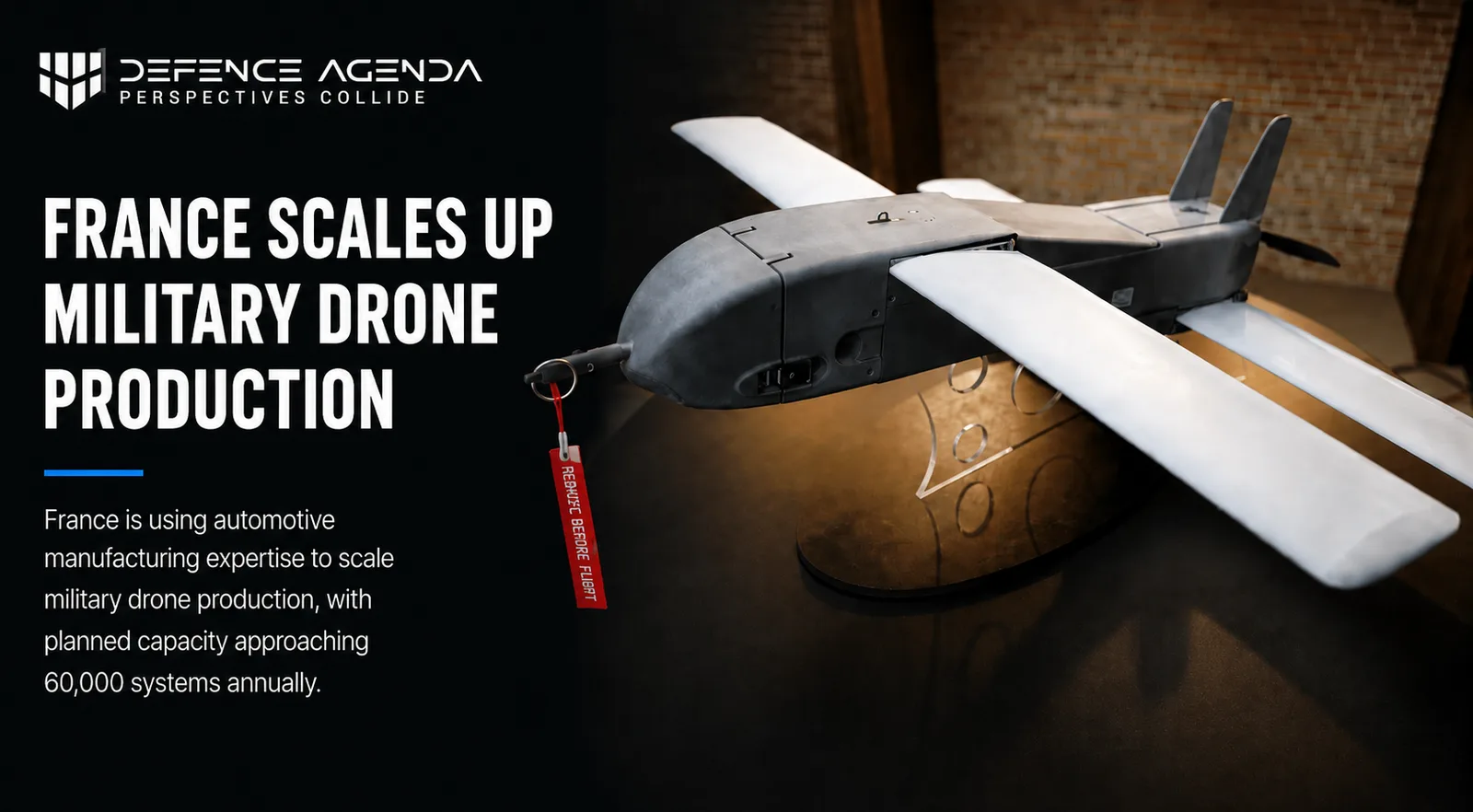
These targets, together with Forvia’s interceptor-drone plans, could create annual capacity of roughly 60,000 systems. That figure represents potential manufacturing throughput rather than confirmed orders or guaranteed deliveries.
Key Facts
- Industrial trend: At least six French defence-automotive partnerships announced in 2026.
- Primary objective: Transfer automotive scale, automation, quality control and cost discipline into drone manufacturing.
- Potential combined capacity: Approximately 60,000 drones annually if selected announced targets are achieved.
- Renault–Thales target: Up to 1,000 TOUTATIS loitering munitions per month from 2027.
- Schaeffler–Delair target: Approximately 100 drones and interceptors per day by November 2026.
- Forvia target: Capacity of approximately 1,000 interceptor drones per month.
- Renault–Turgis Gaillard target: Up to 600 Chorus drones per month within one year.
- Valeo–Harmattan AI: French production of sovereign electric drone motors planned from early 2027.
- Valeo motor design: Developed without heavy rare-earth materials.
- Recent French procurement: 5,000 Harmattan AI DELCO micro-drones ordered in May 2026.
- Delivery target: The 5,000 DELCO systems are due by early 2027.
- Senate assessment: France’s inventory of several thousand drones is insufficient to provide critical mass.
- Strategic emphasis: Maintain training stocks and surge capacity without accumulating rapidly obsolete systems.
Why Is France Expanding Military Drone Production?
The war in Ukraine has demonstrated that drones are consumed at a rate closer to ammunition than to conventional aircraft.
Small reconnaissance aircraft, first-person-view systems, loitering munitions and interceptor drones may be lost after one mission or become technologically outdated within a short period.
This creates a different industrial requirement from traditional defence programmes. Armed forces need systems that are affordable, replaceable and capable of being modified quickly in response to electronic warfare, new sensors and changes in battlefield tactics.
France has strong aerospace and defence companies, but specialist manufacturers do not always possess the factory capacity or supplier networks required to produce tens of thousands of relatively low-cost systems.
The automotive sector offers complementary capabilities:
- Designing products for automated assembly
- Managing high-volume component supply
- Reducing part counts and assembly time
- Applying repeatable quality-control processes
- Controlling unit costs
- Scaling production across several facilities
- Maintaining traceability across large supplier networks
- Introducing engineering changes without stopping the entire line
The emerging French model therefore combines defence companies’ operational knowledge with automotive companies’ industrial engineering.
Which Automotive Companies Are Entering French Drone Production?
| Automotive Partner | Defence or Drone Partner | Industrial Activity | Published Capacity or Schedule |
|---|---|---|---|
| Renault Group | Thales | Industrialisation of the TOUTATIS short-range loitering munition | Up to 1,000 units per month from 2027 |
| Renault Group | Turgis Gaillard | Design and assembly of the Chorus long-range drone | Capacity of up to 600 units per month within one year |
| Schaeffler | Delair | French line for drones and aerial interceptors | Approximately 100 units per day by November 2026 |
| Valeo | Harmattan AI | Development and production of electric drone motors | Production planned to begin in early 2027 |
| Forvia | Undisclosed European counter-drone company | Assembly of AI-enabled interceptor drones | Initial order of about 500; capacity target of 1,000 per month |
Not all projects are at the same stage. Some involve firm orders or defined delivery schedules, while others establish production capacity that will still require customer demand.
How Is Renault Redesigning the TOUTATIS Drone for Mass Production?
Renault Group and Thales announced their TOUTATIS partnership at Eurosatory 2026.
TOUTATIS is described as a short-range remotely operated munition designed for high-intensity warfare. It can be launched by dismounted troops or deployed from land, air and naval platforms.
Thales provides the weapon’s operational design, defence electronics and mission expertise. Renault contributes design-for-manufacturing methods and large-scale production engineering.
Renault said the industrial redesign reduced the number of components by 20% and the number of fasteners by 40% without changing the system’s intended performance.
The companies are also moving away from production methods suited to small batches. Plastic injection moulding and simplified assembly can produce repeatable structures more quickly than manufacturing every airframe through extensive additive manufacturing.
The planned result is capacity for 1,000 TOUTATIS units per month during the first year of production, which could begin in 2027 at a Renault facility in France.
The production site and customer order profile were not fully disclosed in the cited material.
What Is Renault’s Chorus Drone Project?
Renault is separately working with French aerospace and defence company Turgis Gaillard on the Chorus project.
The partnership is developing a long-range drone intended from the beginning for affordable serial production.
Renault is responsible for industrial design, product-process engineering and production preparation. Turgis Gaillard provides aeronautical design, navigation software and flight-test expertise.
Renault confirmed that the Le Mans facility will assemble Chorus aircraft and said capacity of up to 600 units per month could be established within less than one year.
That figure is an industrial ceiling rather than evidence that 600 aircraft have been ordered each month.
How Will Schaeffler Help Delair Reach 100 Drones Per Day?
German automotive and industrial supplier Schaeffler signed a strategic partnership with French drone manufacturer Delair in June 2026.
The companies plan to establish a French production line capable of delivering approximately 100 drones and interceptor systems per day by November 2026.
Delair contributes unmanned-aircraft design, systems integration and operational experience. Schaeffler brings expertise in industrialisation, motion technology, manufacturing processes and supply-chain management.
At continuous operation, 100 units per day would represent annual capacity of more than 36,000 systems. Actual output will depend on working days, product mix, qualified suppliers and customer orders.
The line is expected to produce more than one aircraft type. It should not be interpreted as an annual commitment to deliver 36,500 identical combat drones.
What Is Valeo Producing for Harmattan AI?
Valeo and Harmattan AI are developing a sovereign electric motor for civil and military drones.
Valeo has adapted automotive electrification technologies to produce a motor that does not require heavy rare-earth materials.
This is strategically important because magnets and other motor components can create supply-chain dependencies on a limited number of international suppliers.
Production is expected to begin in early 2027 at a Valeo site in France.
The partnership focuses on a critical subsystem rather than complete drone assembly. It illustrates how the automotive sector can support military production through motors, electronics, sensors, power management and manufacturing equipment as well as through final assembly.
What Is Forvia’s Interceptor-Drone Plan?
Forvia has entered a partnership with an unnamed European defence-technology company specialising in AI-supported air defence and counter-drone systems.
The automotive supplier announced an initial order involving approximately 500 interceptor drones and an objective of raising production capacity to around 1,000 units per month.
Forvia plans to apply its assembly capacity, European industrial footprint and electronics experience to the programme.
The company has not publicly identified its technology partner in the cited reporting. The partner should therefore remain unnamed until an official announcement is made.
How Many Military Drones Could France Produce Each Year?
Reuters estimated that selected announced Renault, Schaeffler and Forvia production targets could provide capacity of approximately 60,000 drones annually.
| Production Plan | Stated Rate | Illustrative Annualised Capacity |
|---|---|---|
| Renault–Thales TOUTATIS | 1,000 per month | Approximately 12,000 per year |
| Schaeffler–Delair line | Approximately 100 per day | Up to approximately 36,500 per year if operated every day |
| Forvia interceptor capacity | Approximately 1,000 per month | Approximately 12,000 per year |
| Indicative combined capacity | Multiple lines | Approximately 60,000 per year |
The calculation is illustrative.
A factory’s theoretical capacity differs from its actual production. Output depends on contracts, labour shifts, component availability, testing requirements, acceptance procedures and the number of operating days.
The systems are also not interchangeable. The total includes short-range loitering munitions, interceptor drones and other unmanned aircraft designed for different missions.
Is France Ordering Tens of Thousands of Drones?
No corresponding order for 60,000 drones has been announced.
France is currently attempting to create manufacturing capacity that could respond quickly if operational demand increases.
Government orders are beginning to grow. The Direction générale de l’armement ordered 5,000 DELCO soldier drones from Harmattan AI in May 2026, following an earlier batch of 1,000 systems.
The new batch is scheduled for delivery to the French Army by early 2027.
This procurement is significant, but it remains much smaller than drone consumption in an active high-intensity war.
Why Does France Want Capacity Instead of a Very Large Stockpile?
Military drones develop more quickly than many conventional weapon systems.
Navigation methods, radio links, frequencies, electronic countermeasures, artificial-intelligence software, cameras and payloads can change within months.
A very large inventory purchased today could therefore lose operational relevance before a future conflict.
French officials are balancing three requirements:
- Enough systems for routine military training
- A useful reserve for the beginning of a crisis
- Factories and suppliers capable of increasing output rapidly
This model treats production readiness as a strategic reserve alongside completed equipment.
What Did the French Senate Recommend?
The French Senate’s defence committee published a report on drones, counter-drone systems and artificial intelligence in July 2026.
The committee described France’s existing inventory of several thousand drones as insufficient to create critical mass.
It did not recommend attempting to match the millions of systems produced by a country already engaged in a major war.
Instead, the committee argued that France should possess several tens of thousands of systems to absorb the initial shock of high-intensity conflict, support training and give industry time to accelerate production.
The report also highlighted a broader need to integrate drones, counter-drone technology, artificial intelligence and battlefield robotics into a coherent force model rather than treating them as disconnected programmes.
What Can Automotive Manufacturing Contribute to Defence?
Automotive production cannot be transferred directly to defence without modification.
Military systems require secure supply chains, controlled software, traceable components, specialist testing and compliance with defence regulations.
Automotive companies nevertheless offer industrial capabilities that smaller defence businesses may take years to build.
| Automotive Capability | Application to Drone Production |
|---|---|
| Design for assembly | Reduces components, fasteners, labour time and opportunities for defects |
| Automated manufacturing | Supports repeatable production of airframes, motors and structural parts |
| Supplier management | Coordinates large numbers of component manufacturers and delivery schedules |
| Quality assurance | Provides statistical control and traceability across production batches |
| Power electronics | Supports motors, batteries, power management and control systems |
| Injection moulding | Enables lower-cost structural components at higher production volumes |
| Rapid engineering changes | Allows successive drone configurations to enter production without rebuilding the full industrial system |
What Are the Main Obstacles to French Drone Mass Production?
- Insufficient long-term orders
- Uncertain demand after initial production investment
- Rapid technological obsolescence
- Dependence on imported electronics and components
- Shortages of qualified motors, cameras and communications equipment
- Military certification and acceptance requirements
- Protection of software and production data
- Integration of explosive payloads and safety systems
- Export-control and licensing requirements
- Competition from lower-cost international manufacturers
- Maintaining surge capacity when factories are operating below maximum output
Industry representatives cited by Reuters said that production ambitions have not yet been matched by enough orders to stimulate every part of the French drone sector.
Building a line without predictable demand can leave manufacturers carrying the cost of facilities, employees and suppliers that are not fully utilised.
Does France Risk Producing Obsolete Drones?
Yes, unless the new industrial system is designed around modularity and frequent updates.
A successful mass-production model will need to separate relatively stable components from parts that change rapidly.
- Relatively stable: basic airframe structures, launch equipment, wiring standards and some propulsion components.
- Rapidly changing: radios, navigation software, artificial-intelligence models, cameras, electronic-warfare protection and mission payloads.
Factories may therefore need to produce common platforms while allowing sensors, communications and software to be changed between production batches.
Stockpiling selected components rather than fully assembled aircraft may also reduce the risk of holding large numbers of outdated systems.
How Does France Compare With Ukraine?
France is not attempting to reproduce Ukraine’s wartime drone economy under peacetime conditions.
Ukraine has developed hundreds of manufacturers and uses drones continuously for reconnaissance, attack, logistics and interception.
Its production requirements reflect immediate battlefield consumption and are therefore much larger than current French procurement needs.
France’s objective is to possess enough equipment for training and initial operations while creating a national industrial base capable of expanding after mobilisation.
The comparison demonstrates the scale of potential wartime demand, but it should not be used to suggest that France requires millions of completed drones in storage during peacetime.
What Does the Shift Mean for Europe’s Defence Industry?
France’s strategy reflects a wider European effort to connect commercial manufacturing capacity with defence technology.
Automotive suppliers possess factories, engineers and production systems that can shorten the transition from prototype to volume manufacturing.
The model may also create cross-border industrial networks. Schaeffler is German, Delair is French and Forvia has a significant French-German manufacturing footprint.
European cooperation could improve scale, but it will require common requirements, predictable procurement and agreement on component standards.
Without coordinated demand, several national factories could produce similar systems in relatively small batches rather than achieving the cost benefits of genuine mass production.
What Should Be Watched Next?
- Opening of the Schaeffler–Delair production line
- Evidence that the line reaches its November 2026 daily-rate objective
- Selection of Renault’s TOUTATIS production site
- First serially produced TOUTATIS systems in 2027
- Chorus prototype and production milestones
- Start of Valeo electric-motor production
- Identification of Forvia’s counter-drone partner
- Follow-on French government orders
- Delivery of 5,000 DELCO drones to the French Army
- Publication of common drone-component and interface standards
- Orders from European and export customers
- Evidence that production lines can change configurations rapidly
Conclusion
France’s military-drone strategy is entering an industrial phase as automotive companies begin converting manufacturing expertise into defence-production capacity.
Renault is working on both the TOUTATIS short-range loitering munition and the Chorus long-range drone. Schaeffler is helping Delair establish a line capable of approximately 100 systems per day. Valeo is preparing sovereign electric-motor production for Harmattan AI, while Forvia is developing interceptor-drone assembly capacity.
If selected announced targets are achieved, the projects could support annual capacity of around 60,000 drones.
That figure should not be confused with confirmed output. France must still provide sufficient orders, secure component supply, qualify products and ensure that systems can be updated before they become obsolete.
The central strategic shift is therefore not the accumulation of millions of completed aircraft. It is the creation of factories, suppliers and engineering processes capable of delivering affordable systems quickly when operational demand increases.
For related coverage, visit Defence Agenda’s unmanned systems, defence industry and aerospace sections. Related reports include US plans for drone-launching unmanned boats, Airbus MARS networked autonomy and the British Army’s Tekever AR5 programme.
Further Reading
- Defense News and Reuters: France’s drone production shifts to the factory floor
- Reuters: France builds scalable military-drone production
- Renault Group: TOUTATIS production partnership with Thales
- Renault Group: Chorus production at Le Mans
- Schaeffler: Partnership with Delair
- Valeo: Sovereign electric motor for Harmattan AI drones
- French DGA: Order for 5,000 DELCO soldier drones
- French Senate: Drone warfare and the need for a strategic response