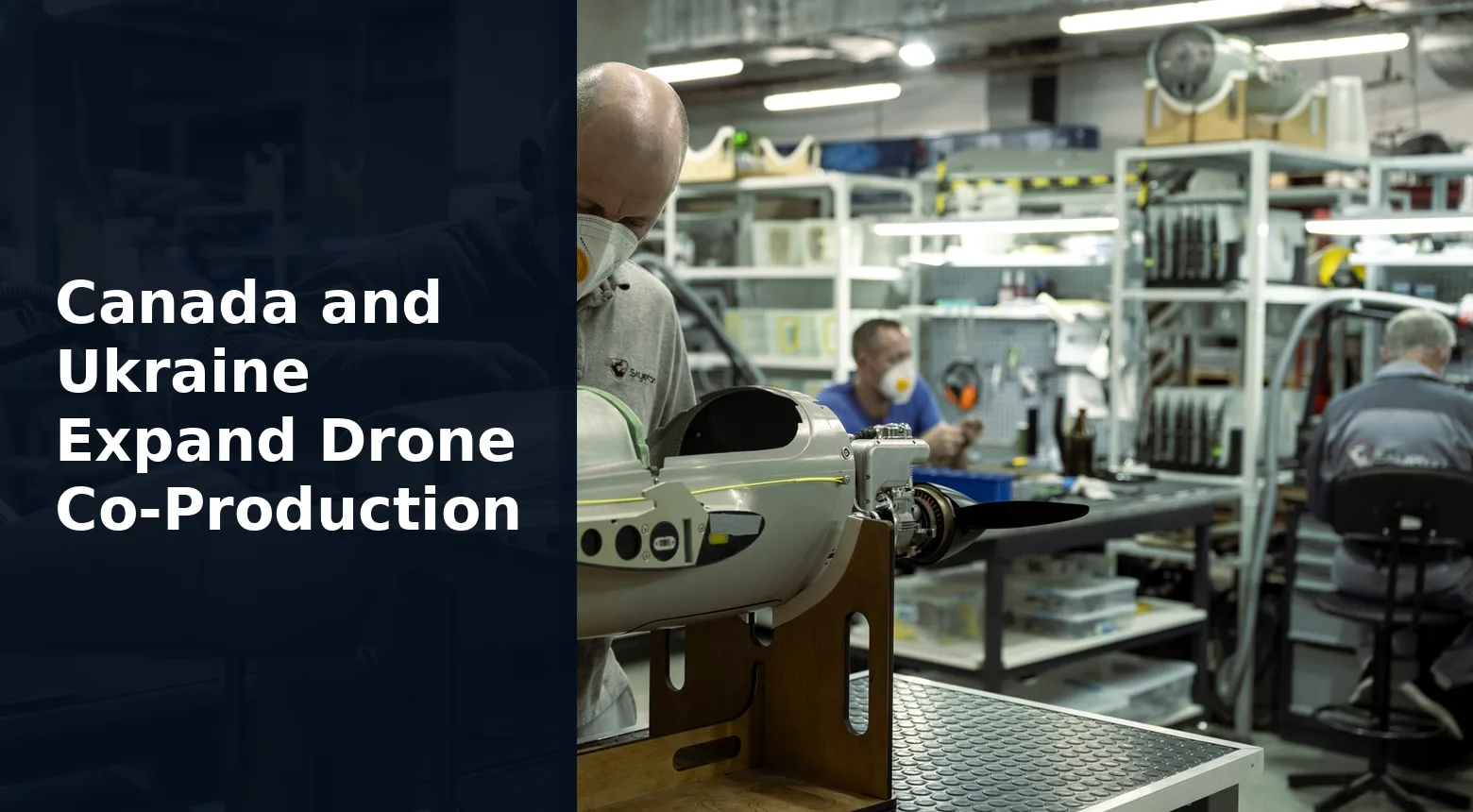
Canada and Ukraine have announced initiatives to strengthen Canadian sovereign drone capacity, expand bilateral co-production and establish longer-term defence and security cooperation. The policy direction is clear, but the available announcement does not yet provide a complete factory list, programme-by-programme contract value or delivery schedule. Ukraine offers rapid battlefield feedback and high-volume production experience, while Canada brings capital, aerospace suppliers and access to allied markets. A durable partnership could shorten development cycles, but only if intellectual property, security and procurement demand are defined.
The initiatives connect operational learning with industrial capacity
Ukraine has compressed drone design, testing and adaptation into short battlefield cycles. Canadian suppliers can contribute aerospace engineering, electronics, materials and regulated manufacturing. The partnership’s potential lies in connecting those strengths, not simply transferring an existing design into a Canadian assembly line.
Sovereign capability requires more than final assembly
Meaningful resilience includes flight-control software, secure communications, propulsion, sensors, batteries and access to replacement components. If critical modules remain concentrated in vulnerable foreign supply chains, domestic assembly alone will not deliver sovereign availability. Procurement policy will need to define which technologies must be controlled or produced in Canada.
Co-production terms will determine industrial value
Joint ventures must allocate intellectual property, export rights, cybersecurity responsibility, quality assurance and upgrade authority. Ukrainian firms also need assurance that cooperation supports near-term defence requirements rather than diverting scarce engineering capacity. Transparent workshare and multi-year demand are essential to attract private investment.
Announcements must be separated from funded output
Political commitments can open the door to projects, but factories, production rates and delivered aircraft require individual contracts and acceptance milestones. Reported ambitions for very large drone quantities should not be converted into confirmed orders until government documents identify funding, recipients and schedules.
Programme and procurement context
This development must be read at its exact maturity level. Canada and Ukraine have announced initiatives to strengthen Canadian sovereign drone capacity, expand bilateral co-production and establish longer-term defence and security cooperation. The policy direction is clear, but the available announcement does not yet provide a complete factory list, programme-by-programme contract value or delivery schedule. Defence programmes pass through distinct stages: policy announcement, requirement definition, competition, contract, testing, production, delivery, acceptance and operational fielding. Collapsing those stages into a single claim can overstate both near-term military utility and industrial certainty.
For acquisition teams, the decisive evidence is funded scope, customer acceptance, integration responsibility and a supportable schedule. Ukraine offers rapid battlefield feedback and high-volume production experience, while Canada brings capital, aerospace suppliers and access to allied markets. A durable partnership could shorten development cycles, but only if intellectual property, security and procurement demand are defined. Public announcements rarely resolve every dependency. Training, secure data, range access, infrastructure, export approval and supplier capacity can delay useful capability even after a technically successful milestone.
Source discipline is equally important. Company releases naturally emphasise momentum; government notices may describe only funded scope; exercise reports show activity without proving full readiness. Values should be labelled as contract ceilings or estimates when appropriate, performance figures as manufacturer claims until independently demonstrated, and dates as targets unless a customer confirms completion. Later primary records should replace early reporting as the programme matures.
The operational question is not whether the technology can be shown once, but whether users can employ it repeatedly under representative conditions. That requires realistic testing, configuration control, trained personnel, spares and an accountable command chain. Industrial significance also depends on repeatable production and quality assurance rather than prototype output alone.
Implications / Next
Track named Canadian and Ukrainian companies, signed co-production agreements, public funding, production locations, annual output and delivery recipients. Treat headline quantity ambitions as targets until contracts and accepted deliveries are documented.
This item remains a draft pending final image-rights review, CMS media assignment and canonical publication data. A later report should be treated as a separate update only if it materially changes the programme status described here.
Further Reading
Australia Launches US$3B Defence Industry Growth Facility