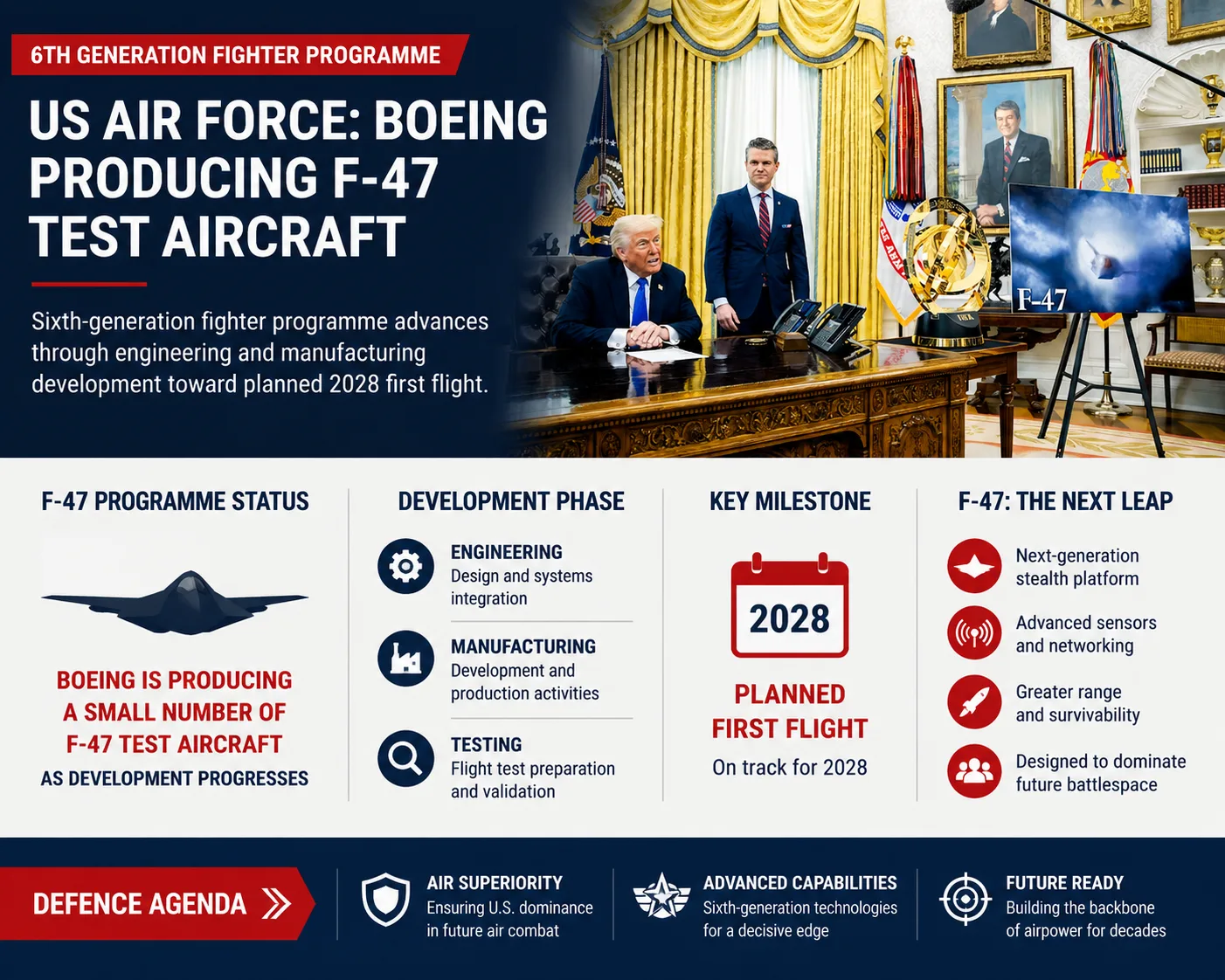
F-47 test aircraft are being produced as the US Air Force and Boeing advance the Next Generation Air Dominance fighter into engineering and manufacturing development ahead of a planned first flight in 2028.
According to Defense News reporting published on 30 July 2026, the development phase will produce a small number of aircraft for flight and systems evaluation. The Air Force has not disclosed the number of test aircraft under construction.
The latest update followed remarks by Gen. Dale White at Life Cycle Industry Days in Dayton, Ohio. The official Air Force account of the address said the programme had entered engineering and manufacturing development with what White described as unprecedented maturity.
The original F-47 contract announcement states that the development phase covers the maturation, integration and testing of the aircraft and includes priced options for low-rate initial production.
Key Facts
- Aircraft: Boeing F-47.
- Programme: Next Generation Air Dominance.
- Customer: United States Air Force.
- Current phase: Engineering and Manufacturing Development.
- Current activity: Production of a small number of test aircraft.
- Number of test aircraft: Not publicly disclosed.
- Planned first flight: 2028.
- Development contractor: Boeing.
- Contract award announced: 21 March 2025.
- Production options: The EMD contract includes priced options for low-rate initial production.
- Planned fleet: The Air Force has stated an intention to acquire at least 185 F-47s.
- Role: Future crewed air-superiority platform replacing the F-22 within the NGAD family of systems.
- Associated systems: Collaborative Combat Aircraft and other networked capabilities.
- FY2026 funding reported by Defense News: $3.45 billion.
- FY2027 request reported by Defense News: More than $5 billion.
What Is Happening With the F-47 Programme?
The F-47 programme has moved beyond source selection and initial contract award into the phase where development-standard aircraft and their supporting systems are manufactured, integrated and tested.
Engineering and Manufacturing Development, commonly abbreviated as EMD, is intended to transform a mature design and its enabling technologies into a production-representative system that can complete developmental and operational evaluation.
For the F-47, this includes the airframe, propulsion integration, mission systems, software, sensors, communications, survivability features, support equipment and interfaces with the wider NGAD family.
The programme is now producing a small number of aircraft that will be used to validate these elements before the Air Force decides how and when to proceed into initial production.
Is the First F-47 Being Built?
Yes. Air Force leaders first confirmed in September 2025 that manufacturing of the initial F-47 article had begun.
The July 2026 programme update provides a broader description of the work, confirming that the EMD phase is producing multiple test aircraft rather than only one standalone demonstrator.
The Air Force and Boeing have not disclosed how many aircraft are included in the development fleet, where every aircraft will be assembled or how the flight-test fleet will be divided between structural, mission-system and operational evaluation tasks.
The term “test aircraft” is important. These aircraft are being built to mature and evaluate the design and should not be described as operational fighters or normal production deliveries.
When Will the F-47 Fly?
The Air Force continues to target 2028 for the first flight of the Boeing F-47.
White said the aircraft would fly during the current US presidential administration. The 2028 target is consistent with the schedule publicly outlined by senior Air Force leaders since September 2025.
A first flight would begin the crewed development aircraft’s flight-test campaign. It would not represent operational service entry, combat readiness or the completion of developmental testing.
The Air Force has not publicly announced an initial operational capability date for the F-47.
F-47 Development Timeline
| Milestone | Date or Target | Programme Significance |
|---|---|---|
| Experimental precursor testing | Approximately five years before the contract award | Secret X-plane activity matured technology and operational concepts |
| Boeing EMD contract announced | 21 March 2025 | Boeing selected to develop the crewed NGAD platform |
| Initial aircraft manufacturing confirmed | September 2025 | Air Force confirmed construction of the first article had begun |
| EMD test-aircraft production confirmed | July 2026 | Programme producing an undisclosed small number of evaluation aircraft |
| Planned first flight | 2028 | Beginning of crewed F-47 flight testing |
| Low-rate initial production | Not publicly scheduled | Priced contract options exist, but exercise of those options has not been publicly confirmed |
| Operational service | Not publicly announced | Will follow development, testing, production and operational preparation |
What Does Engineering and Manufacturing Development Include?
The official contract announcement identifies three primary EMD activities: maturing, integrating and testing all aspects of the F-47.
In practice, a fighter development programme may use different aircraft and ground-test articles for structural testing, flight-envelope expansion, propulsion evaluation, avionics integration, weapons testing and mission-system validation.
The Air Force has not provided a public breakdown showing which specific roles will be assigned to each F-47 test article.
The contract also includes competitively priced options for low-rate initial production. This creates a contractual route toward early production but does not mean LRIP has already started.
Why Does the Air Force Describe the F-47 as Highly Mature?
The F-47 did not begin with the March 2025 contract announcement.
The Air Force and the Defense Advanced Research Projects Agency had already flown experimental aircraft for several years to evaluate technologies and operating concepts relevant to the future fighter.
The Air Force says these classified X-planes accumulated hundreds of flight hours and helped advance areas including range, survivability and autonomous-system integration.
These aircraft should not automatically be described as operational F-47 prototypes. Public statements identify them as experimental predecessors that reduced technical risk and informed the final programme.
This preceding work is the basis for Air Force descriptions of the F-47 as entering EMD with an unusually high level of design and technology maturity.
How Is the F-47 Different From the Earlier X-Planes?
| Area | Experimental X-Planes | F-47 EMD Aircraft |
|---|---|---|
| Primary purpose | Technology and concept demonstration | Development and evaluation of the production-representative fighter |
| Programme identity | Classified precursor activity | Formal F-47 programme of record |
| Manufacturer details | Not fully disclosed publicly | Boeing is the EMD contractor |
| Configuration | Experimental and potentially different from the operational design | Intended to mature the selected F-47 design |
| Production relevance | Reduced risk before acquisition decision | Supports flight testing and progression toward production |
What Public Capabilities Are Associated With the F-47?
Detailed F-47 specifications remain classified or undisclosed.
The Air Force publicly describes the aircraft as a crewed sixth-generation air-superiority platform designed around next-generation stealth, sensor fusion, long-range strike and modular integration of emerging technology.
Service leaders have also stated that the F-47 is intended to provide longer range, greater adaptability, improved sustainability and higher availability than the F-22 and other existing fifth-generation fighters.
No authoritative public specification currently confirms the final aircraft’s dimensions, maximum speed, combat radius, payload, engine arrangement, radar cross-section, weapons-bay capacity or sensor configuration.
Artist renderings released by the Air Force should therefore be treated as conceptual imagery rather than complete disclosure of the production design.
Is the F-47 a Standalone Fighter?
No. The F-47 is the crewed platform at the centre of a wider Next Generation Air Dominance family of systems.
The family includes Collaborative Combat Aircraft, networked sensors, communications, weapons and other capabilities intended to operate together in highly contested environments.
The fighter is expected to command, coordinate with or benefit from uncrewed aircraft performing roles such as sensing, electronic warfare, weapons carriage and distributed engagement.
Air Force officials have described this relationship as central to future air-superiority operations rather than an optional addition to a conventional fighter fleet.
How Does the F-47 Relate to Collaborative Combat Aircraft?
The F-47 and Collaborative Combat Aircraft are separate acquisition programmes but form complementary elements of the future force.
The crewed fighter is intended to provide high-end sensing, decision-making, command and combat capability. CCAs are intended to add affordable combat mass and distribute sensors, weapons and mission effects across a larger formation.
The Air Force is already flight-testing CCA designs and developing a government-owned mission-autonomy architecture intended to reduce dependence on a single software supplier.
Operational integration between the F-47 and future CCA fleets will require secure communications, common mission planning, human-machine interfaces and resilient coordination in electronically contested environments.
How Many F-47s Does the Air Force Plan to Buy?
The Air Force has publicly stated an intention to acquire at least 185 F-47 aircraft.
This figure broadly corresponds to the planned scale of the F-22 fleet the aircraft is intended to replace.
The number is a force-planning objective rather than confirmation that all 185 aircraft are currently under contract or funded.
Final procurement quantities may be influenced by programme cost, production capacity, threat assessments, CCA force structure, annual budgets and decisions by Congress.
How Much Funding Is Going to the F-47?
Defense News reported that the programme received $3.45 billion in fiscal year 2026 and that the fiscal year 2027 budget request includes more than $5 billion.
A budget request is not the same as a final congressional appropriation. The requested amount may be modified during the authorisation and appropriations process.
The funding supports design maturation, test-aircraft production, software and systems integration, ground and flight testing, supplier activity and preparation for later production.
The total value of Boeing’s classified EMD contract and the projected unit cost of a production F-47 have not been publicly disclosed.
What Does “Extreme Teaming” Mean for the Programme?
White described the programme’s acquisition model as “extreme teaming” between the Air Force and its industrial partners.
The phrase reflects an effort to integrate operators, acquisition officials, requirements organisations, engineers and manufacturers earlier than in traditional sequential development programmes.
The objective is to identify technical and operational problems before they become expensive late-stage redesigns.
The Air Force is also emphasising modular and government-owned architectures so that new software, sensors and weapons can be integrated without redesigning the entire aircraft or remaining permanently dependent on one supplier.
What Are the Main Risks to the 2028 First-Flight Target?
- Completion and integration of flight-critical software
- Propulsion-system availability and qualification
- Structural and fatigue-test results
- Low-observable manufacturing and quality control
- Mission-system and sensor integration
- Supply-chain performance
- Secure communications and open-architecture integration
- Test-aircraft assembly and instrumentation
- Ground testing before flight clearance
- Funding continuity
- Classification and cybersecurity requirements
- Unexpected redesign following test findings
The programme’s preceding X-plane activity may reduce some technical uncertainty, but it does not eliminate the normal risks associated with integrating a complete new combat-aircraft system.
What Will Happen Before the First Flight?
Before the first F-47 test aircraft can fly, the programme will need to complete a sequence of manufacturing, integration and safety activities.
- Major structural assembly
- Installation of propulsion and aircraft systems
- Flight-control software verification
- Mission-computer and avionics integration
- Electrical and hydraulic testing
- Structural ground testing
- Electromagnetic compatibility evaluation
- Low-speed and high-speed taxi testing
- Airworthiness reviews
- Flight-test instrumentation checks
- Emergency-procedure validation
- Formal first-flight clearance
The Air Force and Boeing have not released a public schedule for these individual milestones.
What Should Be Watched Next?
- Confirmation that the first test aircraft has completed major assembly
- Ground-test and taxi-test announcements
- Selection of flight-test locations
- Updates on the propulsion programme
- Further fiscal year 2027 congressional funding decisions
- Exercise of low-rate initial-production contract options
- Construction of operational and test infrastructure
- Integration milestones involving Collaborative Combat Aircraft
- Disclosure of an initial operational capability target
Because much of the programme remains classified, progress may be reported through broad acquisition milestones rather than detailed technical disclosures.
Conclusion
The F-47 programme has entered the stage where Boeing is producing development aircraft intended to turn years of experimental technology work into a flight-tested operational design.
The Air Force says the programme remains on schedule for a first flight in 2028 and has entered engineering and manufacturing development with an unusually high degree of maturity.
The EMD contract will produce a small number of test aircraft and includes priced options for low-rate initial production. The number of test aircraft and the timing of any initial-production decision remain undisclosed.
The 2028 flight will be a major development milestone, but it should not be confused with operational fielding. A substantial campaign of flight-envelope expansion, mission-system testing, weapons integration and operational evaluation will still be required.
The clearest indicators of programme progress will be completion of the initial test aircraft, the beginning of ground trials and evidence that propulsion, software, survivability and mission systems are converging in time for the planned first flight.
For related coverage, see Defence Agenda reports on Anduril FQ-44 production for the Collaborative Combat Aircraft programme, networked autonomous air missions and the ANKA III production configuration.