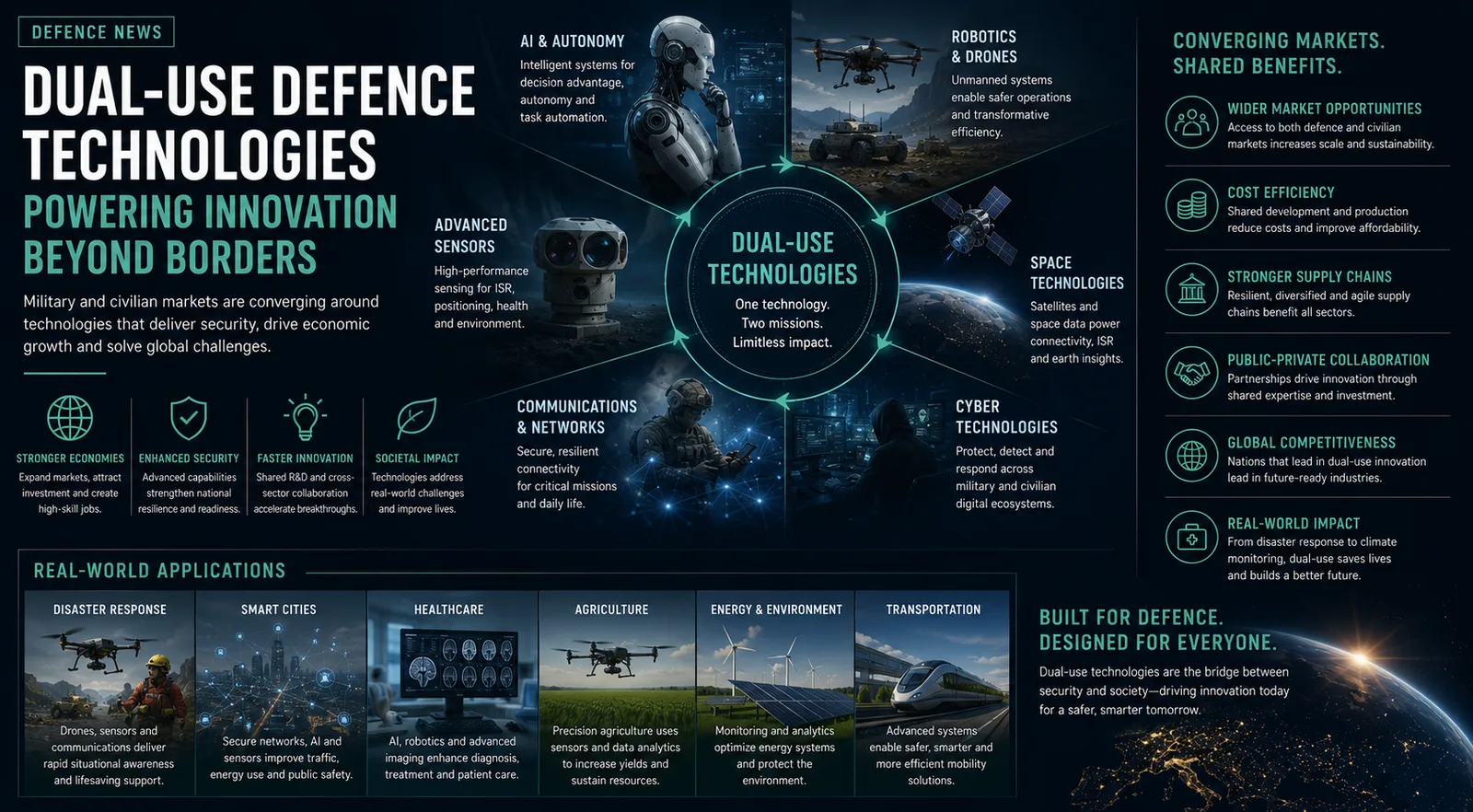
Dual-use defence technologies are becoming central to modern innovation as military and civilian markets converge around artificial intelligence, robotics, drones, sensors, cyber security, communications, space systems and disaster-response technologies.
A SAHA Blog analysis defines dual-use products as goods, software and technologies that can serve both military and commercial purposes. The article also argues that dual-use is no longer only about controlling sensitive exports. It is now an innovation model that connects defence capability with civilian economic value.
This convergence is one of the most important shifts in defence industry. In the past, military laboratories often pushed advanced technologies into civilian life. Today, the flow also moves in the other direction. Civilian breakthroughs in software, semiconductors, robotics, autonomy, big data and synthetic biology are increasingly shaping military capability.
The result is a more complex innovation environment. The best defence technologies may begin in commercial markets. At the same time, defence-grade engineering can create civilian value in health, mobility, disaster response, energy, aviation, logistics and communications.
Dual-Use Defence Technologies Start With a Dilemma
The dual-use problem is not new. The SAHA Blog article traces the “dual-use dilemma” back to technologies that created major civilian benefits while also enabling military or harmful applications. This is why dual-use technologies have long been linked to export controls, non-proliferation and international security regimes.
The dilemma is simple but difficult. A technology can save lives, increase productivity and create economic value. The same technology can also be adapted for surveillance, targeting, weapons production or strategic coercion.
Today, that dilemma is sharper because many modern technologies are general-purpose. Artificial intelligence, drones, advanced sensors, quantum systems, cyber tools and synthetic biology can move quickly between civilian and defence use cases.
The Meaning of Dual-Use Has Changed
The SAHA Blog article makes an important distinction. During earlier periods, dual-use was often understood in a static way: sensitive technologies had to be controlled because they could support weapons proliferation.
That meaning still matters. Export controls remain essential. However, dual-use now has a more dynamic meaning. It also describes technologies intentionally developed to serve both civilian and military needs.
This dynamic model fits today’s innovation economy. Defence organisations can no longer depend only on closed military R&D systems. They must work with start-ups, universities, commercial technology firms and global supply chains.
Civilian Technology Is Now Driving Defence Capability
One of the strongest trends in dual-use defence technologies is the growing military dependence on civilian innovation. Commercial markets now move faster than many traditional defence procurement systems.
Artificial intelligence, big data, robotics, 3D printing, cloud computing, communications, synthetic biology, battery technology, autonomous navigation and advanced materials are often developed first for civilian markets. Defence users then adapt them for operational requirements.
This changes defence procurement. Militaries must identify useful commercial technologies earlier, test them faster and create pathways for secure adoption. Otherwise, the innovation cycle will move faster than the acquisition cycle.
NATO DIANA Shows the New Dual-Use Model
NATO DIANA is one of the clearest examples of the new dual-use model. NATO describes DIANA as a mechanism to find and accelerate innovation for defence and security effects across the Alliance. Its challenges ask innovators to develop deep-tech dual-use technologies for critical defence and security problems.
This matters because DIANA is not designed only for traditional defence primes. It connects start-ups, test centres, investors and defence end users. That structure reflects the new reality: many important technologies now emerge outside the conventional defence-industrial base.
The NATO Innovation Fund reinforces the same logic. It is a €1 billion venture capital fund focused on early-stage start-ups and venture funds developing dual-use emerging technologies relevant to NATO priorities.
Europe Is Rebuilding Dual-Use Innovation Policy
Europe is also changing its approach. The European Commission’s work on technologies with dual-use potential reflects a broader shift in European economic security, industrial competitiveness and defence readiness.
The policy challenge is delicate. Europe wants more investment in technologies that can support security and defence. At the same time, it must manage export-control risks, human-rights concerns, cyber-surveillance issues and strategic dependencies.
This is why dual-use policy cannot be only about funding. It must also include governance, trusted investors, export-control compliance, technology protection, ethical safeguards and clear market pathways.
Export Controls Remain Central
Dual-use defence technologies require strong export-control discipline. EU Regulation 2021/821 sets up a Union regime for the control of exports, brokering, technical assistance, transit and transfer of dual-use items.
This framework is important because dual-use items can move through complex supply chains. A component, software module, sensor, material or cyber tool may appear harmless in one context but become sensitive when integrated into a military system.
For companies, export-control compliance must therefore become part of business strategy. The risk is not only legal. It is also reputational, financial and operational.
Military-to-Civil Spillover Still Creates Value
Dual-use is not only about civilian technologies entering defence. Defence technologies can also create major civilian value. The SAHA Blog article highlights how defence R&D can strengthen national science, technology and industrial capacity while opening new commercial markets.
This effect is visible in sensors, communications, avionics, medical devices, materials, disaster-response systems, simulation technologies and robotics. Defence-grade reliability can become a competitive advantage in civilian sectors that require high performance and safety.
The key is market translation. A defence product cannot simply be moved into a civilian market without adaptation. It needs cost reduction, certification, user-friendly design, after-sales support and commercial distribution.
Türkiye’s Ventilator Experience Shows Civilian Impact
Türkiye’s COVID-19 ventilator experience is one of the clearest dual-use examples cited in the SAHA Blog article. ASELSAN, BAYKAR, BİOSYS and Arçelik worked together to produce mechanical ventilators during a period of severe medical need.
The strategic lesson is not only that defence companies helped manufacture a medical device. The deeper lesson is that defence-sector engineering, systems integration, supply-chain management and rapid industrial mobilisation can serve civilian emergencies.
This is one of the strongest arguments for dual-use ecosystems. When national crises occur, defence-industrial capacity can be redirected or adapted to support public resilience.
Disaster Response Is a Major Dual-Use Market
The SAHA Blog article also points to disaster-response use cases. Thermal cameras, wall-penetrating radar, UAVs, unmanned ground vehicles, communication systems, field hospitals and inflatable structures can all support emergency response after earthquakes, fires and other disasters.
This is an important market because disasters require technologies that are rugged, mobile, reliable and fast to deploy. These are also qualities demanded by defence users.
For Türkiye, disaster-response dual-use capability is especially relevant. Earthquakes, forest fires and difficult terrain create recurring needs for sensing, communications, logistics, rescue robotics, aerial mapping and emergency infrastructure.
SAHA ODAK Points to Organised Dual-Use Adaptation
The SAHA Blog article describes SAHA ODAK as an effort to coordinate technologies for forest fires, earthquakes and disasters. This type of structure is important because dual-use adaptation does not happen automatically.
Companies may have relevant capabilities, but public agencies need clearly defined needs. Universities and research centres can support testing. Clusters can connect firms, users and problem owners.
Organised coordination is therefore essential. Dual-use ecosystems work best when they connect real problems with existing technologies, then create a pathway for adaptation, validation and procurement.
Health, Mobility and Energy Are Civilian Growth Areas
Dual-use defence technologies can support several civilian growth markets. The SAHA Blog article points to health technologies, rail transportation, electric vehicles, traffic and automation systems, energy systems, civilian telecommunications and civil avionics as areas where defence companies can develop commercial products.
These markets are attractive because they require systems engineering, electronics, software, sensors, safety, reliability and integration. Those are areas where defence companies often have strong experience.
However, commercial success requires a different mindset. Civilian customers often prioritise cost, ease of use, regulation, service networks and product lifecycle. Defence-grade performance must be translated into market-ready design.
Dual-Use Startups Need a Different Funding Model
Dual-use start-ups often face a difficult funding gap. Civilian investors may avoid defence exposure. Defence customers may move too slowly for start-up timelines. Export controls and security requirements can also make scaling more complex.
This is why accelerators, test centres, trusted investors and defence adoption pathways matter. NATO DIANA and the NATO Innovation Fund are examples of structures designed to reduce this gap by connecting commercial innovators with defence users and capital.
For Türkiye, similar mechanisms could help dual-use start-ups move from prototypes to validated products. The critical requirement is not only grants. Start-ups need testing environments, pilot customers, procurement access, export guidance and integration partners.
The Main Risk Is Ambiguous End Use
The biggest risk in dual-use defence technologies is ambiguous end use. A technology may be sold for civilian monitoring, logistics, navigation, sensing or analytics, but later adapted for military or coercive purposes.
This is especially important for AI, cyber tools, autonomous systems, drones, biotechnology and advanced surveillance technologies. Companies must understand not only what their product is, but also how it could be misused.
Responsible dual-use strategy therefore requires customer screening, export-control checks, human-rights due diligence, technical safeguards, licensing discipline and internal governance.
Artificial Intelligence Makes Dual-Use Harder to Govern
AI makes the dual-use problem more difficult because it is a general-purpose technology. The same model architecture can support medical diagnostics, logistics optimisation, drone autonomy, target recognition, cyber defence or influence operations.
This means governance cannot depend only on hardware control. Data, model weights, software updates, training pipelines and deployment context all matter.
For defence and civilian companies, AI governance must include capability testing, model evaluation, access control, monitoring, auditability and clear policies for conflict-related use cases.
Dual-Use Requires Open but Controlled Ecosystems
The best dual-use ecosystems are open enough to innovate and controlled enough to protect security. Excessive secrecy can slow learning and isolate defence from civilian technology. Excessive openness can create proliferation, cyber and misuse risks.
The right balance depends on technology maturity, sensitivity, end-user risk and market context. A disaster-response drone, a medical imaging device and a cyber-surveillance tool cannot be governed in the same way.
This is why dual-use policy must be risk-based. It should support beneficial innovation while placing stronger controls on technologies with high misuse potential.
Türkiye Has a Strong Dual-Use Opportunity
Türkiye’s defence ecosystem has a strong dual-use opportunity because it already combines defence production, aerospace capability, software, electronics, robotics, UAVs, communications, sensors and systems integration.
The next step is to convert this capability into a broader civil-defence innovation engine. This means building products that can serve military users, disaster agencies, health systems, infrastructure operators, logistics firms, airports, municipalities and export markets.
The goal should not be to dilute defence focus. The goal should be to multiply value. A company that can sell to both defence and civilian markets can improve scale, resilience and investment capacity.
A Practical Roadmap for Dual-Use Growth
A practical dual-use roadmap should begin with problem mapping. Defence firms and public agencies should identify civilian needs where defence-grade technologies can create measurable value.
The second step is technology matching. Existing sensors, drones, communication systems, radar, simulation tools, software platforms, robots and materials should be assessed for civilian adaptation.
The third step is validation. Products must be tested with real users in hospitals, disaster zones, airports, industrial facilities, transportation systems, energy sites and municipal environments.
The fourth step is market readiness. Companies need certification, pricing strategy, distribution, after-sales service, export compliance and product documentation suitable for civilian customers.
The fifth step is governance. Every dual-use product should have end-user controls, export-control screening, cyber-security requirements and responsible-use policies.
Clusters Can Accelerate Dual-Use Translation
Clusters are especially important for dual-use defence technologies. A single company may have the technical product, but it may lack civilian market access, certification knowledge, field-testing partners or public-agency relationships.
A cluster can connect companies with universities, regulators, municipalities, disaster agencies, hospitals, infrastructure operators and investors. It can also help identify shared needs and create joint pilot projects.
This is why dual-use should be treated as an ecosystem strategy, not only a company strategy. The most successful countries will build institutions that help technologies move across markets safely and quickly.
Conclusion
Dual-use defence technologies are now at the centre of defence innovation. They connect military capability with civilian markets and turn national security technologies into broader tools for resilience, health, mobility, disaster response and economic growth.
The opportunity is significant, but so is the responsibility. Dual-use technologies require export controls, end-user discipline, ethical governance, cyber security and careful management of misuse risks.
For Türkiye, the opportunity is clear. The country’s defence ecosystem can become a stronger engine of civilian value while continuing to support national security. The winning model will combine engineering depth, market adaptation, responsible governance and coordinated ecosystem leadership.
For further Defence Agenda coverage, read our defence technology, defence industry and cyber defence sections. Related analysis includes future warfare technologies and military strategy, digital troops and battlefield command and 5G military communications and next-generation weapon systems.