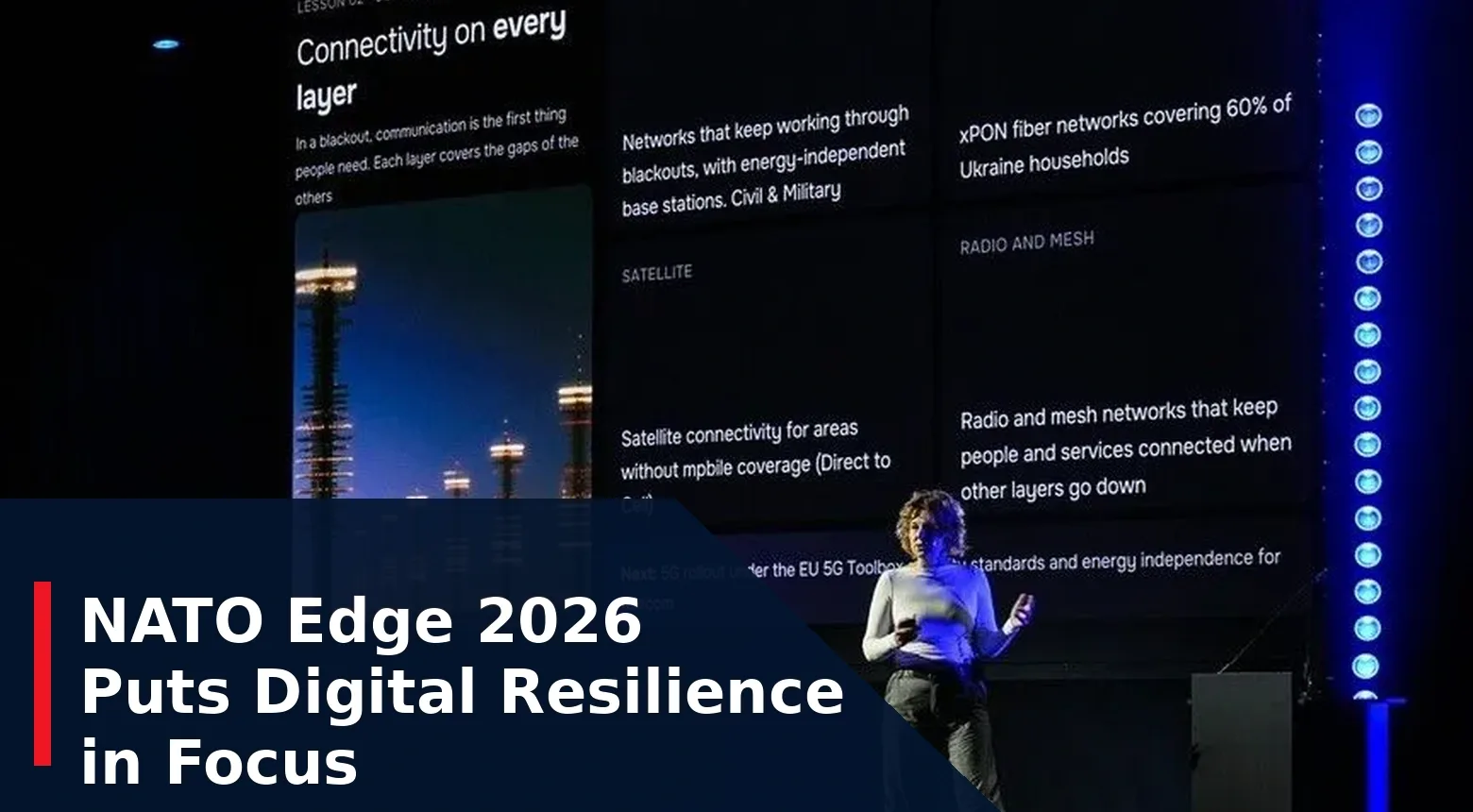
NATO Edge 2026 opened in İzmir, Türkiye, on 17 November 2026, bringing NATO officials, defence companies and technology specialists together to examine how the Alliance can deliver secure communications and information capabilities under operational pressure. A 17 November Anadolu Agency report framed remarks by Dr Dylan Browne, General Manager of the NATO Communications and Information Agency (NCIA), around the Alliance's ability to withstand crises. The underlying issue is NATO digital resilience: whether multinational forces can continue sharing trusted information when networks, spectrum access or individual services become unreliable. NCIA's documented 2026 projects show what is being developed and tested, although they do not establish that every capability is already operational.
NATO Edge 2026 and the Challenge of Resilient Allied Communications
The NCIA's official NATO Edge 26 programme announcement identifies the event, held 17–19 November 2026 in İzmir, as a platform linking NATO's capability requirements with industry. Its agenda spans command, control, communications, computers, intelligence, surveillance and reconnaissance (C4ISR), with an emphasis on turning emerging technologies into usable Alliance services. NCIA's leadership register confirms that Browne assumed the General Manager role in December 2025.
The crisis-readiness question is larger than a particular network product. NATO relies on national and Alliance-managed systems with different security classifications, communication standards, availability requirements and levels of protection. A command post may need to combine terrestrial communications with satellite connectivity and mobile services while preserving access controls and coherent data exchange. Achieving that combination at scale is an engineering, governance and training problem as well as an acquisition task. The existence of multiple communications paths does not automatically guarantee an uninterrupted service if interfaces, permissions or fallback procedures fail.
NCIA's work in 2026 provides concrete examples of this approach. From 19 to 30 October 2026, NATO's Digital Backbone eXperimentation event, DiBaX, examined network resilience, 5G network slicing and ways to integrate different digital services in Latvia. According to the NCIA's 28 October account, technical activities included counter-drone command-and-control data flows, spectrum management and communication links combining experimental 5G with European Space Agency satellite infrastructure. The programme reported trials of systems and interoperability; it was not an announcement of fleet-wide or Alliance-wide certification.
That distinction is particularly important in contested electromagnetic environments. Military communications must be able to adapt when radio frequencies are congested or disrupted. At DiBaX, NCIA reported that an in-house spectrum-deconfliction approach allowed participating radio systems to change frequencies within seconds during the experimental activity. This is a reported test observation within a defined environment. The agency did not publish a common field-wide availability metric that could be applied to all NATO operations.
There is a related organisational challenge: interoperability is not demonstrated merely by connecting equipment in a laboratory. The June 2026 CWIX exercise involved nearly 4,000 participants from more than 41 Allied and partner nations, with approximately 25,000 interoperability tests across 20 focus areas. Those are exercise activity measures, not the number of fully qualified deployed systems. They nonetheless show why standards, data-sharing rules and repeated testing are needed to establish confidence in multinational digital services.
Similarly, NCIA reported that Steadfast Duel 26, conducted from 6 to 15 October 2026, involved around 8,000 military and civilian participants from 32 NATO nations. The official exercise account describes command-and-control support for a simulated multi-domain environment. Simulation creates opportunities to test procedures and expose integration problems, but it should not be presented as proof that every communications system would remain available in a real crisis.
Procurement, Delivery Risks and the Next Test of NATO Digital Resilience
For suppliers, the significance of NATO Edge extends beyond conference presentations. On 7 July 2026, the NCIA announced a roughly €200 million Protected Business Network contract with Accenture. The programme aims to create a more standardised, cloud-enabled NATO enterprise and support roughly 29,000 users. The seven-year performance period extends across 2026–2033, with delivery through firm-fixed-price task orders. The €200 million figure is the agency's estimated overall programme value, not a new procurement award made at NATO Edge on 17 November.
This contracting model illustrates one of the trade-offs facing NATO capability managers. Common digital services can make cybersecurity controls, maintenance and software updates easier to coordinate. Yet commonality can also concentrate operational dependence if an architecture lacks sufficient redundancy, vendor diversity or national-level fallback paths. Defence planners must therefore distinguish an improved digital enterprise from a guarantee of continuous command-and-control availability. Security accreditation, workload migration, data classification, cross-border governance and operator training will influence whether a new cloud service provides real operational benefit.
In its 1 July 2026 transformation announcement, NCIA described organisational reforms intended to accelerate the delivery of secure, resilient and interoperable communications and information services. The public announcement identifies an ambition and institutional changes; it is not an independent audit of procurement cycle-time improvement. That outcome would need evidence from contract execution, acceptance, exercise results and service availability over time.
Turkish industry already has an example of the distinction between winning a NATO contract and achieving accepted service. Defence Agenda's report on ASELSAN's NATO VLF monitoring upgrade records the installation, verification, acceptance testing and user training completed for Allied Maritime Command. The maritime monitoring project is technically separate from the NCIA digital-backbone programme, but it shows the importance of explicit delivery milestones. Defence Agenda's review of the NATO Joint Warfare Centre's 2026–2030 campaign plan examines the training and validation side of digital change, while its analysis of 5G military communications explains why commercial wireless performance cannot be substituted for tested multinational interoperability.
The strategic counterpoint is that rapid adoption of commercial technology does not eliminate the need for military-specific security and resilience. Satellite services can extend reach, but availability and control may depend on providers and national permissions. Modern 5G can support specialised network configurations, but infrastructure access and contested-spectrum performance remain operational variables. AI-enabled processing may help handle information volume, yet it introduces additional requirements for data provenance, assurance and human oversight. No single category of technology resolves all three dependencies.
For industry participants at NATO Edge 2026, relevant requirements may include secure networking, cloud migration, cyber monitoring, satellite integration, software-defined communications and interoperability testing. These are technology and programme themes supported by NCIA's published work, not announced 17 November contract opportunities with assigned procurement values. A supplier should distinguish a conference presentation, a technical trial, a notice of intent, a signed contract and an accepted service before treating any of them as evidence of future revenue.
The next markers to watch are the published outcomes of NATO Edge 26, future NCIA contracting notices, implementation progress under the Protected Business Network, and evidence that DiBaX-style test results are reproduced during larger Allied exercises. For NATO decision-makers, the core question remains whether communications and decision-support systems are both interoperable in routine operations and resilient under realistic disruption. At the time of writing on 17 November 2026, the event is under way; its final conclusions and any subsequent procurement decisions have not yet been established in the cited material.
Further Reading
- NCIA: NATO Edge 26 programme and capability-delivery priorities — 18 June 2026
- NCIA: DiBaX 2026 tests NATO's digital backbone — 28 October 2026
- NCIA: €200 million Protected Business Network contract — 7 July 2026
- NCIA: CWIX 2026 interoperability exercise — 25 June 2026
- Defence Agenda: ASELSAN Completes NATO VLF Monitoring Upgrade
- Defence Agenda: NATO JWC Campaign Plan 2026–2030
- Defence Agenda: 5G Military Communications Power Next-Gen Weapon Systems