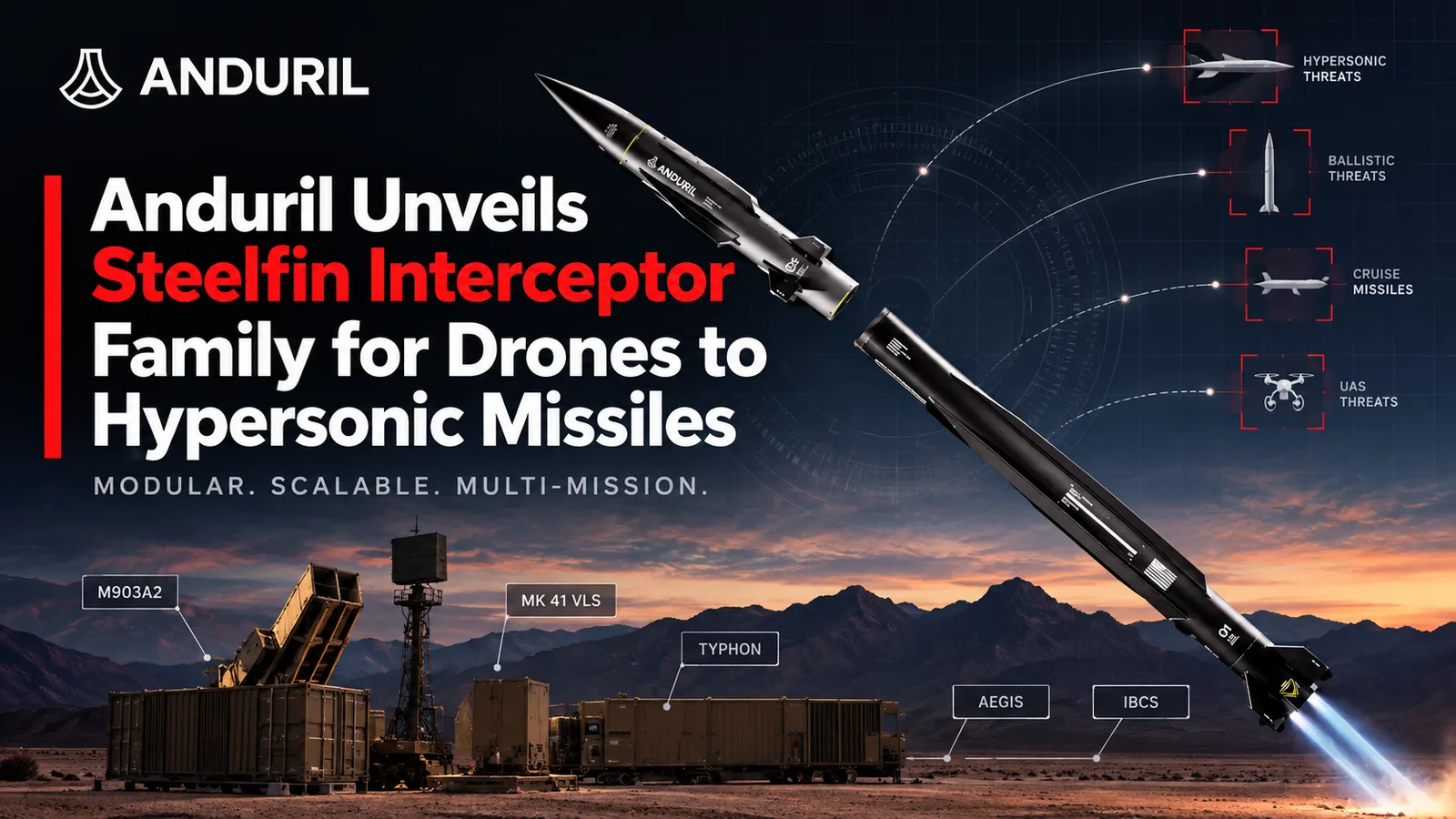
Anduril Industries has unveiled Steelfin, a configurable family of two-stage surface-to-air interceptor missiles designed to counter threats ranging from unmanned aircraft and cruise missiles to ballistic and maneuvering hypersonic weapons. The company says it has already completed ballistic testing with representative air vehicles and plans to begin flight testing in 2027.
Steelfin is built around a common terminal interceptor paired with interchangeable first-stage boosters and configurable seekers and mission systems. Anduril says the design is intended to deliver multiple interceptor classes from a shared architecture and production backbone rather than requiring a separate missile programme for every threat set.
Steelfin Uses a Common Terminal Interceptor and Interchangeable Boosters
The core of Steelfin is a two-stage architecture. The first stage can accept different solid-rocket-motor boosters to change range, acceleration, launch configuration and packing density. The second stage uses a common terminal-interceptor baseline that shares its airframe, avionics, software, flight-control system and interfaces across the family.
Open interfaces in the second stage allow Anduril to change seekers, mission systems and other components without redesigning the entire missile. The company’s stated objective is to make capability changes resemble configuration changes rather than multi-year clean-sheet development programmes.
The Threat Set Runs From Aircraft and Cruise Missiles to Hypersonic Weapons
Anduril’s current Steelfin product page lists cruise missiles, ballistic missiles, hypersonic missiles, manned aircraft and unmanned aircraft as the intended target set. Speed is described as ranging from supersonic to hypersonic depending on the booster, while the altitude envelope runs from low altitude to the high endoatmosphere.
Those descriptions define a family rather than one fixed missile. Engagement range, speed and altitude therefore vary by Steelfin configuration, and Anduril has not published a single maximum range or velocity that applies across every variant.
Booster Options Span Several Existing Missile-Defence Classes
Aviation Week reported that Anduril plans booster diameters of approximately 10 inches, 18 inches and 21 inches. The spread is intended to give Steelfin variants access to different performance classes and launcher geometries while retaining the same basic terminal-interceptor concept.
The smaller configuration aligns most closely with the U.S. Army’s Patriot-related Future Interceptor requirement space, while the larger boosters move Steelfin toward the diameter classes used by higher-performance air- and missile-defence interceptors. The family concept should not be read as proof that each configuration already matches the engagement envelope of PAC-3 MSE, THAAD or SM-3.
Steelfin Is Designed Around Existing Launch Infrastructure
Anduril says Steelfin variants are being engineered for compatibility with the M903A2 Patriot launcher, the Navy’s Mk 41 Vertical Launch System, the Army’s Typhon system and emerging containerized launchers. The company also lists AEGIS and IBCS as examples of fielded fire-control and command systems with which Steelfin is intended to integrate.
This is a critical part of Anduril’s market strategy. A new interceptor that requires a completely new launcher, command architecture and training ecosystem creates additional cost and fielding time. By targeting existing infrastructure, Anduril is trying to make Steelfin an additional effector within systems that U.S. and allied forces already operate.
The Architecture Targets the Cost-Exchange Problem
Anduril argues that today’s air-defence inventory often forces high-end interceptors to be used against lower-cost threats. The problem becomes more severe in sustained drone and missile attacks, where an attacker can try to exhaust a defender economically as well as physically.
Steelfin is intended to address that by allowing different boosters, seekers and subsystems to be matched to different targets. A lower-cost configuration could be used against a comparatively inexpensive one-way attack drone, while a more capable configuration could be reserved for high-speed cruise, ballistic or hypersonic threats.
Anduril Is Positioning Steelfin for High-Volume Production
Reuters reported that Anduril intends to produce several thousand Steelfin variants per year in the near term. Because multiple variants share the same basic architecture and production processes, the company says output can shift between configurations without creating a new dedicated production line for each interceptor.
Breaking Defense reported that Anduril expects most Steelfin subassemblies to be produced at its Arsenal-1 manufacturing facility in Ohio, with final integration conducted with a smaller group of partners. Solid rocket motors may come from both Anduril and outside suppliers.
The Production Ambition Is Larger Than the Current Test Maturity
Anduril’s manufacturing goal is aggressive relative to the programme’s current maturity. The company has completed ballistic testing with representative air vehicles, but flight testing is not scheduled to begin until 2027. No production procurement has been announced with the unveiling.
That means the near-term challenge is technical validation rather than factory throughput. Guidance, propulsion, seeker integration, manoeuvrability, launcher compatibility and end-to-end intercept performance all have to be demonstrated before high-volume production becomes operationally meaningful.
Steelfin Fits the Army Future Interceptor Requirement Space
Anduril executives have said Steelfin is a natural fit for the U.S. Army’s Future Interceptor requirement. The Army’s FY2026 budget documents describe Future Interceptor as a lower-tier air- and missile-defence effort intended to improve velocity, altitude and manoeuvrability against current and emerging air, missile and hypersonic threats.
However, Anduril has not publicly confirmed that Steelfin has been selected for the Future Interceptor development programme. Reporting on the Army competition has identified Lockheed Martin’s PAC-3 Edge as one participant, while Anduril has declined to confirm its own selection status. Defence Agenda therefore treats Future Interceptor as a target requirement space rather than a confirmed award.
Anduril Is Also Competing in the Army’s Low-Cost Interceptor Push
The U.S. Army’s xTech Apex Intercept competition lists Anduril as a finalist in its low-cost interceptor all-up-round and fire-control category. The competition is seeking affordable interceptor technologies to augment Patriot against air-breathing threats, cruise missiles and close- and short-range ballistic missiles.
The xTech competition is separate from the Future Interceptor programme. Both reflect the same strategic pressure — more incoming threats, higher expenditure rates and a need to expand magazine depth — but they should not be merged into a single acquisition programme.
Steelfin Enters an Increasingly Competitive Interceptor Market
Steelfin arrives days after Lockheed Martin unveiled PAC-3 Edge, its candidate for the Army’s Future Interceptor effort. Raytheon is also expanding production across the Standard Missile and counter-UAS portfolios as U.S. and allied demand rises.
Anduril’s differentiator is the claim that one modular architecture can cover multiple threat classes while using existing launchers and a shared manufacturing backbone. Whether that translates into a meaningful cost and production advantage will depend on the results of flight testing, qualification and government competitions.
What Remains Unknown
Anduril has not publicly disclosed Steelfin’s exact engagement ranges, maximum speeds, unit prices, seeker configurations, warhead designs, test quantities or customer commitments. The company also has not announced a production contract or confirmed selection for Future Interceptor.
The next major milestones are flight testing in 2027, evidence of successful integration with fielded launch and command systems, and government decisions that turn the architecture into a funded acquisition programme. Until then, Steelfin is best viewed as a high-ambition interceptor family moving from ballistic testing toward flight qualification.