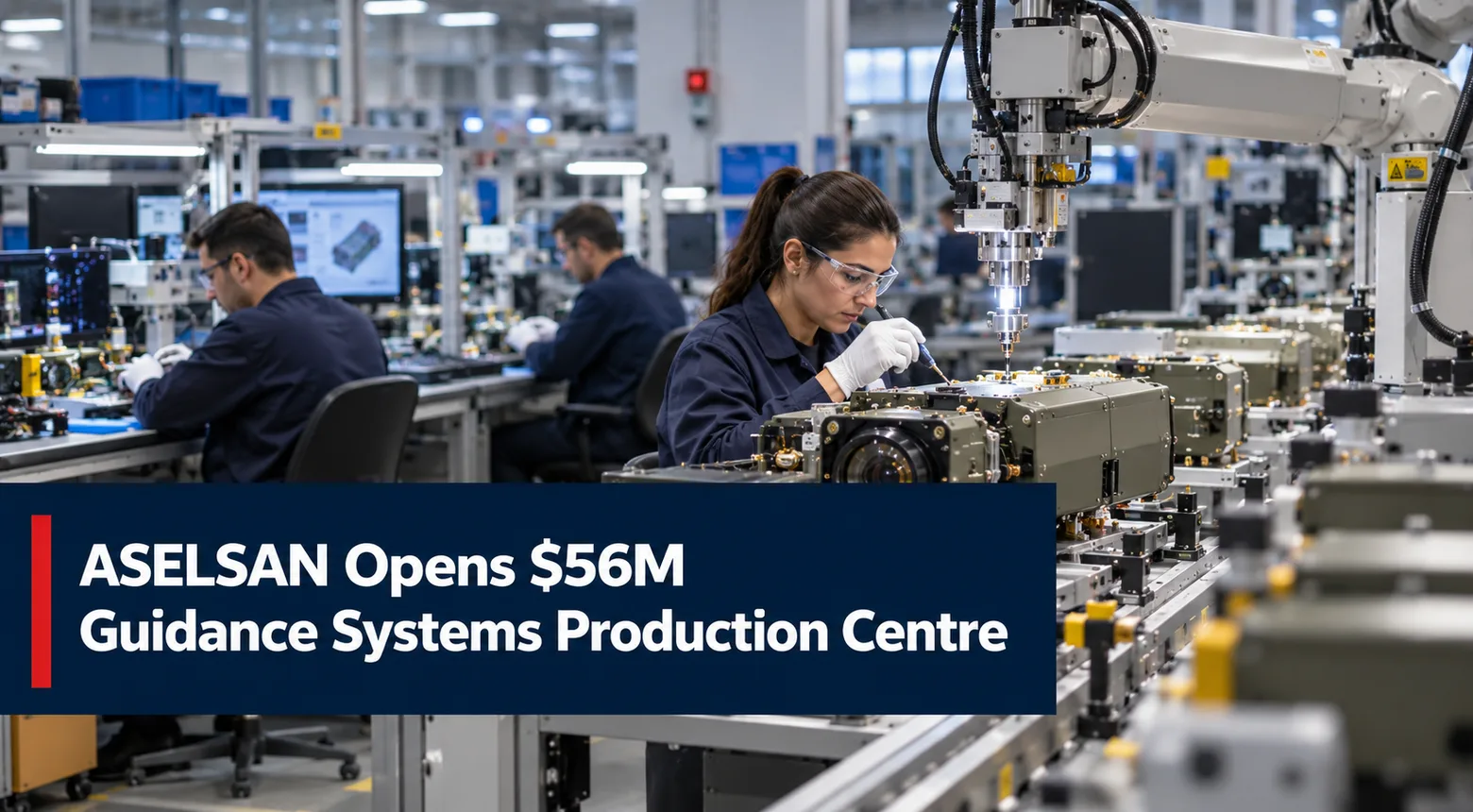
ASELSAN has commissioned a $56 million Guidance Systems Production Centre with 17,865 square metres of indoor space, expanding the manufacturing infrastructure behind its precision-guidance portfolio. The company disclosed the investment on 18 September 2026 and linked it directly to rising order volume and the need to increase production capacity, speed and quality.
The new centre is already commissioned, not merely planned
ASELSAN’s KAP filing states that the Guidance Systems Production Centre has been put into operation. The investment totals $56 million and covers 17,865 square metres of enclosed space. This makes the announcement a completed capacity milestone rather than a future construction plan or memorandum of understanding.
The company said the centre strengthens robotics and automation used in guidance-system production. It also said the investment increases delivery capacity, production speed and quality capability. No annual unit-output figure was disclosed, so the size of the capacity increase should not be converted into an estimated number of kits or munitions.
The investment responds to a larger order book
ASELSAN explicitly linked the facility to growing order volume. That context matters because defence-electronics companies can face constraints not only in final assembly but also in precision components, calibration, test, integration and quality assurance. Increasing throughput in guidance production can therefore affect the delivery cadence of several downstream products even when the company does not publicly identify which contracts will be processed in the new building.
The KAP notice itself does not list specific weapon programmes. Reporting that connects the facility to particular guidance kits or full-up guided munitions should therefore be treated as contextual rather than as a programme allocation disclosed in the investment notice. The safest description is that the centre supports ASELSAN’s guidance-system manufacturing base as a whole.
Robotics and automation are central to the capacity increase
The most concrete production change disclosed by ASELSAN is the reinforcement of robotics and automation infrastructure. In precision-guidance manufacturing, automation can support repeatability in assembly, inspection and test while reducing the variability that becomes more difficult to manage as output rises. The company’s emphasis on speed and quality indicates that the plant is intended to improve both volume and process control.
That distinction is important for suppliers. A new building adds floor space, but production capacity depends on equipment, qualified processes, trained personnel and component availability. ASELSAN’s statement indicates that the investment includes manufacturing-system changes rather than only physical expansion, although it does not disclose machine counts, staffing or line rates.
The centre fits a broader shift from development to sustained production
Türkiye’s defence industry is increasingly dealing with the industrial problem of producing mature systems at scale. Guidance systems are a common enabling technology across precision munitions, air-defence interceptors and other weapon families, so additional manufacturing depth can have effects beyond a single programme.
ASELSAN has also been expanding in radar, electronic warfare, air defence and other electronics-heavy areas. The new centre should be viewed in that wider context: the company is adding dedicated production infrastructure at the same time that domestic and export demand is increasing. The investment is therefore strategically relevant even without a public list of which contracts will consume the added capacity.
Implications / Next
The next useful indicators are production-line qualification, hiring, supplier expansion, annual output data or contract-delivery statements that show how the new plant changes throughput in practice. Future annual reports may also provide a clearer link between the centre and particular product families.
For programme analysis, the key point is that the facility is operational and the investment value and floor area are confirmed. What remains undisclosed is the exact increase in annual output and its allocation across programmes. The milestone should therefore be reported as a manufacturing-capacity expansion, not as evidence that any particular weapon has entered a new production lot.