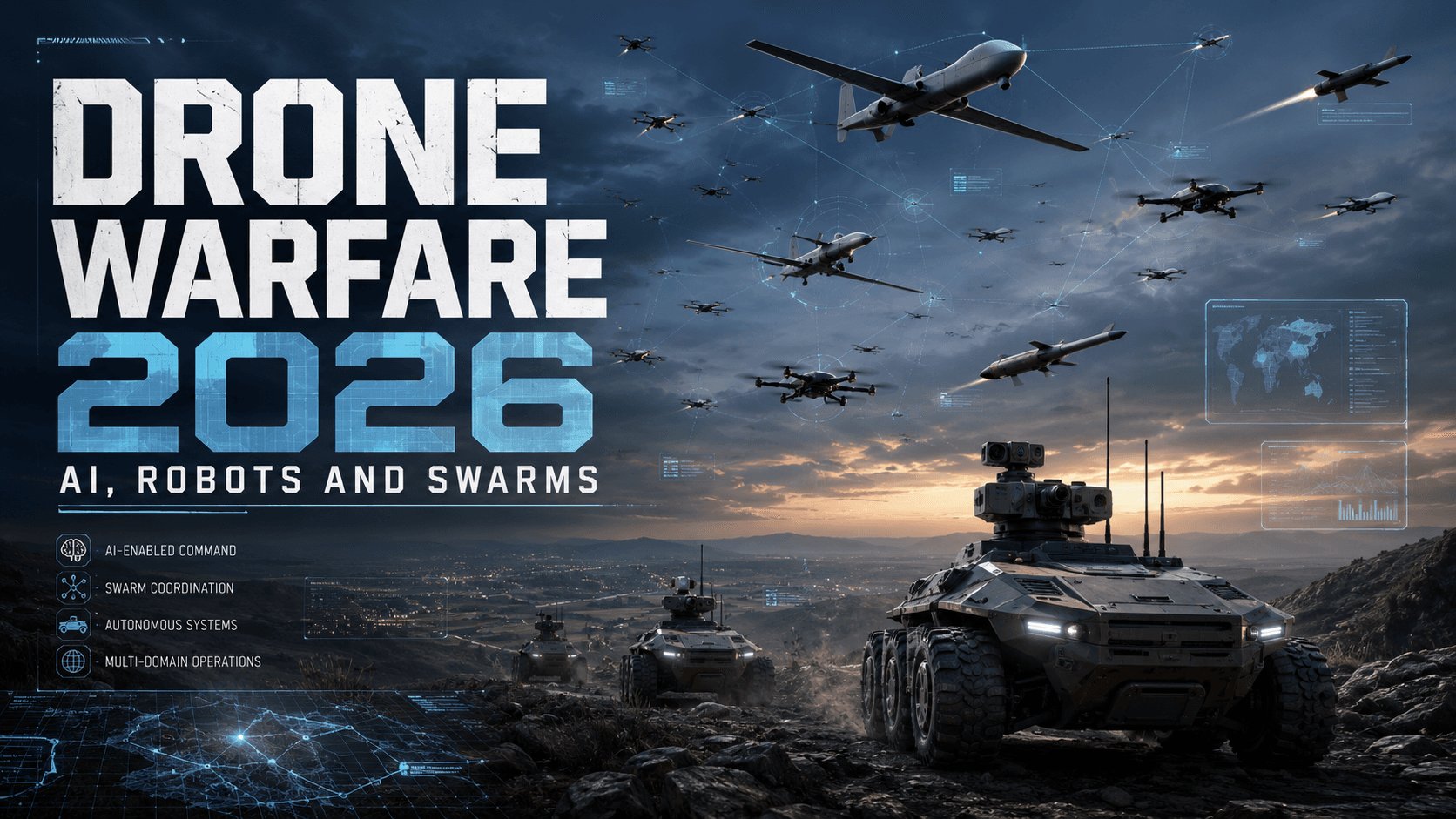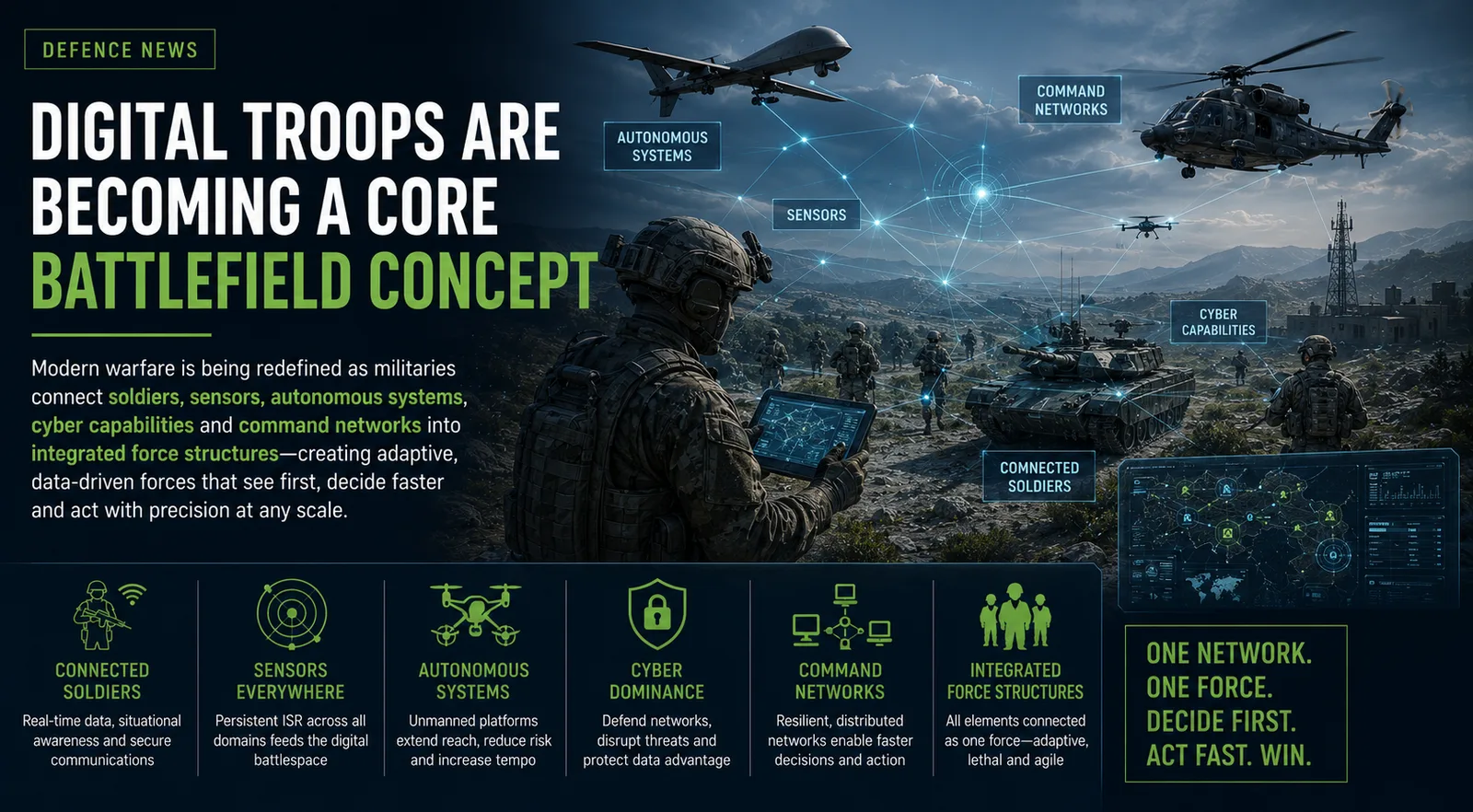
Digital troops are becoming a core force-design concept as militaries connect soldiers, sensors, autonomous systems, cyber capabilities and command networks into a single battlefield architecture.
A SAHA Blog analysis frames digital troops as a new stage in military transformation. The article argues that warfare is no longer defined only by land, sea and air power. Space, cyber, data and autonomous systems now shape how forces see, decide and act.
The concept goes beyond a future-soldier kit. It includes cloud computing, big data, artificial intelligence, cyber defence, augmented reality, wearable technologies, simulations, tactical data links and autonomous robotic systems.
This matters because future military advantage will depend on speed and resilience. The force that can collect data, protect networks, process information and act faster than its opponent will gain decision superiority.
Digital Troops Turn Soldiers Into Networked Nodes
The digital troops concept changes the role of the individual soldier. A soldier is no longer only a weapons operator. In a connected force, each soldier becomes a networked node inside a wider combat system.
This network can include wearable sensors, smart helmets, tactical radios, body-worn cameras, positioning systems, biometric monitors, small UAVs and unmanned ground vehicles. When these systems are connected securely, they improve situational awareness and shorten the time between detection and action.
The objective is not to flood soldiers with data. The objective is to deliver the right information at the right time, in a usable format, under battlefield pressure.
Digital Superiority Becomes a Battlefield Requirement
Digital superiority is becoming as important as fire superiority or air superiority. It means a force can collect, process, protect and exploit information faster than an adversary.
NATO’s Alliance Digital Strategy reflects this direction. The strategy focuses on secure, resilient and interoperable digital capabilities that support data-driven operations and human-machine collaboration.
This aligns directly with the digital troops model. A modern unit must operate inside a protected digital environment where soldiers, command networks, sensors and autonomous systems work together.
Cyber and Electronic Warfare Shape the Digital Force
Digital troops depend on networks. That creates new capability, but it also creates new vulnerability. A connected unit can see more and act faster, but it can also be exposed to jamming, spoofing, cyber intrusion and electromagnetic attack.
Therefore, cyber defence and electronic warfare are not support functions. They are combat requirements. Secure communications, encrypted tactical networks, resilient routing, spectrum awareness and intrusion-resistant architectures are now central to battlefield survival.
The U.S. Army’s Next Generation Command and Control work shows how this issue is being tested in practice. Recent exercises have examined how command networks perform under cyber and electronic warfare pressure.
Wearable Technologies Expand Soldier Performance
Wearable technologies are one of the most visible layers of the digital troops concept. Smart helmets, AR glasses, integrated radios, health monitors, exoskeletons and tactical displays can improve awareness, mobility and survivability.
The SAHA Blog article highlights lightweight exoskeletons, 5G-supported augmented reality communications, AR/VR-enabled smart glasses and multi-sensor wearable systems as key elements of future soldier transformation.
However, the challenge is not only innovation. Wearables must be rugged, secure, power-efficient and simple enough for combat use. Equipment that increases cognitive load can reduce effectiveness instead of improving it.
Simulation and Digital Twins Improve Readiness
Training is another pillar of digital troops. Modern units need realistic simulation environments because urban warfare, proxy conflicts and hybrid threats require rapid adaptation.
High-fidelity simulation allows soldiers and commanders to rehearse complex missions without physical casualties. It also helps forces test tactics, evaluate risks and prepare for different operational scenarios.
Digital twins can extend this approach. They create digital versions of real platforms, units, facilities or operational processes. In defence, digital twins can support mission rehearsal, logistics, predictive maintenance and force-performance assessment.
Autonomous Systems Become Part of the Unit
The digital troops concept becomes more powerful when soldiers are connected to autonomous systems. UAVs, unmanned ground vehicles, robotic sensors and loitering munitions can extend a unit’s reach while reducing risk to personnel.
HAVELSAN describes Digital Troops as a force-multiplier concept linked to autonomous and robotic systems. These systems can increase soldier safety, improve operational efficiency, reduce human error and enhance precision.
In practical terms, the infantry unit of the future may include human soldiers, small UAVs, ground robots, autonomous sensors, tactical AI tools and secure data links operating as one team.
Tactical Data Links Are the Backbone
Tactical data links are essential for digital troops. They allow sensors, shooters, command posts and platforms to share information across the force.
The SAHA Blog article points to Türkiye’s work in network-enabled capability, unit tracking and tactical data links. It cites ASELSAN’s unit-tracking and network-enabled capability systems, Meteksan’s KEMENT tactical data link and HAVELSAN’s Tactical Data Link Management Centre as examples that support the digital troop concept.
These capabilities matter because modern operations require coordination across land, air, sea, cyber and space. A tactical data link is not just a communications tool. It is part of the kill chain and command architecture.
Multi-Domain Operations Require a Digital Backbone
Digital troops fit into a broader multi-domain operations model. NATO’s digital transformation work links secure digital capabilities, federated cloud, edge services, space-domain integration and human-machine collaboration to future operations.
This is critical because the battlefield is no longer divided into separate domains. A small land unit may depend on space-based navigation, drone ISR, cyber protection, air-defence coverage, electronic warfare support and cloud-based command tools.
Therefore, the digital troops concept must be built around interoperability. Systems must connect across units, services, allies and mission partners without creating security gaps.
The Main Risk Is Digital Fragility
The digital troops model creates a clear risk: digital fragility. A force that depends too heavily on networks can become vulnerable if those networks fail.
Jamming, cyberattack, satellite disruption, power shortages, software failure and data overload can all weaken a connected force. This means digital troops must be designed to degrade gracefully.
Units must still fight when networks are limited, delayed or unavailable. The best digital-force architecture will combine advanced connectivity with redundancy, offline capability, mission command and disciplined data use.
Türkiye’s Defence Ecosystem Has a Strong Entry Point
Türkiye’s defence ecosystem has several strong entry points into the digital troops market. These include command-and-control software, tactical data links, simulations, autonomous systems, cyber security, secure communications and unmanned platforms.
The SAHA Blog article argues that Türkiye has already shown capability in network-centric warfare and portable communication systems. It also calls for the defence ecosystem to accelerate value-added projects around the future soldier concept.
This creates an important opportunity. Countries that can integrate software, sensors, communications, autonomy and soldier systems will gain an advantage in future land-warfare modernisation.
Digital Troops Could Reshape Defence Procurement
Digital troops could also change procurement behaviour. Traditional military acquisition often buys platforms first and networks later. The digital-force model reverses that logic.
Future armies will need integrated systems: soldier kits, communication networks, AI tools, data platforms, simulation environments, cyber protection, autonomous systems and sustainment software.
This will create demand for defence companies that can act as software-driven integrators. It will also reward suppliers that deliver modular, upgradeable and interoperable systems instead of closed products.
Conclusion
Digital troops are not a futuristic slogan. They are an emerging force-design model for modern warfare. The concept links soldiers, autonomous systems, cyber defence, tactical data links, AI, simulations, digital twins and command networks into a single operational architecture.
The opportunity is significant, but so is the risk. Digital troops can improve decision speed, survivability and battlefield awareness. However, they must be resilient against cyberattack, electronic warfare, data overload and network failure.
The countries and companies that master this balance will shape the next phase of land warfare. Digital superiority will depend not only on technology, but also on integration, training, doctrine and disciplined execution.
For further Defence Agenda coverage, read our defence technology, C4ISR and cyber defence sections. Related analysis includes aircraft carrier drones and naval airpower, the UK Storm Fighter CCA programme and ITAR-free defence products in Europe.