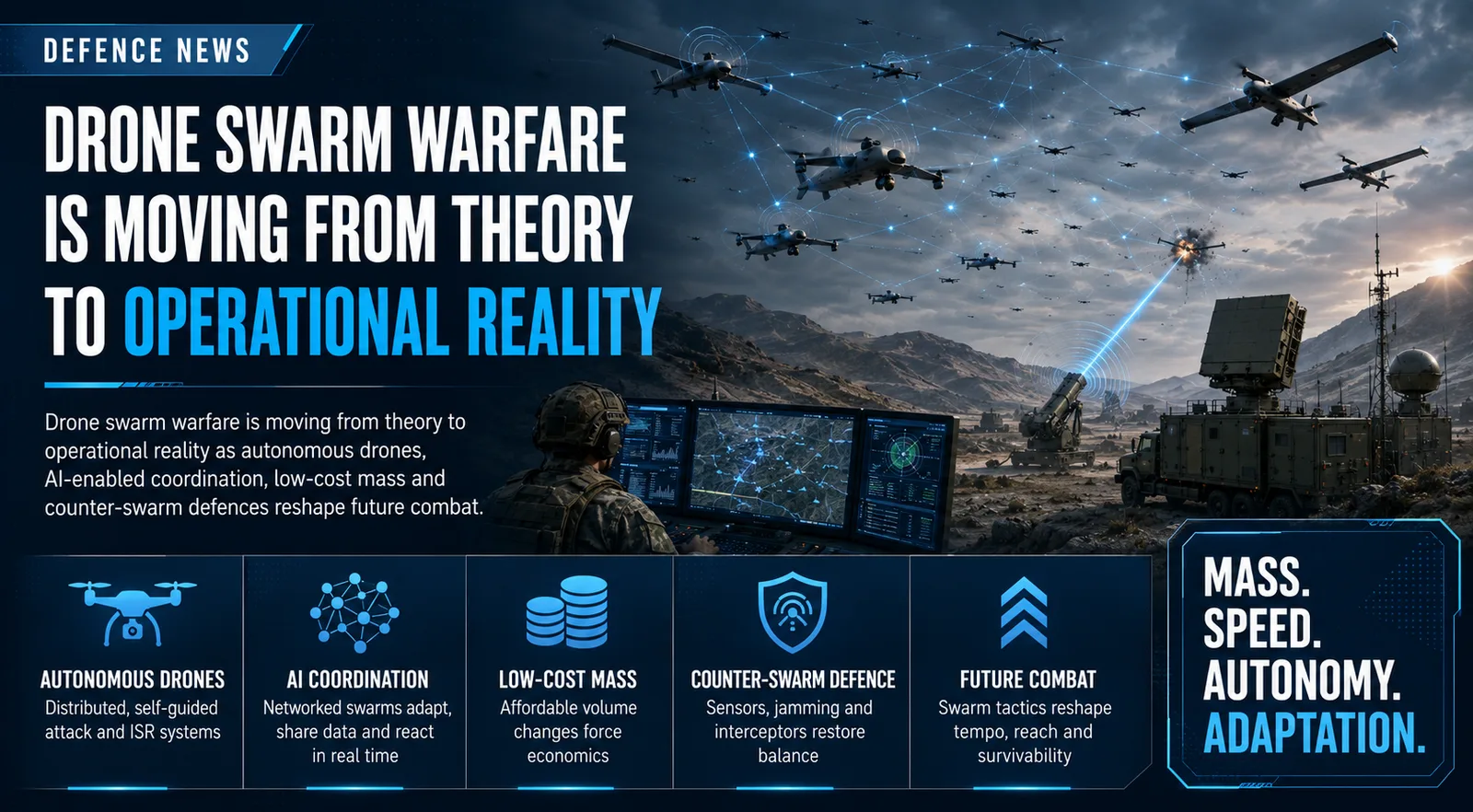
Drone swarm warfare is moving from theory to operational reality as autonomous systems, artificial intelligence, low-cost mass and networked command structures reshape future combat.
A SAHA Blog analysis frames drone swarming as a military extension of natural swarm behaviour. The article explains how coordinated groups of autonomous systems can act together, share information and create pressure from multiple directions.
The key shift is not simply that militaries are using more drones. The real shift is coordination. A single drone can observe or strike. A swarm can search, confuse, saturate, relay, decoy and attack as a distributed system.
This is why swarming has become central to the future of unmanned combat. It offers mass without traditional manpower, persistence without constant pilot control and tactical complexity at lower cost than many crewed platforms.
Drone Swarm Warfare Begins With Nature-Inspired Coordination
The SAHA Blog article starts from a simple idea: nature solved coordination problems long before modern militaries did. Bees, ants, birds and microorganisms can act collectively without a single central controller directing every movement.
This principle is important for drone swarm warfare. A military swarm does not need every platform to be individually controlled at all times. Instead, platforms can follow mission rules, share data, adapt to local conditions and support the wider group objective.
In military terms, this creates a different type of force. The value is not only in each drone’s payload. The value is in the collective behaviour of the swarm.
Swarming Changes the Logic of Military Mass
Traditional military mass usually depends on large formations, expensive platforms and concentrated firepower. Drone swarm warfare changes that logic by distributing mass across many smaller systems.
Small unmanned systems can be cheaper, easier to produce and more expendable than crewed aircraft or major weapon platforms. When they operate together, they can create operational effects that are larger than their individual size.
This makes swarms attractive for reconnaissance, decoy missions, electronic attack, target saturation, loitering operations and support to crewed platforms.
DARPA OFFSET Shows Human-Swarm Teaming at Scale
DARPA’s OFFensive Swarm-Enabled Tactics programme, known as OFFSET, is one of the clearest examples of how drone swarm warfare has been explored at scale. DARPA says OFFSET envisions small-unit infantry forces using swarms of more than 250 small unmanned air and ground systems in complex urban environments.
The most important part of OFFSET is not only the number of systems. It is human-swarm teaming. A future commander should not have to manually fly hundreds of drones. The commander needs tools to direct the swarm, monitor mission progress and intervene when necessary.
This is where interfaces become as important as airframes. Augmented reality, voice control, gesture control, mission-planning software and AI decision support can help operators manage complexity without losing human oversight.
Gremlins Points to Reusable Swarm Economics
DARPA’s Gremlins programme highlights another major theme: reusable low-cost mass. The programme explores launching groups of unmanned air systems from existing aircraft and recovering them in flight after completing their mission.
The economic logic is important. Many military platforms are expensive because they are built for long service lives and multi-role performance. A reusable small UAS can be designed for a shorter life, lower cost and specific mission sets.
In drone swarm warfare, cost exchange matters. A swarm that forces an adversary to spend expensive interceptors, reveal air-defence positions or overload command systems can create value even before direct kinetic effects occur.
LOCUST Shows Naval Swarming Potential
The U.S. Navy’s Low-Cost UAV Swarming Technology programme, known as LOCUST, showed how naval forces could use rapidly launched autonomous UAVs to create tactical advantage.
The Office of Naval Research said LOCUST used information sharing between UAVs to enable autonomous collaborative behaviour in defensive or offensive missions. The system also demonstrated how compact UAVs could launch from ships, vehicles, aircraft or unmanned platforms.
This matters because naval warfare is increasingly shaped by saturation threats. Ships need more sensors, more decoys, more distributed effectors and more options to operate in contested littorals.
Swarms Strengthen A2/AD and Saturation Concepts
The SAHA Blog article also links swarming to anti-access and area-denial concepts. In maritime environments, large numbers of autonomous or semi-autonomous surface, subsurface and aerial systems can complicate access to a theatre.
This is especially relevant for smaller navies and regional powers. A fleet of low-cost unmanned systems cannot replace major combatants, but it can increase the cost and risk of operating near defended coastlines, ports, chokepoints and island chains.
Drone swarm warfare therefore supports asymmetric strategy. It gives forces a way to challenge more expensive platforms through mass, mobility, deception and distributed sensing.
AI Turns Swarms Into Adaptive Systems
Artificial intelligence is central to the next phase of drone swarm warfare. Without AI-enabled autonomy, a swarm risks becoming only a large group of remotely controlled drones.
AI can support route planning, target recognition, obstacle avoidance, sensor fusion, mission allocation and adaptive behaviour when communications are degraded. It can also help the swarm continue operating when some platforms are lost.
NATO DIANA’s 2026 autonomy cohort reflects this direction. The programme highlights innovators working on resilient navigation, advanced sensing, counter-drone defence, distributed decision-making and mesh networking for autonomous systems.
Electronic Warfare Is the Main Battlefield Test
The main battlefield test for drone swarms is electronic warfare. Swarms depend on navigation, timing, datalinks, sensors and command architecture. These systems can be jammed, spoofed, detected or attacked.
A capable swarm must therefore operate in GPS-denied and communications-degraded environments. It must use resilient navigation, secure datalinks, local autonomy, spectrum discipline and fallback mission logic.
This is why the future of swarming is not only about more drones. It is about more resilient autonomy. The winning swarm will be the one that continues to function when the network is under attack.
Counter-Swarm Defence Is Becoming a Market of Its Own
As swarms become more credible, counter-swarm defence is becoming a major procurement priority. NATO announced in July 2026 that Allies would invest more than 40 billion dollars in counter-drone capabilities over five years and train five times as many drone operators by the end of 2027.
This shows the strategic scale of the problem. Defending against one drone is hard enough. Defending against coordinated waves of low-cost systems is much harder.
Reuters also reported that MBDA is developing a Counter Mass Interceptor to address large-volume drone and low-cost munition attacks. The programme reflects a wider European search for more affordable defences against saturation threats.
Ethics and Control Will Shape Adoption
The SAHA Blog article correctly raises a difficult issue: who controls autonomous drones? This question becomes more important as systems move from remote control to partial autonomy and then to higher levels of machine decision-making.
Drone swarm warfare must be designed with clear human oversight, mission boundaries, rules of engagement, auditability and fail-safe mechanisms. Military advantage cannot come at the cost of uncontrolled escalation.
The central policy challenge is balancing speed and control. Swarms need autonomy to operate at scale, but military commanders still need responsibility, accountability and lawful control over the use of force.
Türkiye Has a Strong Entry Point Into Swarm Systems
Türkiye’s defence ecosystem has a strong entry point into drone swarm warfare because it already has experience in unmanned aerial systems, mission software, sensors, communications, electronic warfare, command-and-control and tactical data links.
The next step is integration. Türkiye’s opportunity is not only to build individual drones. It is to build swarm-capable architectures that connect drones, ground robots, naval systems, manned platforms and command networks.
This requires autonomy software, secure mesh communications, electronic warfare resilience, testing ranges, simulation environments, doctrine and operator training. The industrial prize is a complete swarm ecosystem rather than a single platform.
Manned-Unmanned Teaming Is the Practical Path
Drone swarms will not remove humans from warfare overnight. The more realistic path is manned-unmanned teaming. Crewed aircraft, ships, vehicles and command posts will increasingly operate with groups of autonomous systems.
In this model, swarms support crewed platforms by scouting ahead, absorbing risk, relaying communications, detecting threats, confusing defences or carrying mission-specific payloads.
This is also the safest path for adoption. It allows militaries to build trust, test doctrine and improve autonomy while keeping humans inside the command structure.
The Main Risk Is Dependence on Fragile Networks
The biggest operational risk is dependence on fragile networks. A swarm that requires constant connectivity may fail when jamming, terrain, cyberattack or spectrum congestion disrupts communications.
Future swarms must therefore be designed for graceful degradation. They need to continue basic mission functions even when datalinks are limited, GPS is degraded or some platforms are lost.
This makes software architecture critical. Swarm drones need local autonomy, distributed decision-making, mission-level commands and robust recovery behaviour.
Procurement Will Reward Open Architectures
Drone swarm procurement will reward open architectures. Militaries will need to integrate different drones, payloads, radios, sensors, AI models and command systems without being locked into one closed supplier.
This is especially important because swarm technology will evolve quickly. New sensors, new jamming threats, new counter-drone systems and new AI tools will appear faster than traditional procurement cycles.
Open architectures can help militaries upgrade swarm systems over time. They can also support allied interoperability, which will be essential for NATO and coalition operations.
Conclusion
Drone swarm warfare is becoming one of the defining concepts of unmanned combat. It combines low-cost mass, AI-enabled autonomy, distributed sensing, electronic warfare resilience and networked command structures.
The strategic value is clear. Swarms can increase operational reach, create saturation effects, reduce risk to personnel and challenge expensive legacy platforms. However, they also create new risks around command, control, ethics, cyber security and escalation.
The future will not be decided by the drone alone. It will be decided by the swarm system: autonomy, datalinks, sensors, doctrine, human oversight, counter-swarm defence and industrial scale. The forces that master this architecture will shape the next phase of unmanned warfare.
For further Defence Agenda coverage, read our drones, unmanned systems and electronic warfare sections. Related analysis includes 5G military communications and next-generation weapon systems, digital troops and battlefield command and unmanned underwater vehicles and naval warfare.
Further Reading
- SAHA Blog: Sürü Dronların Yükselişi — İnsansız Savaşın Geleceği
- DARPA: OFFensive Swarm-Enabled Tactics
- DARPA: Gremlins programme
- U.S. Navy: LOCUST autonomous swarming UAVs
- NATO: Counter-drone capabilities and drone training investment
- NATO DIANA: Autonomy and unmanned systems
- Reuters: MBDA counter-mass interceptor for mass drone attacks