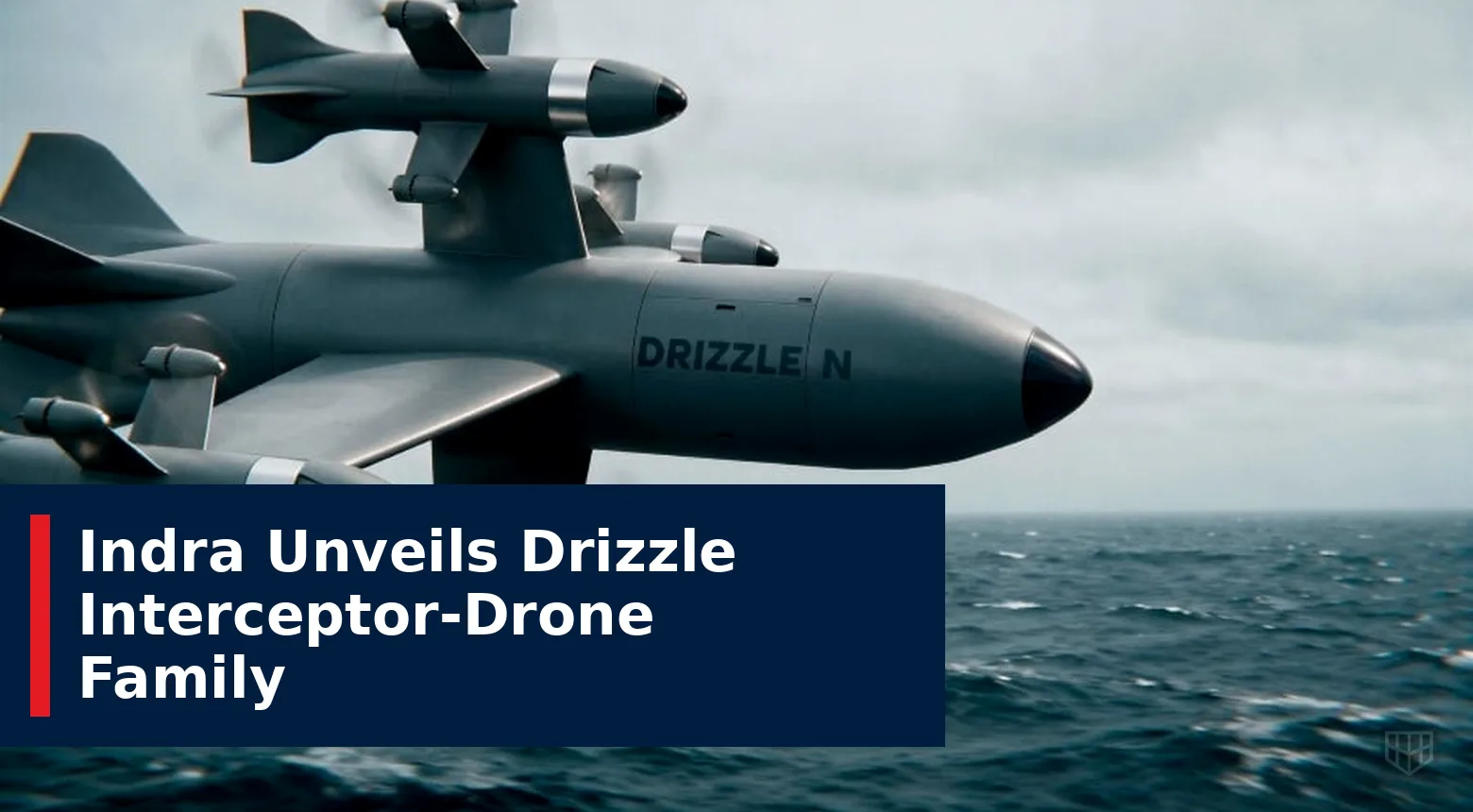
Indra has unveiled Drizzle, an autonomous interceptor-drone family designed to counter mass attacks at speeds above 400 km/h.
A layered interceptor concept
Spanish technology group Indra has unveiled Drizzle, a family of compact autonomous interceptor drones intended to defeat uncrewed-aircraft attacks. Presented at the UNVEX unmanned-systems exhibition, the design is described as exceeding 400 kilometres per hour and reaching roughly 80 kilometres when used independently. Indra positions the system for the defence of infrastructure, convoys and deployed forces, either as part of a wider counter-drone architecture or as a platform-mounted self-protection option.
The announcement establishes the design and its intended performance, not operational fielding. Indra did not identify a launch customer, production order, unit price or completed military acceptance campaign. Public material also does not provide an engagement envelope against different target classes. Drizzle should therefore be treated as a newly disclosed interceptor family under development, with company-reported characteristics that still require representative testing and customer qualification.
Sensors and terminal guidance
Drizzle uses an Indra-developed search and detection system intended to discriminate threats and acquire targets. Electro-optical and infrared sensors feed onboard processing for the terminal phase, allowing the interceptor to analyse imagery and refine its approach in real time. Indra says later development phases will add radar, which could improve detection in poor visibility or against targets that are difficult to maintain in an optical track.
Performance will depend on more than top speed. Detection range, false-alarm control, target classification, seeker field of view and resistance to electronic countermeasures determine whether an interceptor can reach the correct object in a crowded environment. Rules of engagement and safe debris patterns are particularly important around cities, airports and friendly formations. Those data have not yet been released and should not be inferred from the advertised kinematic figures.
A mothership extends reach
Indra has paired the interceptor with an expendable mothership drone able to carry several smaller effectors. The company says the carrier can fly at about 30,000 feet for the first 80 kilometres, release the interceptors and allow them to cover a further 50 kilometres. This creates the stated overall reach of about 130 kilometres while moving part of the interceptor magazine closer to the threatened area.
The motherships are also intended to operate in groups and release several interceptors in a coordinated 'drizzle'. Indra says the carrier could become an attack vector after deploying its payload. That concept offers flexibility, but it adds command-and-control, identification and deconfliction requirements. A larger carrier is also more visible and may need protection before it reaches the release point, particularly against an opponent with layered air defence.
Affordability must be demonstrated
Indra describes the effectors as fungible and suitable for production at scale. The economic logic is clear: defenders need weapons whose cost and manufacturing rate are proportionate to large numbers of inexpensive hostile drones. Yet no public unit-cost or production-rate data were included. A complete comparison must include sensors, launch equipment, operators, motherships and the number of interceptors normally required for each successful engagement.
The next evidence should be controlled and operational trials against representative targets, including swarms, low-altitude flight and electronic interference. An identified customer and production contract would establish demand, while test results could show whether the 80- and 130-kilometre figures translate into useful defended area. For now, Drizzle is a technically ambitious counter-UAS concept whose speed, modular deployment and distributed magazine warrant attention but remain company claims rather than verified field performance.
Editorial assessment
Drizzle will also need to demonstrate how it receives target tracks from external radars and command systems. A fast effector has limited value if cueing arrives late or if several launchers pursue the same object. Network behaviour, engagement allocation and re-attack logic are therefore central to the advertised mass-attack mission.
The mothership creates a useful magazine-extension option but changes the logistics calculation. Forces must transport, prepare and launch two vehicle types and maintain communications across the hand-off. Testing should show whether the additional reach justifies that complexity when compared with more conventional ground-launched interceptors positioned closer to the defended site.